Today marks the first day of fall. Here’s the science behind the equinox

The equinoxes and solstices are getting later each year right now, but in 2028, they'll set a new 232-year record.
Tuesday, September 22 is the Autumnal Equinox for the northern hemisphere in 2026, marking the first day of astronomical fall for the year, and this year it is the latest fall equinox since 2023.
Standing here on Earth's surface, everything may seem perfectly normal with the universe. However, looking at our world from afar, the entire planet is slightly off-kilter.
As Earth follows its elliptical path around the Sun, the planet's rotational axis — the imaginary line that runs through the North and South Poles — is tilted with respect to that path, by roughly 23.4 degrees. Earth doesn't 'wobble' back and forth by that much, mind you. The tilt is constant, such that the North Pole always points roughly towards a bright binary star named Polaris.
This consistent tilt, along with our world's motion around the Sun, are the reasons for our seasons.
It's science: Why September 1st is the start of meteorological fall
We don't really feel this tilt from here on the surface. Earth's gravity is the strongest force we feel, and it's constantly pulling us in towards the planet's core. However, we do see the tilt's effects. The most directly noticeable impact is how high the Sun reaches as it arcs across the sky each day throughout the year.
In the solargraph image shown below, each arc across the image is the path the Sun took through the sky, with one arc accounting for each reasonably clear day between June 21 and December 21, 2023. In a single image, then, is revealed how high and how low the Sun reaches in the sky over Oakville, Ontario, Canada, due to the tilt of Earth's axis.
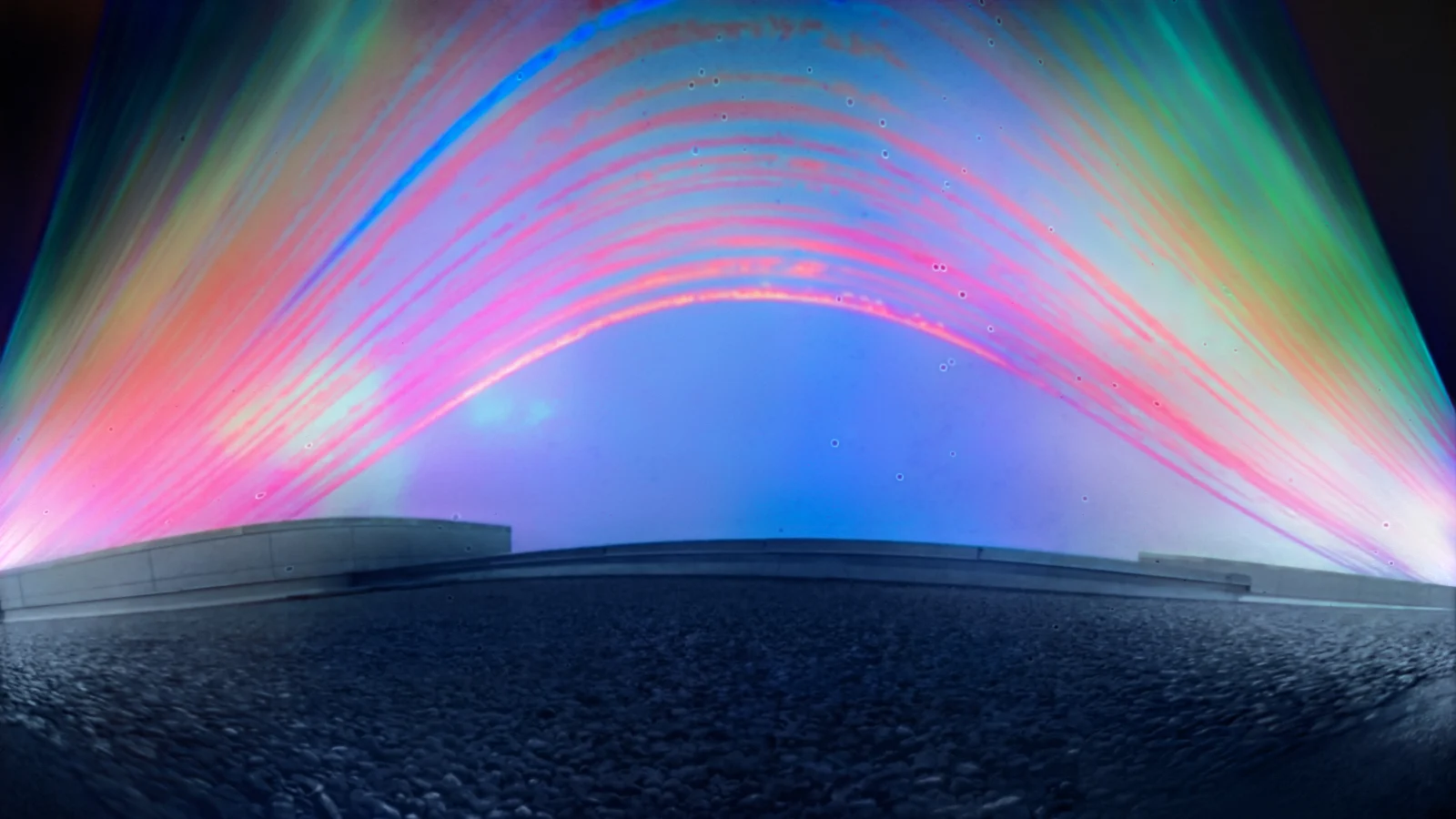
This 'solargraph' image shows the Sun's changing path through the sky from its highest point at Summer Solstice to its lowest point at Winter Solstice, in 2023. The image was achieved using a pinhole camera containing a piece of light-sensitive photographic paper, with a tiny pinhole in the side of the camera focusing sunlight onto the paper's surface each day over the six-month period. (Bret Culp)
While the solstices represent the two extremes in the image, there is one arc around the middle of the swath that was recorded on a day when the Sun lit up both the northern and southern hemispheres of Earth equally. This was the Fall Equinox.
Latest fall equinox since 2023
While the equinoxes and solstices happen around the same time each year, their exact day and time are never the same, year-to-year.
Partly, this is because our planet experiences gravitational influences from the Moon, and the other planets in the solar system, which causes our orbit to differ slightly each time we go around the Sun. Also, both our yearly calendar and our daily clock use precise whole numbers to track periods of time that are anything but precise and whole.
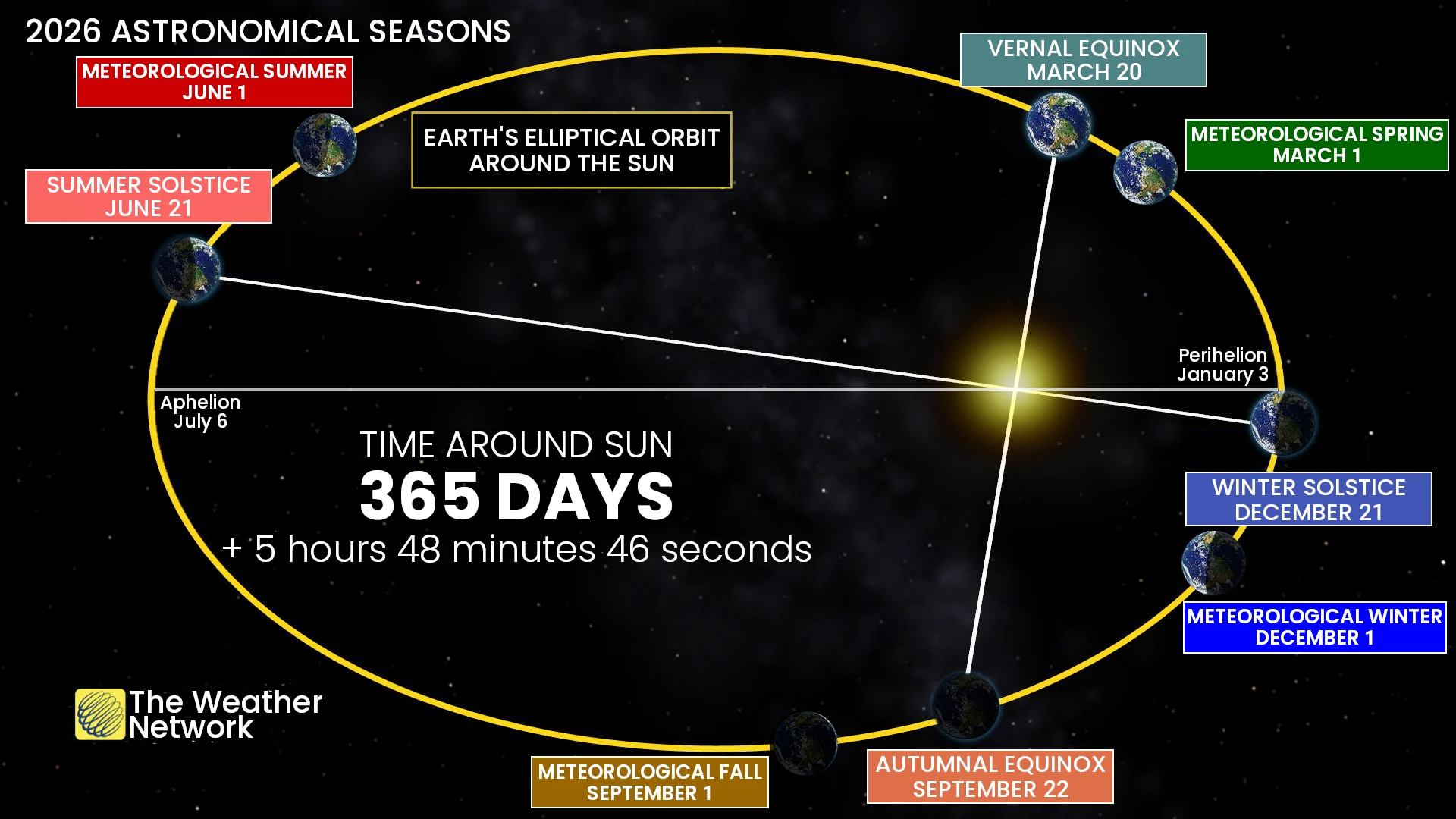
Credit: NASA/Scott Sutherland
While our calendar has 365 days, it actually takes us around 365.25 days to go around the Sun. Also, our 24-hour clock doesn't account for the fact that it only takes 23 hours, 56 minutes, and 4 seconds (on average) for our planet to complete one revolution on its axis.
We handle these discrepancies using leap years.
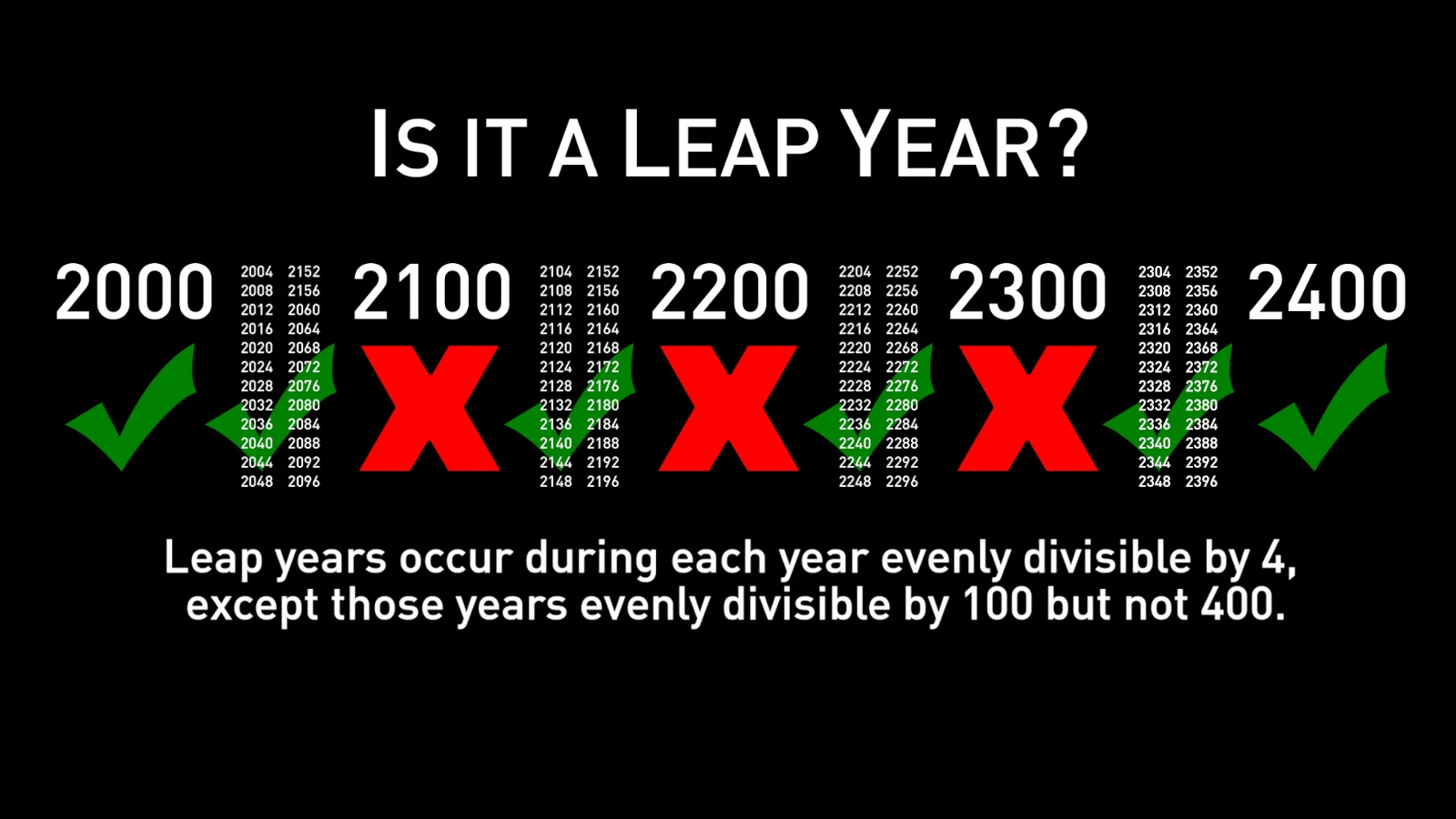
Essentially, since there's an extra quarter-day that we're not counting each year, every fourth year we add a full 366th day, which is tacked on to the end of February. Plus, to compensate for the extra time we add to each day, we skip a few potential leap years, specifically those 'century years' that can't be evenly divided by 400 (1800, 1900, 2100, etc).
This use of leap years produces a very specific pattern in the timing of the equinoxes and solstices.
Every normal year, they occur roughly six hours later than the year before. Then, each leap year, with the additional day added to the calendar, their timing flips back around 18 hours from the previous year. Coincidentally, it turns out that whenever this occurs, their times during the leap year are earlier than they were during the previous leap year.
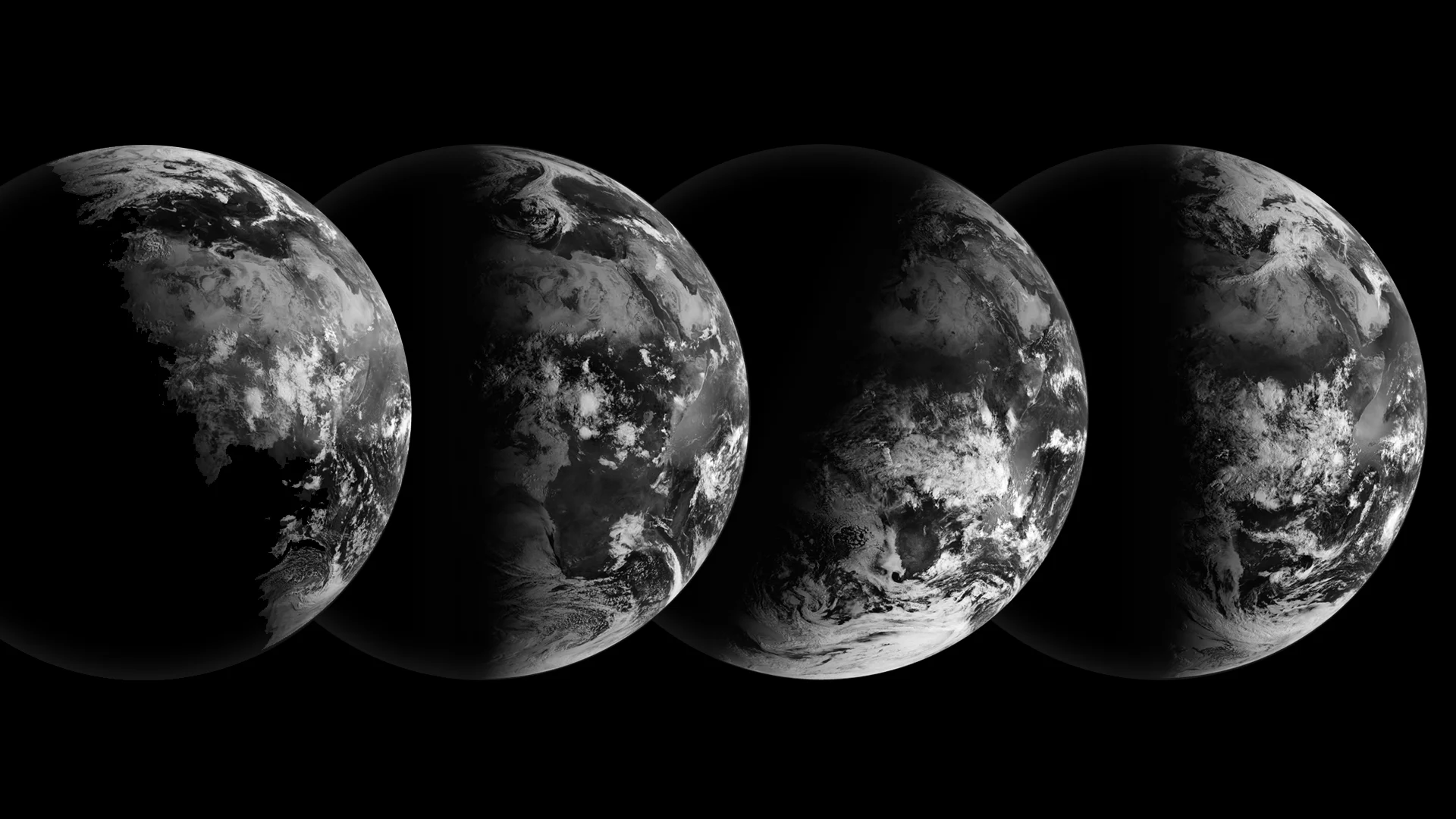
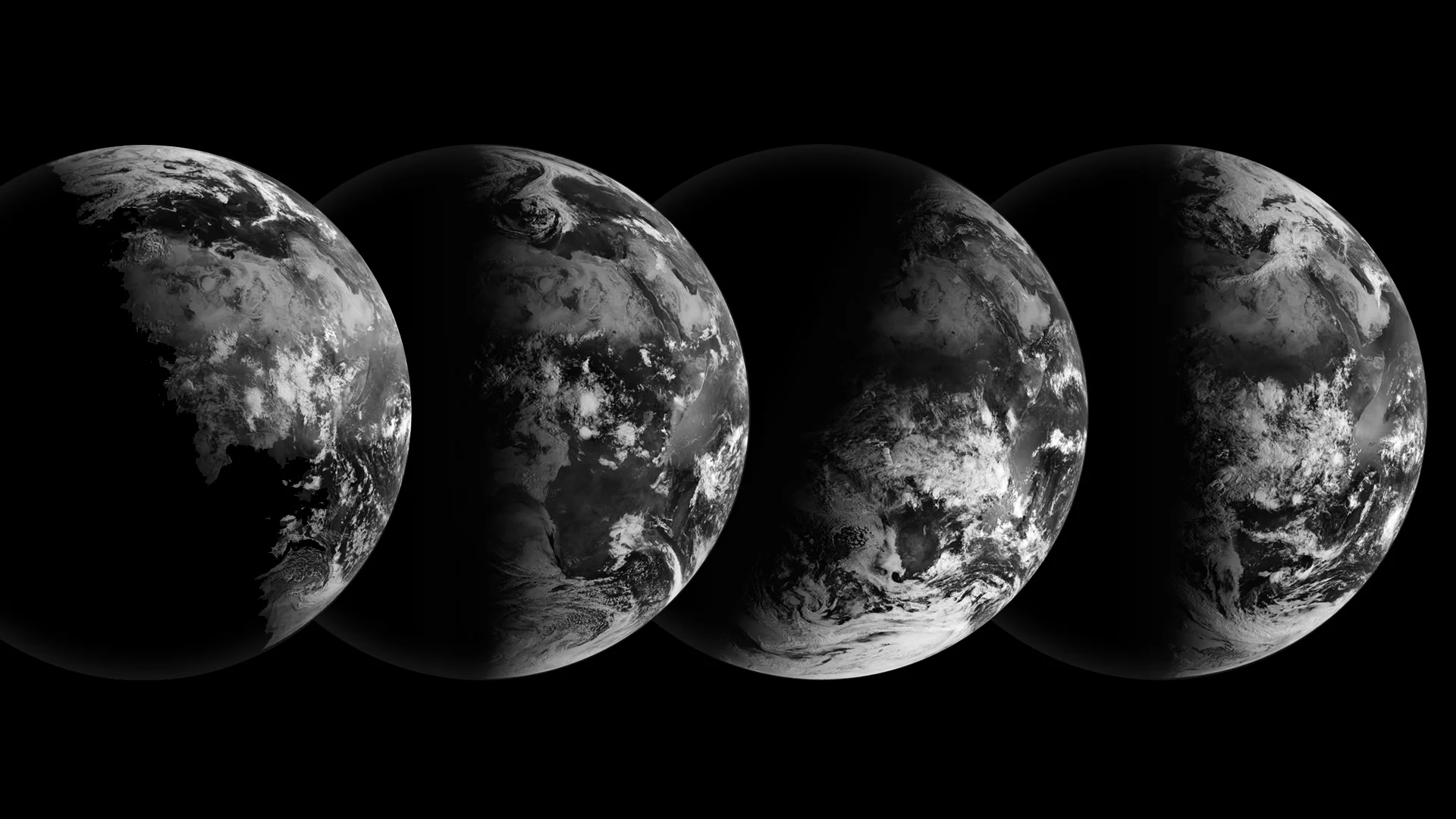
These four views of Earth from satellites in space show our planet, from left to right, during the northern summer solstice, fall equinox, winter solstice, and spring equinox (NASA)
So, due to this, Fall Equinox 2026 is the latest we've seen since 2023. That year, it occurred early in the day on September 23rd (EDT). The leap year in 2024 shifted it back to 8:43 a.m. EDT on the 22nd, then it was at 2:19 p.m. EDT on the 22nd in 2025, and now it's at 8:04 p.m. EDT on the 22nd for 2026.
Next year, it will be timed even later, for early on September 23 again, while in 2028, it will 'leap' back to early on the 22nd once more.
Something interesting has been going on so far in this new century, though. Each time the leap year rolls around, we are seeing new records for the earliest equinoxes and solstices!
In 2024, we had the earliest spring equinox in 128 years, with the last earlier one occurring on Sep. 22, 1896. However, that fall equinox was the earliest in 228 years, since Sep. 22, 1796.
The reason for this is the year 2000.
Fall 2026: Meteor shower season is about to begin!
Before then, whenever we reached a century year (1800, 1900), it was skipped as a leap year. So, at that point, rather than getting the regular once-every-fouth-year reset, the timing of the equinoxes and solstices advanced by about a full day over the next four years. Then, during the next leap year after, their timing shifted back by 18 hours again, and we saw earlier and earlier equinoxes and solstices each leap year, until the next century year.
The difference with the year 2000 is that number can be divided equally by 4, 100, and 400. So, it didn't get skipped as a leap year, and rather than the equinox and solstice timing getting later from 2000-2003, the every-four-years pattern from the 1900s continued uninterrupted. Thus, the equinoxes and solstices have gotten even earlier with each leap year, and we're seeing new records set every time!
Going forward, on the next leap year in 2028, the fall equinox will be the earliest in 232 years. By the end of this century, in 2096, it will have shifted back onto the 21st of September, which will be the earliest since 1752. Then, we skip the year 2100 as a leap year, and the full pattern resets once again.
READ MORE: Watch our seasons go topsy-turvy without leap years
Myths of the Equinox
There are a few urban myths surrounding the equinoxes that make their rounds on the internet each year, no matter how often they're debunked.
1. Balancing act
Whenever the equinox is approaching, spring or fall, word spreads that this is the day to perform a "fantastical feat" of egg balancing.
While balancing an egg on its narrow end is challenging at any time, the equinox in no way makes that task easier.
The reason for this? Basically, while it's true that every object in the universe tugs on every other object, here on Earth's surface, our planet's gravity completely overwhelms any other gravitational forces we (or eggs) might experience.
The Moon's gravity is the next strongest influence, followed by the Sun, and they are the reasons for our ocean tides. However, the tides only occur due to the cumulative effect of these objects simultaneously pulling on each individual molecule in an immense body of water or land. For something as small as an egg, the gravitational pull of the Moon and Sun is so weak that it has no effect whatsoever.
Only three factors matter in balancing eggs: the stability of the surface you are using, the 'bumpiness' of the eggs being balanced, and the steadiness of your hands.
2. Those crazy days (and nights)
There are two days during the year when night and day are roughly 12 hours long. However, despite the word equinox coming from the Latin words for 'equal' and 'night', those two days do not fall on the equinoxes.
Depending on your latitude, the dates of roughly equal day and night can happen anywhere from a couple of days up to a few weeks before the spring equinox, and after the fall equinox. The closer you are to the equator, the bigger the gap between equinox and equilux is.
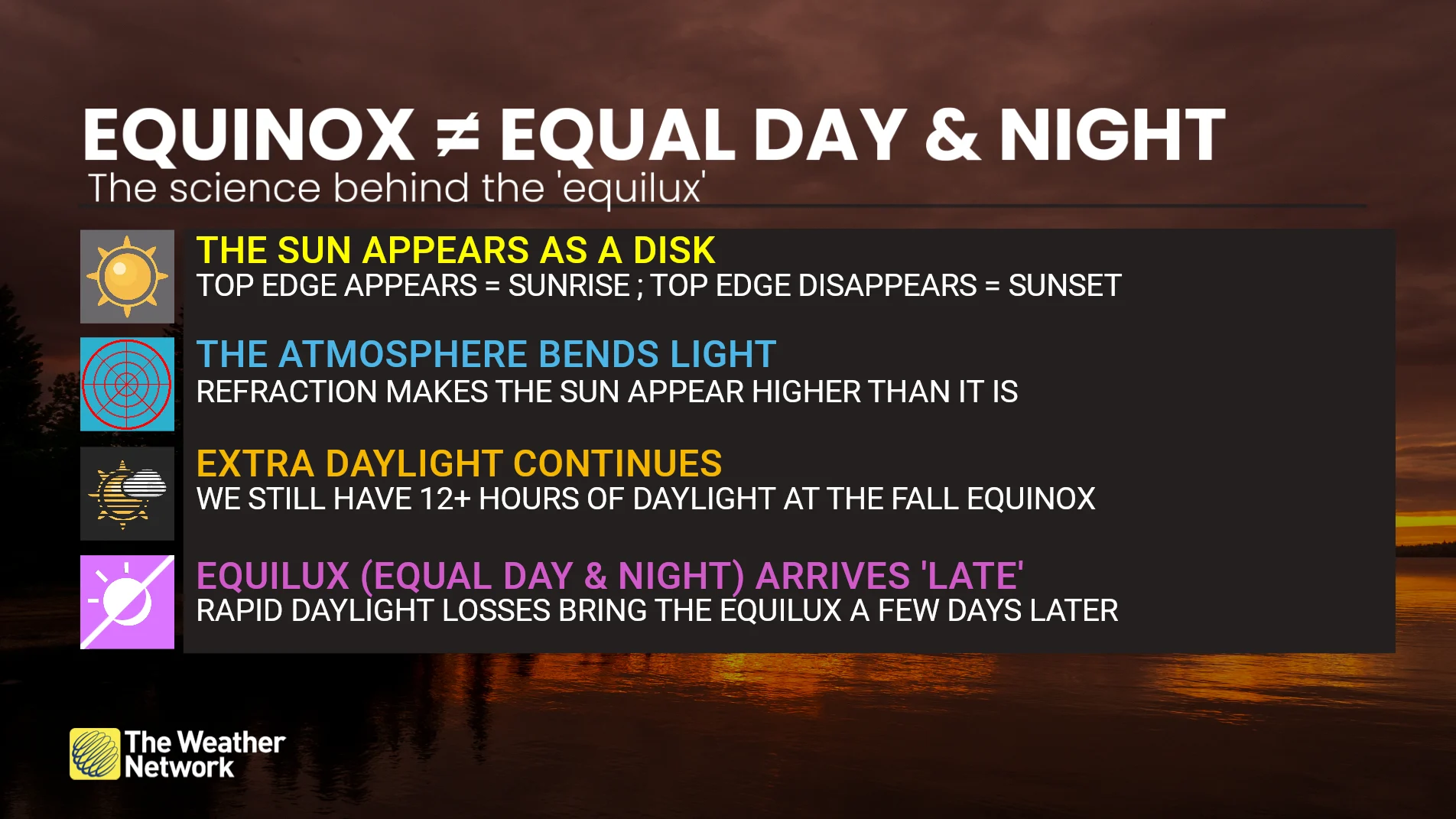
For most of Canada, in 2026, equilux is around the 25th of September. For Mexico City, Mexico, it is around the 28th. At the equator, though, the days are always around six minutes longer than the nights.
This is due to how we track sunrise and sunset. 'Sunrise' is the exact moment when the top edge of the Sun crests the eastern horizon. 'Sunset' is when the top edge of the Sun completely disappears below the western horizon. Based on that, we always add several minutes to the length of our day.
To have equal day and night on the equinoxes (and on the equator), we would need to change those definitions. Sunrise would have to be when the Sun is precisely centred on the eastern horizon, and sunset when it was precisely centred on the western horizon.
3. Shadows stick to us
It's difficult for us to escape from our shadow, even during the equinox.
Occasionally, claims circulate that you will not cast a shadow, even on a sunny day, if you stand on the equator during the equinox. Unfortunately, this takes some precise timing and very specific conditions to even be almost true.
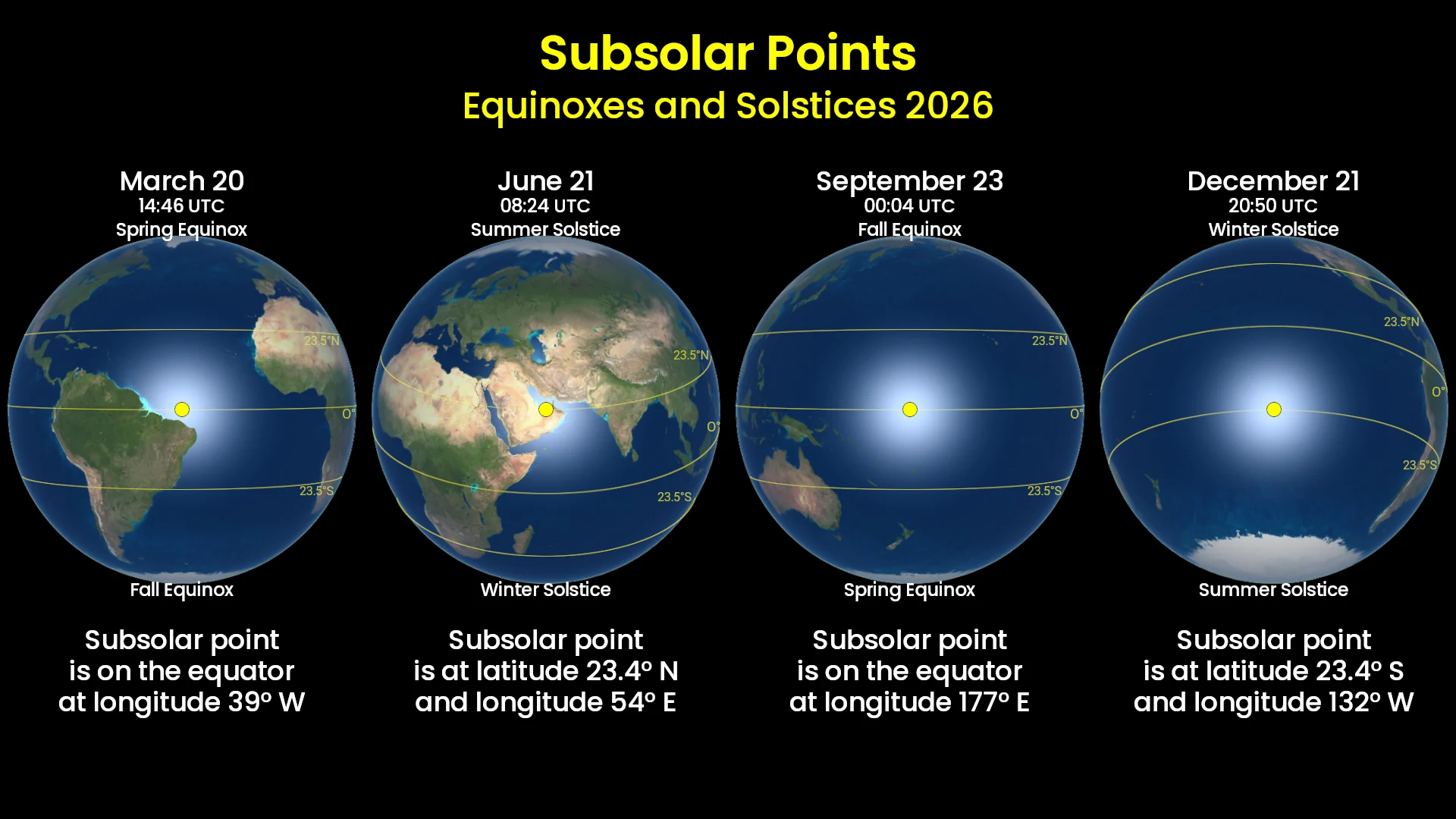
The locations of the subsolar points on the Equinoxes and Solstices for 2026 shows where the Sun's rays shine directly down onto the planet at those dates and times. (Celestia/Scott Sutherland)
Read More: On May 26, Honolulu lost all its shadows. Here’s why
Given that the equinox is at 0:04 UTC on the 23rd, you'd have to pick your location perfectly. That would be on a ship, in the middle of the Pacific Ocean, on the equator, just west of longitude 180°, exactly at that time.
Even with the Sun shining directly down onto the top of your head, though, your torso and arms would still cast a shadow onto your legs and feet. However, if you put down a box or a bottle on the ship's deck, they wouldn't appear to cast a shadow at all.