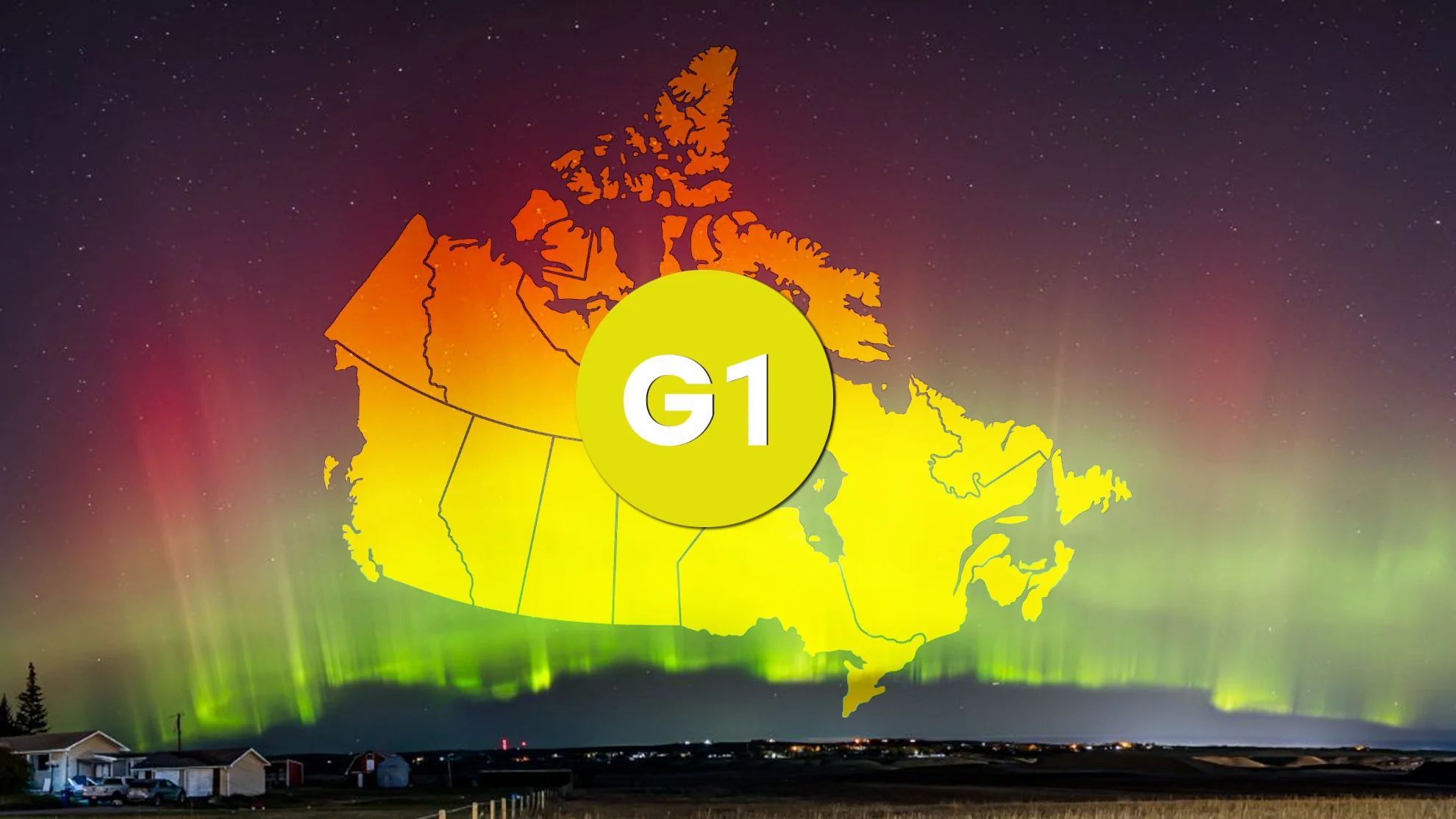
Auroras may shine across Canada Wednesday night due to blustery solar wind

At this time of year, aurora displays could be enhanced by a phenomenon known as equinox cracks.
Check your weather forecast for clear skies Wednesday night through Thursday morning, as a blustery stream of the solar wind could spark aurora displays across parts of Canada.
Over the past week, observers have been watching two large gaps in the solar corona, the Sun's magnetically-infused atmosphere. As these two 'coronal holes' have been tracking across the face of the Sun, they emit fast streams of particles out into the solar system, forming what solar scientists call 'coronal hole high speed streams'. These high speed streams break up the normal, relatively sedate flow of the solar wind, and when one sweeps past Earth, it can spark auroras that extend down into the mid-latitudes.
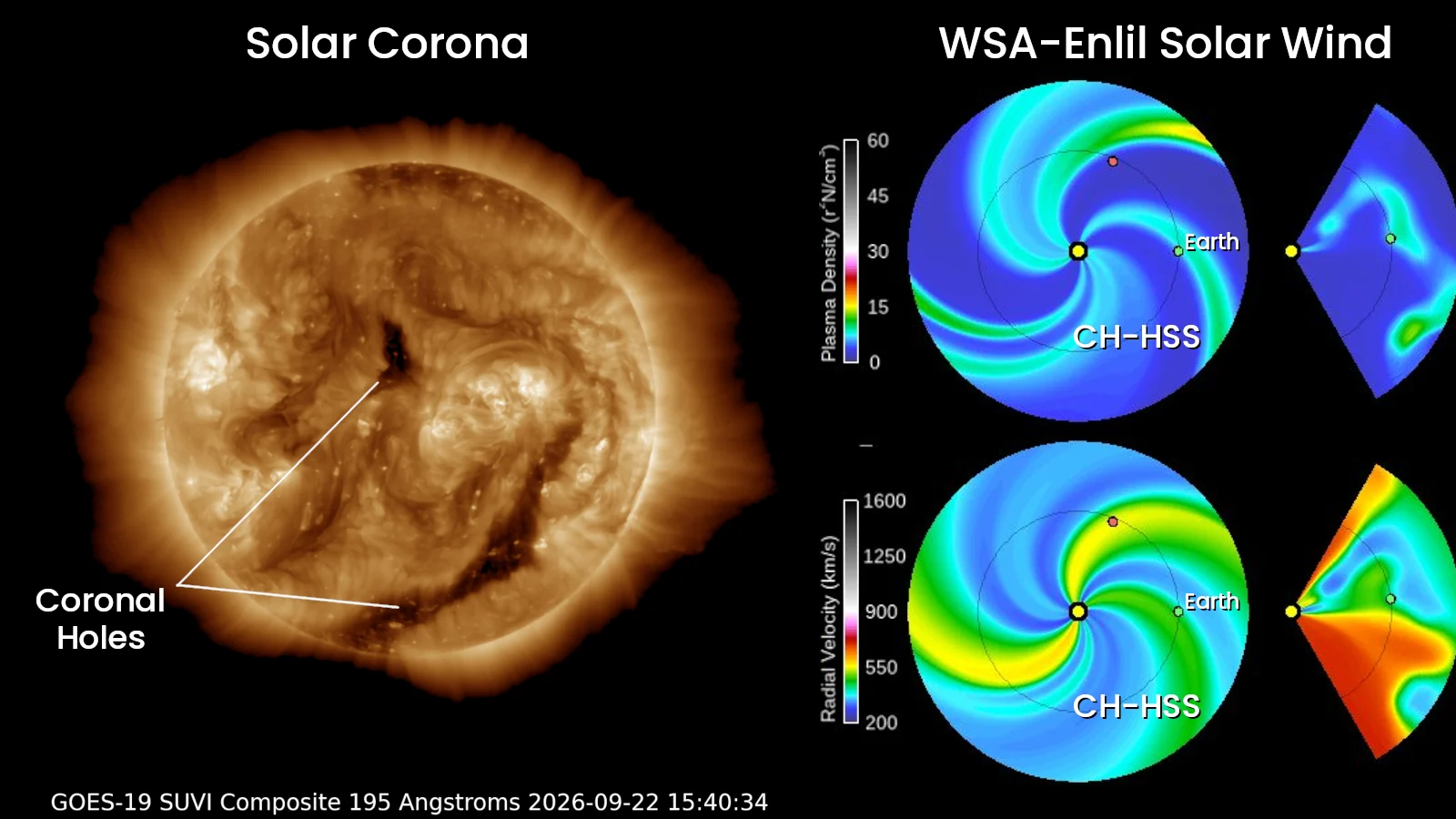
The Sun (left), showing the corona and two coronal holes, and the WSA-Enlil computer model run for late on Sep. 23, 2026 (right), showing the CH HSS (coronal hole high speed stream) arriving at Earth. (NOAA SWPC/Scott Sutherland)
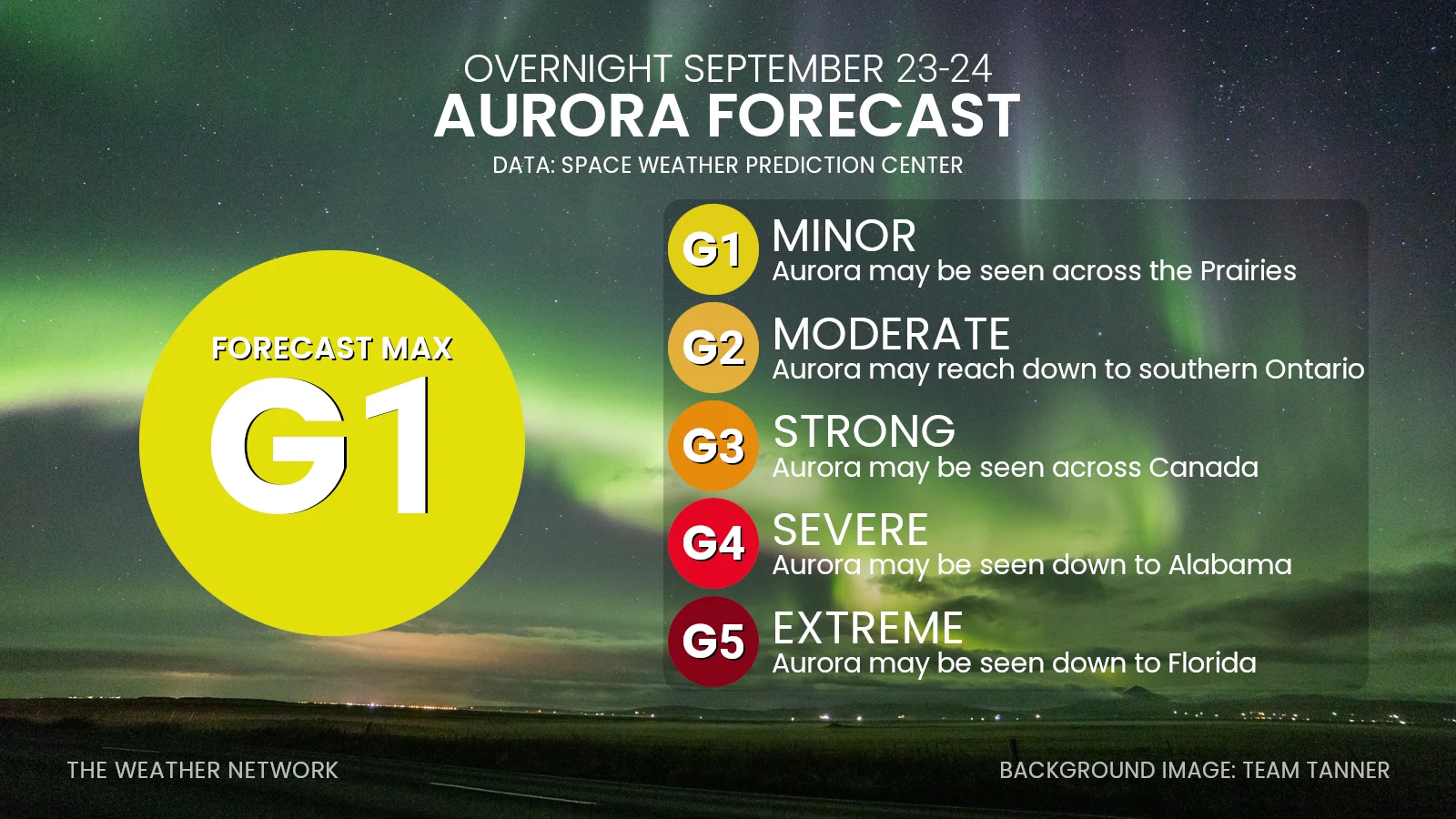
With the leading edge of this CH HSS expected to arrive at Earth overnight from Wednesday into Thursday, NOAA's Space Weather Prediction Center has issued a G1 (minor) geomagnetic storm watch.
The timing of their forecast puts the arrival around 11 p.m. EDT, with the increased aurora activity likely to last until 5 a.m. EDT on Thursday.
DON'T MISS: Geomagnetic storms: When should we look up and when should we worry?
Given that Northern Lights displays from a G1 geomagnetic storm tend to stay farther north in the eastern half of the country — across Labrador, northern Quebec, and northern Ontario — the best viewing for this event will likely be in the central Prairies.
That puts the timing slightly earlier, from 10 p.m. through 4 a.m. CDT in Manitoba, and 9 p.m. through 3 a.m. MDT/CST in Saskatchewan and Alberta.
In general, it is possible for the auroras to show up at any time after the sky becomes sufficiently dark. However, the 'aurora oval' does tend to be centred over any particular region around their local midnight. This is also when the auroras tend to deliver the most dynamic and active displays.
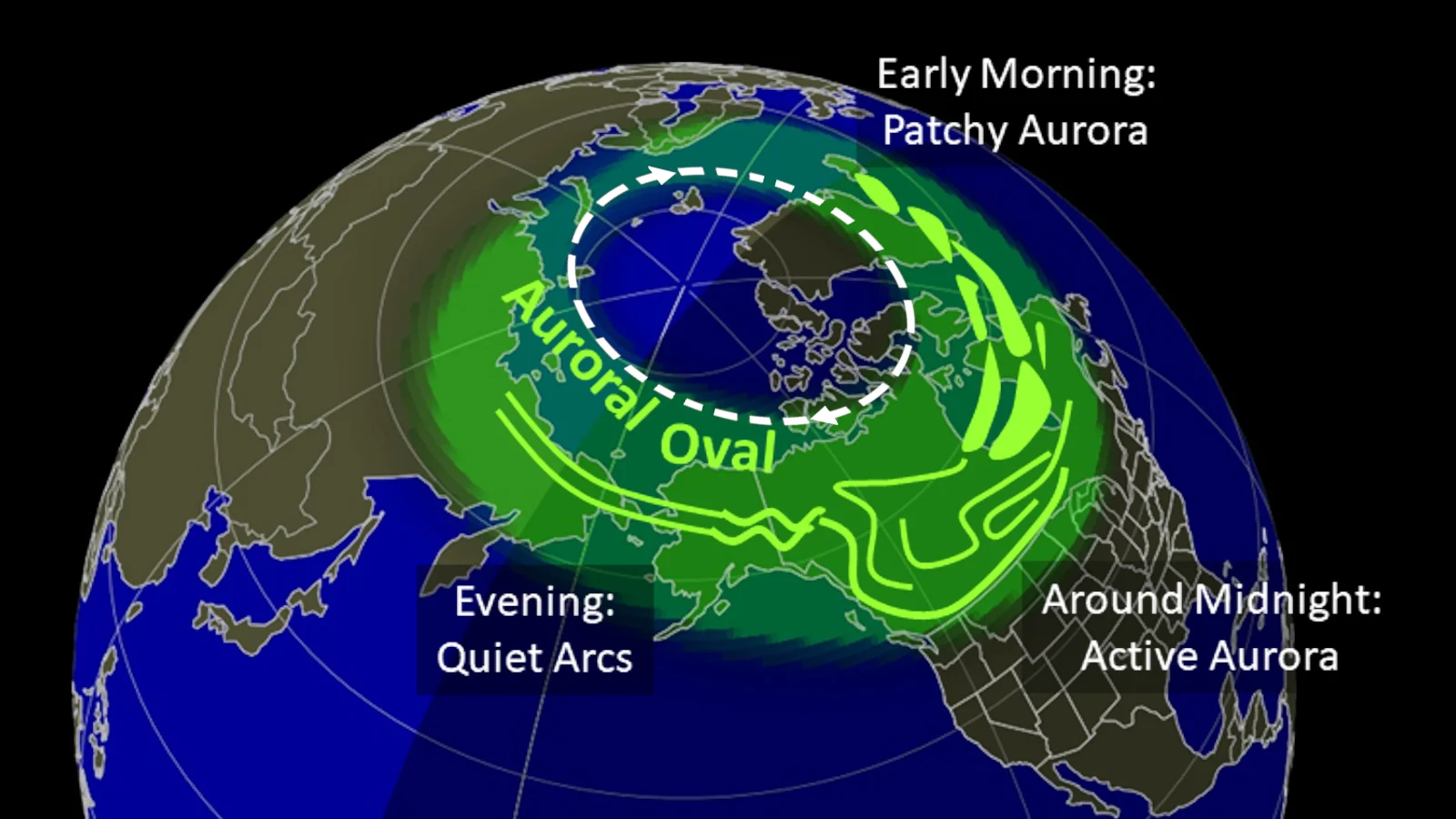
As shown in this graphic, Northern Lights displays tend to show up as quiet arcs first, in the evening, followed by dynamic, active auroras around local midnight, and finish up as patchy auroras in the early morning. (NOAA SWPC/Scott Sutherland)
READ MORE: Our Sun is capable of producing devastating superflares; should we worry?
Due to the time of year we are in right now, any show put on by the Northern Lights could also be enhanced — becoming brighter or extending farther south — due to a phenomenon known as equinox cracks.
Equinox Cracks?
The Sun and Earth are each surrounded by their own magnetic field. The Sun's magnetic field contributes to solar activity, such as solar flares, coronal mass ejections (aka solar storms), and the solar wind. Meanwhile, the Earth's magnetic field reacts to these solar storms, and to the flow of the solar wind, which results in coloured displays across Canadian skies known as the Aurora Borealis, or the Northern Lights.
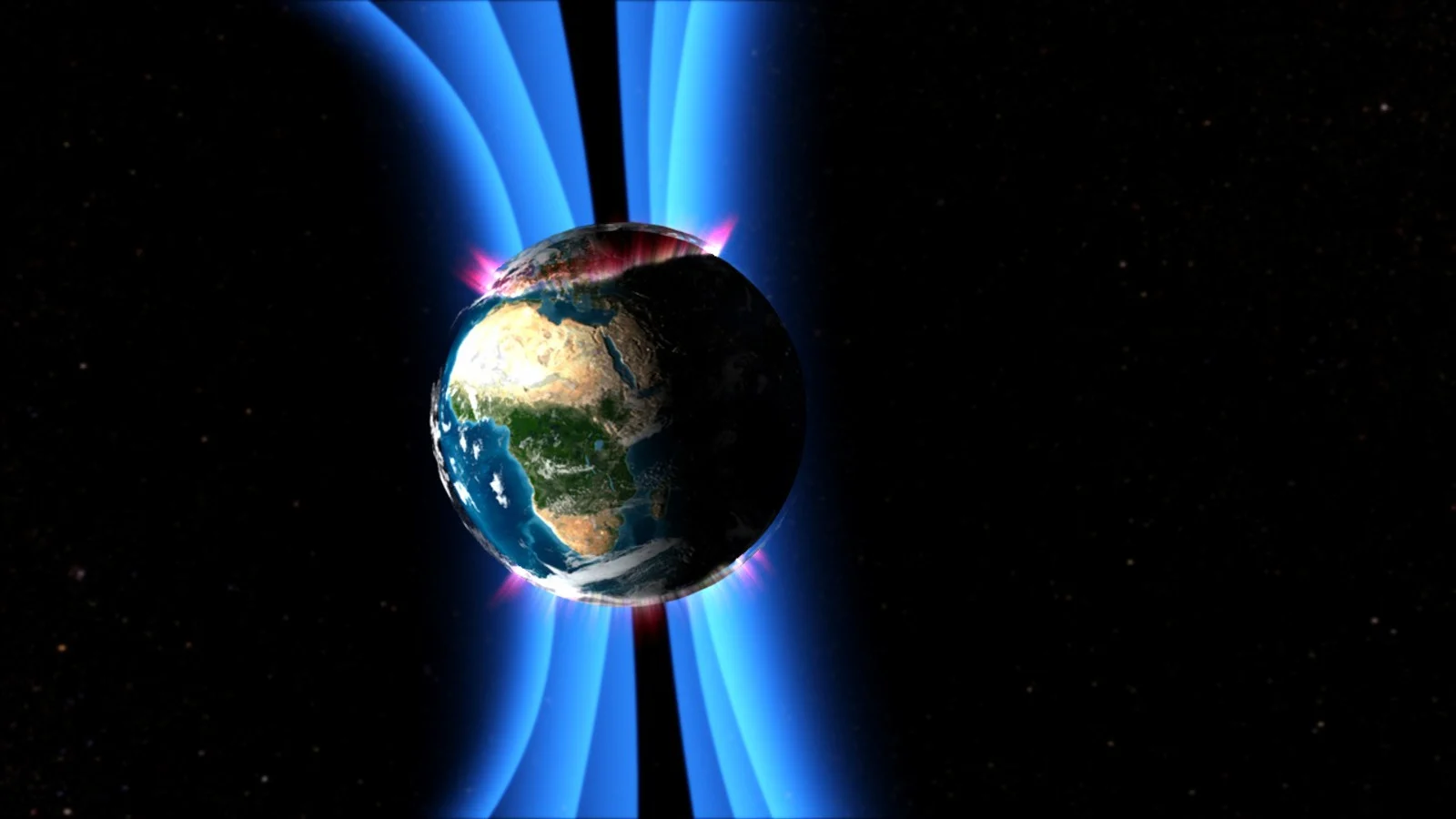
Auroras appear around the north and south poles of Earth as Earth's geomagnetic field traps particles from the solar wind and funnels them down into the atmosphere. (NASA)
Due to Earth's tilt, our planet's magnetic field is nearly always out of alignment with the Sun's magnetic field. So, even under the absolute ideal conditions for a solar storm or the solar wind to result in auroras, that misalignment effectively reduces the overall intensity of any that do appear.
However, around the spring and fall equinoxes, the magnetic fields of the Sun and Earth line up better than they do during the rest of the year. This can cause strong connections to form between the two, effectively opening up 'cracks' in Earth's magnetic field.
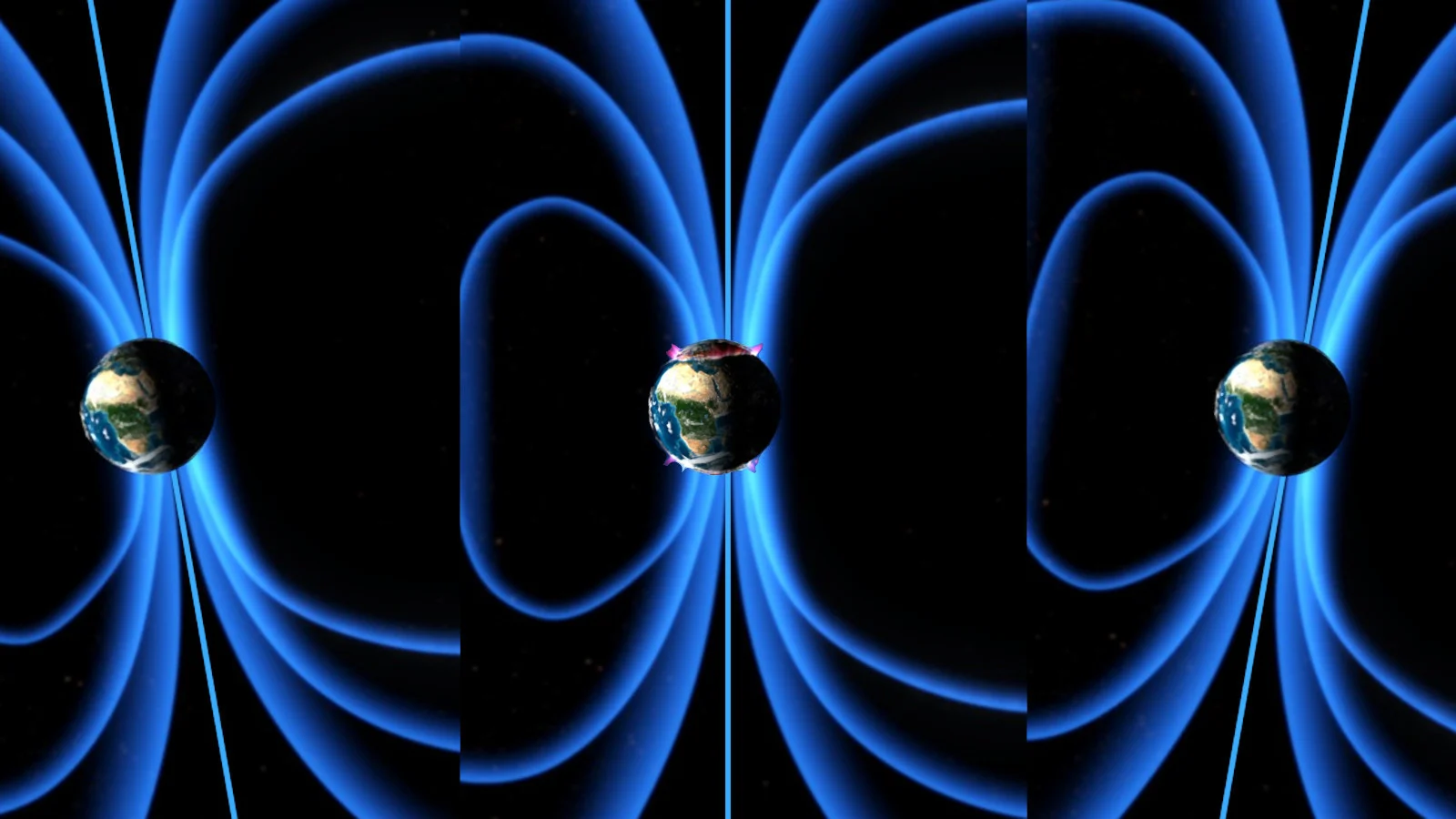
The orientation of Earth's magnetic field at northern summer solstice (left), equinox (centre), and northern winter solstice (right). The Sun is located far off the left side of the field of view, and its magnetic field is oriented most in alignment with the centre panel. (NASA/Scott Sutherland)
READ MORE: Why have the Northern Lights been so supercharged lately and how long will it last?
This is known as the Russell-McPherron effect, and it produces fast-tracks for particles from the solar wind, or from solar storms, to stream down through that protective barrier and into the upper atmosphere.
As a result of all this, auroras that occur in the weeks before and after the equinoxes tend to be some of the brightest and most colourful of the entire year!
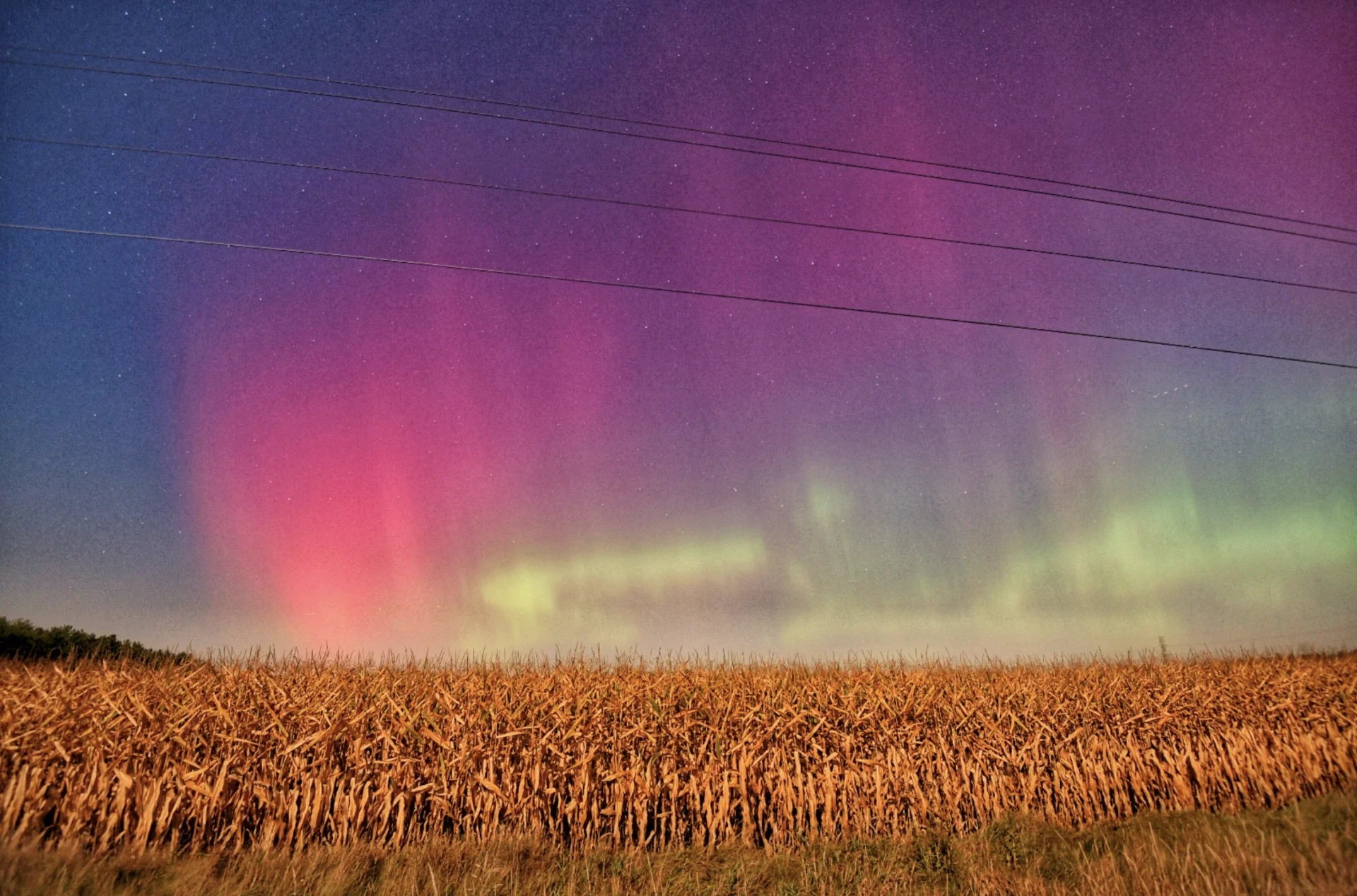
These bright, colourful auroras were seen on Sep 16, 2024, near Guelph, Ontario. (Mark Robinson)
Given that the geomagnetic field is effectively invisible, it is difficult to factor phenomena like equinox cracks into space weather forecasts. Thus, they are not taken into account in NOAA's forecast for this event. We will just need to wait until Wednesday night to see what happens.
(With files from The Weather Network)