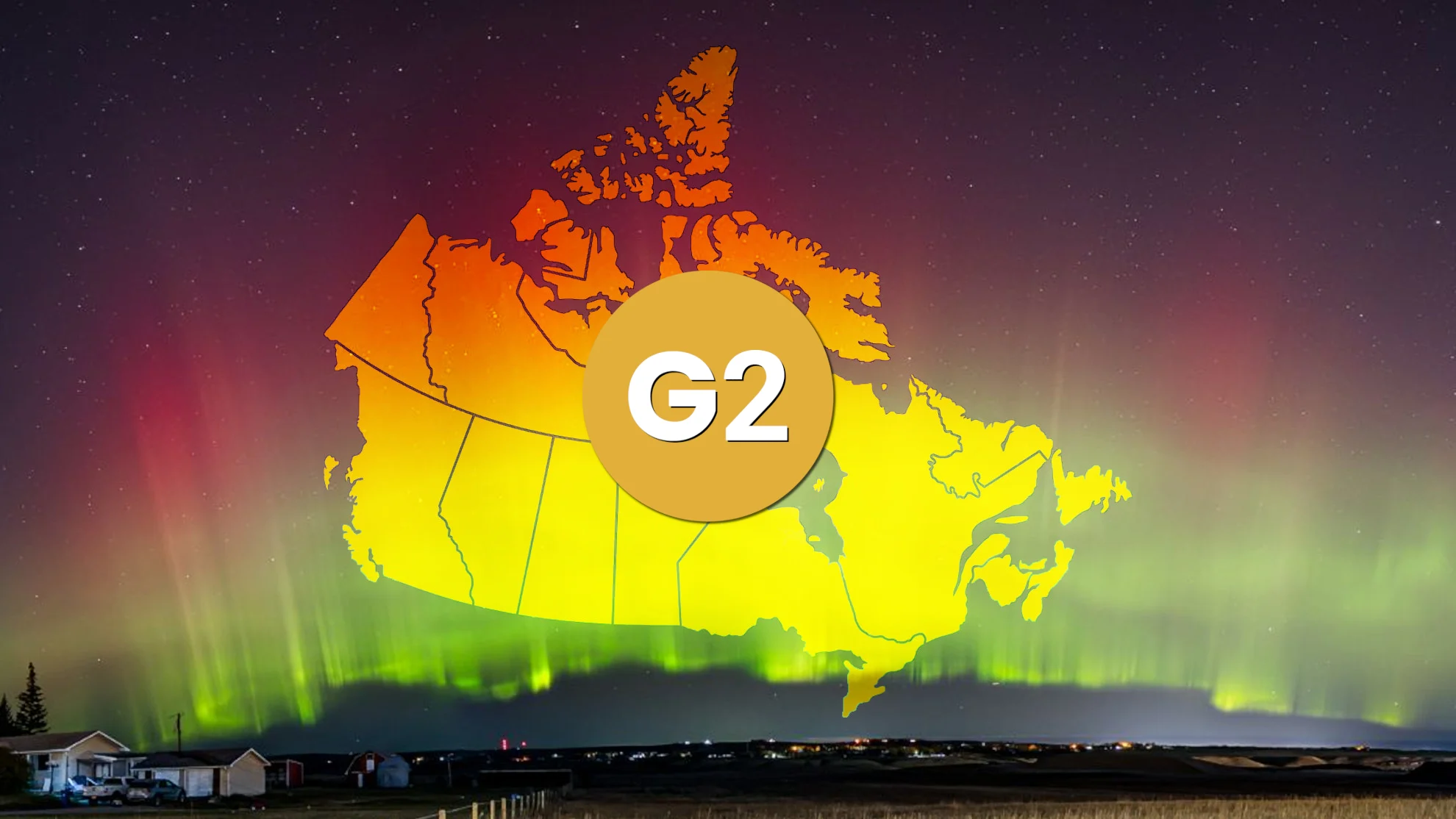
Delayed solar storm may spark auroras over Canada Friday night

The aurora displays that were supposed to accompany last night's lunar eclipse apparently weren't cancelled, but only delayed by a day instead.
The solar storm that erupted from the Sun on Tuesday now appears to have arrived, delayed by a day, and could spark auroras across parts of Canada tonight.
Earlier this week, a magnetic explosion on the Sun known as a solar flare launched a massive cloud of solar particles into space. The eruption of this coronal mass ejection, or 'solar storm' was at least partly aimed towards Earth. As a result, space weather forecasters were expecting the edge of the storm to score a 'glancing blow' on Earth's geomagnetic field sometime late on Thursday, coinciding with the arrival of a fast stream of the solar wind.
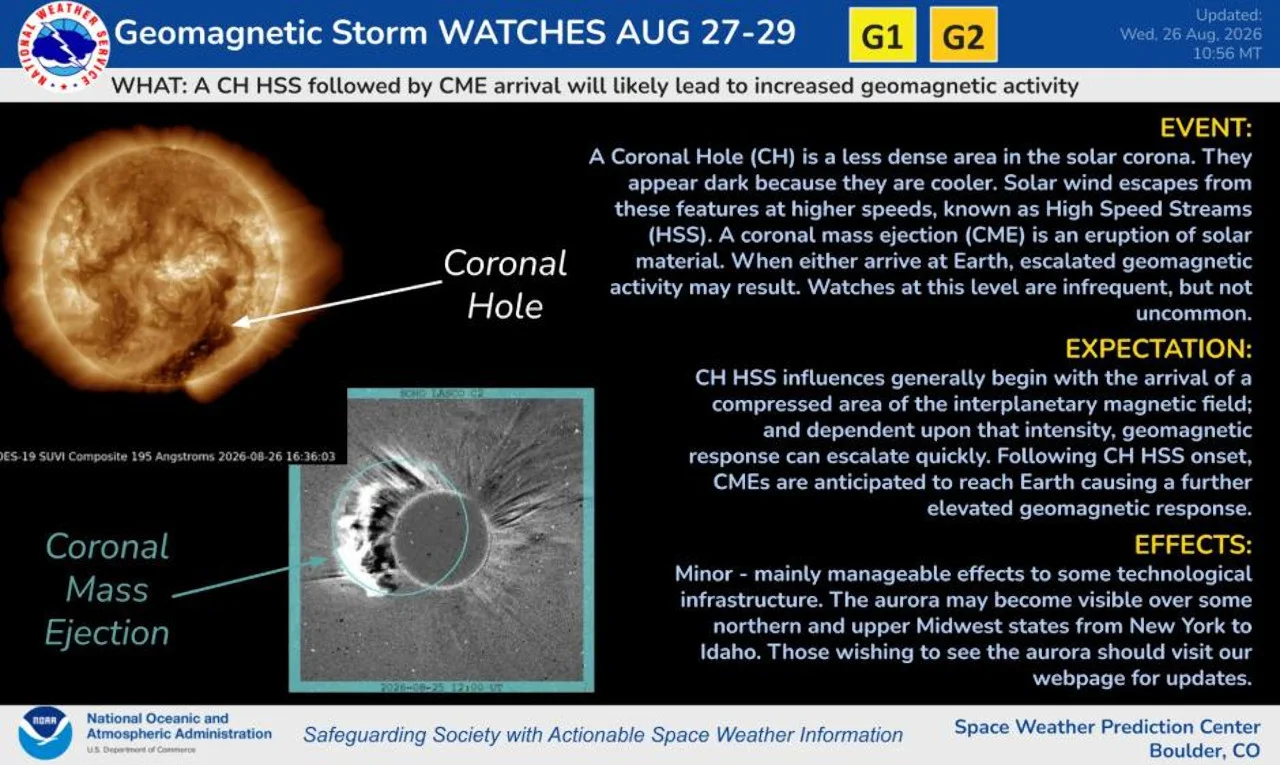
NOAA's geomagnetic storm watch graphic includes images of the coronal hole where a fast stream of the solar wind is originating (top left), and the coronal mass ejection that erupted on August 25 (bottom centre). (NOAA SWPC)
DID YOU MISS IT? Thursday night's Full Moon produced a 'nearly-total' lunar eclipse in the sky
As it happened, satellite data showed no sign of the CME's arrival on Thursday. Thus, the nearly-total lunar eclipse that occurred that night apparently had the sky all to itself, with no major aurora displays to be seen. However, based on data from the Canadian Space Weather Forecast Centre, some overnight 'substorm' activity may have sparked brief northern lights displays in northern regions.
Today, as of around 2 p.m. EDT, we are already seeing indications that the CME has now arrived.
With Earth currently in the flow of the fast solar wind stream, conditions appear much more favourable for geomagnetic storm activity tonight. And that means there's a better chance of seeing auroras across parts of Canada.
Due to this, NOAA's Space Weather Prediction Center has extended their G2 geomagnetic storm watch to overnight August 28 to August 29.
COMING UP! NASA's new space telescope will tackle some of the universe's biggest mysteries
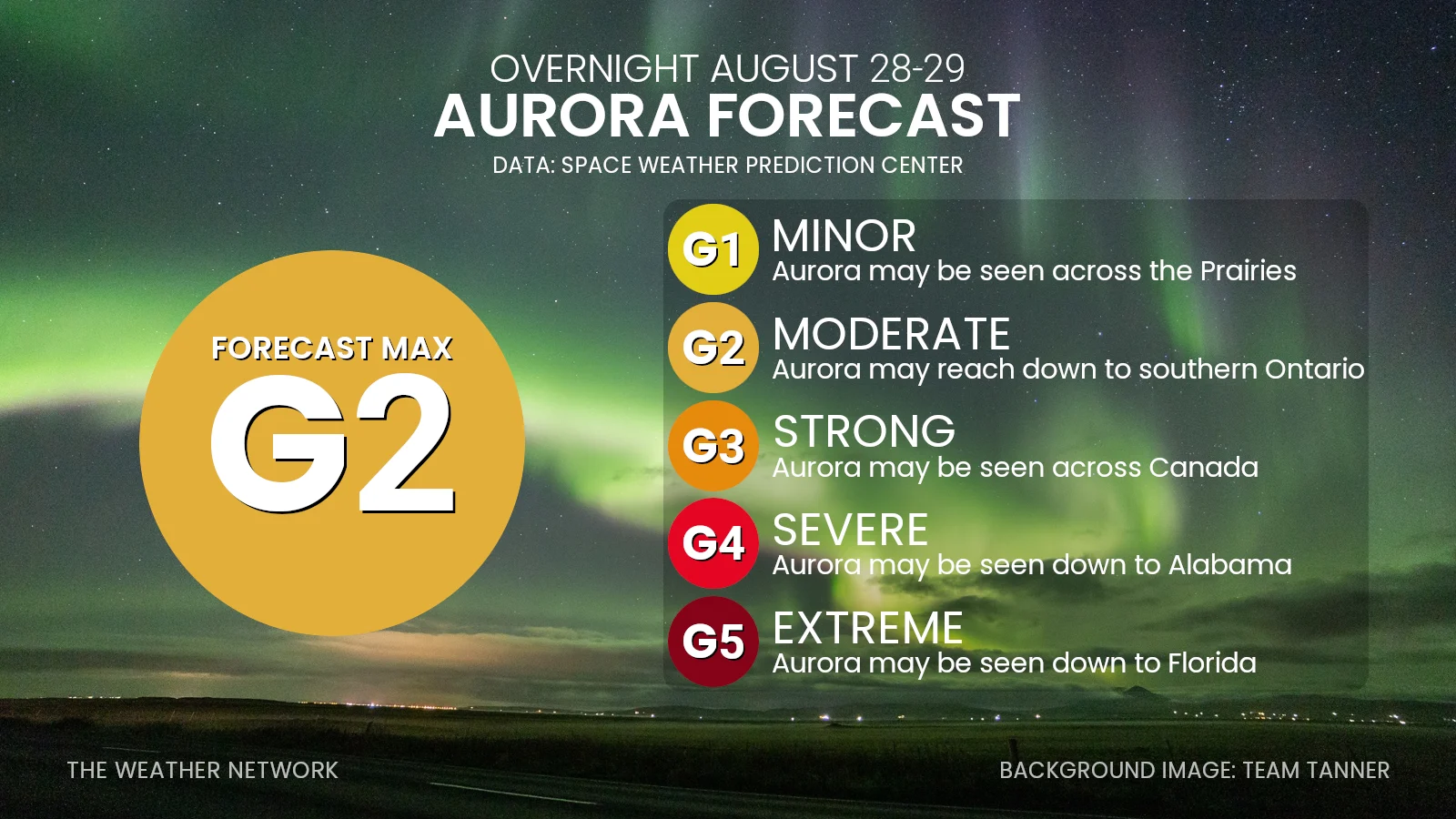
The SWPC forecast has activity reaching G1 (minor) levels Friday afternoon, increasing to G2 (moderate) by this evening, and continuing at G2 levels until after midnight (EDT).
Afterwards, they expect activity to ramp back down to G1 (minor) levels until predawn.
Auroras from a G2 geomagnetic storm typically reach as far south as the Gulf of St. Lawrence in the east, and the northern shores of Lake Huron, Georgian Bay, and Lake Superior. Observers well south of those regions may still spot auroras along the far northern horizon, given ideal dark sky conditions.
In western Canada, given the higher latitude, auroras are more likely to appear overhead, or at least closer to the north.
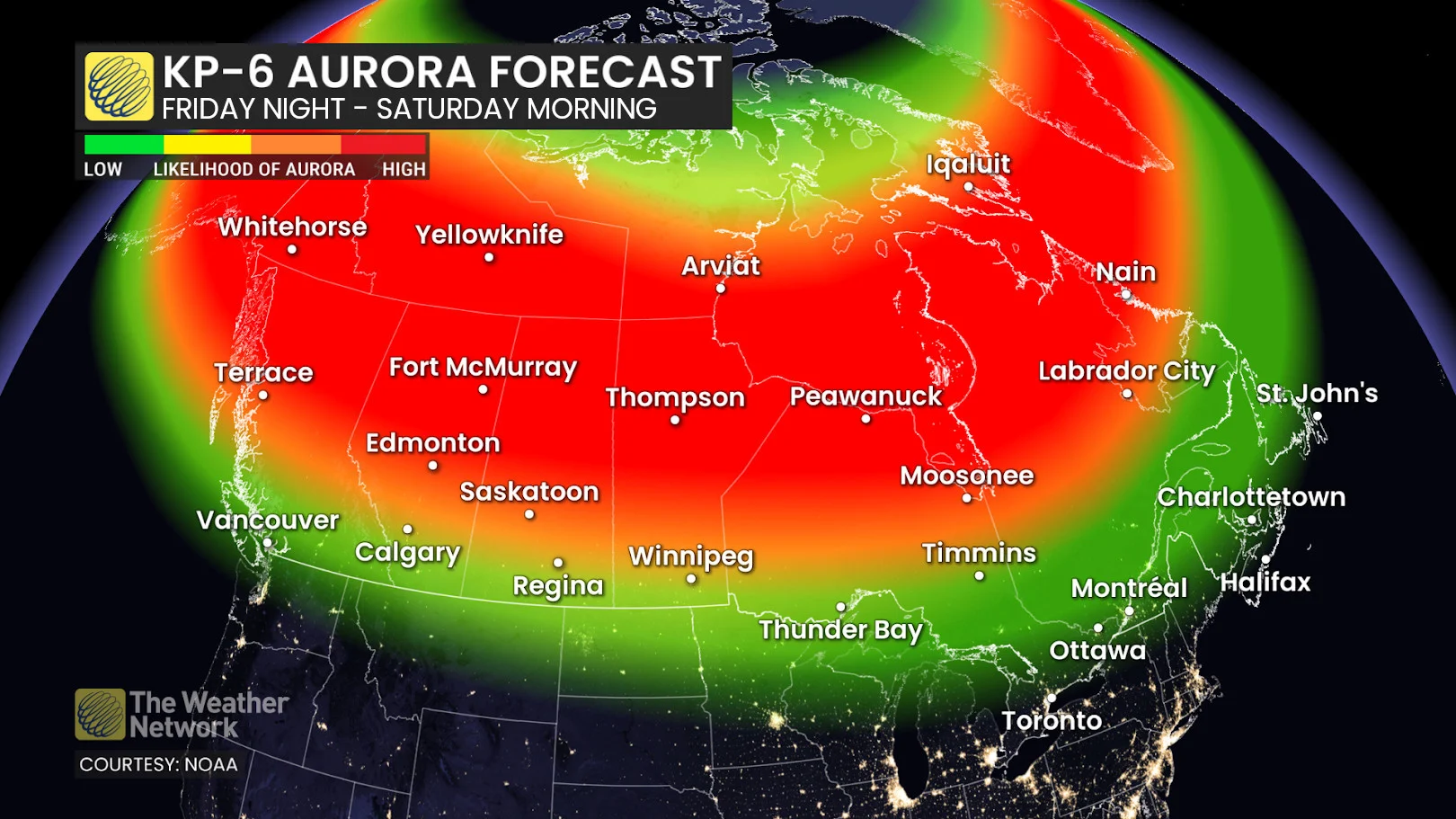
Kp=6 is the planetary k-index level experienced here on Earth due to a G2 geomagnetic storm occurring in space. (data from NOAA SWPC)
Based on the timing of the NOAA SWPC forecast, aurora displays will be at their brightest over northern regions of Atlantic Canada, Quebec, and Ontario, from just after dark until around 1 a.m. on Saturday.
This timing also favours Manitoba, and to a lesser extent Saskatchewan and Alberta. The concern here is: the farther west the observer, the earlier the expected rampdown to G1 conditions will occur (based on the forecast). Thus, aurora displays could diminish or retreat to the north only a short time after the sky has grown dark enough to see them.
It is possible that G2 conditions could persist longer. Also, substorm activity in the hours after midnight may provide some brief bursts of brighter auroras. So, keep an eye on the skies tonight.