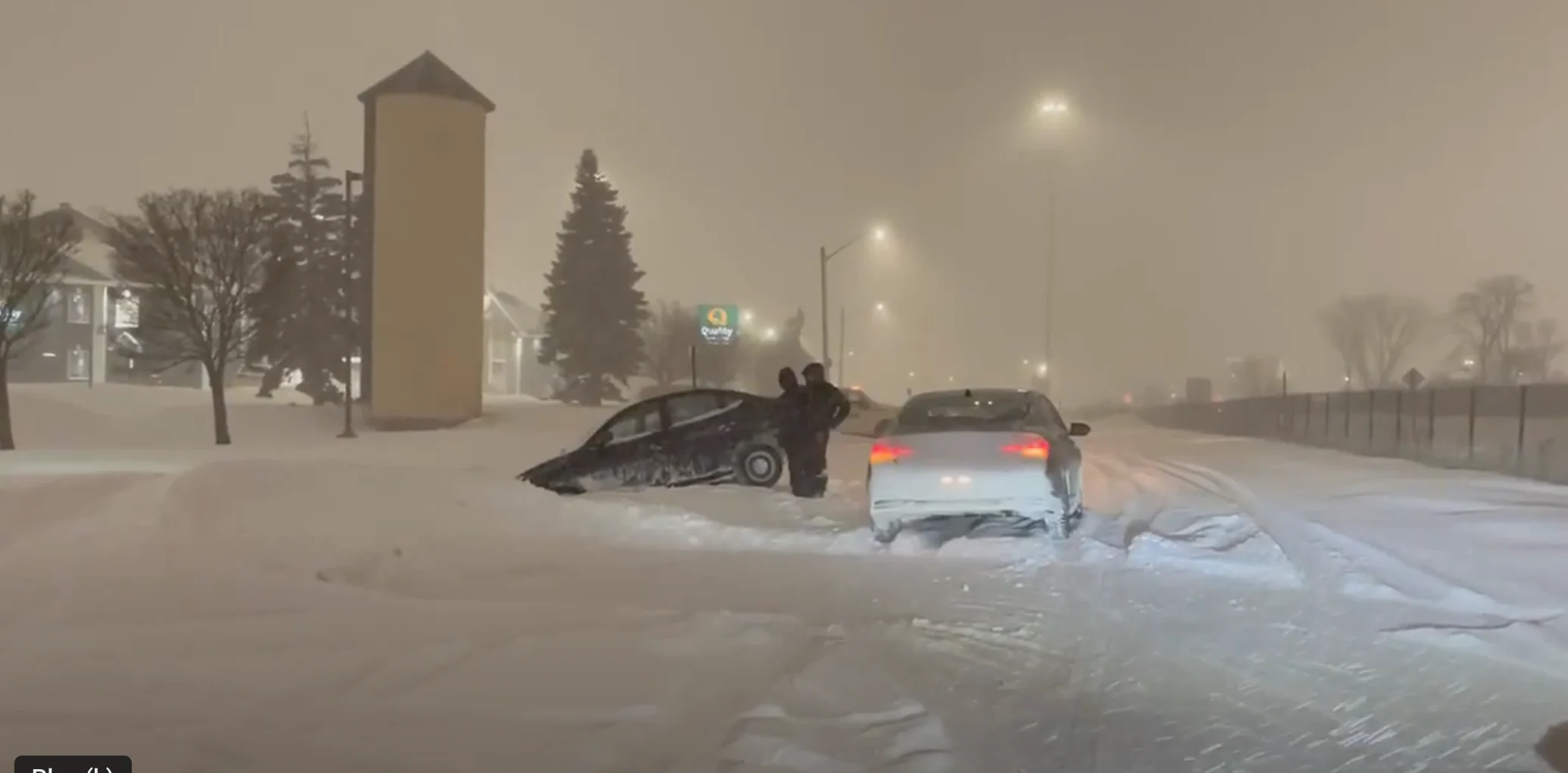
Why are cars flying over Ontario highway guardrails? Snow and driver error cited

A car flying over highway guardrails, propelled into the air with the help of a snowbank on the shoulder, might seem unusual. But since a snowstorm swept Ontario last month, it has happened four times in just over a week.
On Sunday, shortly before 7 p.m., a vehicle going south on Highway 427 lost control and went onto the shoulder, where there was a snowbank, before flying over a concrete wall. It struck a transport truck on Highway 401 below, before it came to rest on its roof near the Eglinton Avenue exit.
Somehow, the two people inside the vehicle suffered no life-threatening injuries.
PHOTOS: Toronto's snowiest day on record, 40-50+ cm reported
"Preliminary investigation suggests speed and snow may have been contributing factors in the collision," OPP said in a news release this week.
On Friday at 10:50 a.m., a vehicle lost control on a ramp from the Queen Elizabeth Way, Fort Erie bound, to Highway 420 in Niagara Falls. It struck the snow on the shoulder, causing it to climb over the guard rail, but landed in bushes, which prevented it from rolling onto the Toronto-bound lanes below.
The driver, a 23-year-old woman, was rescued by witnesses. She was not injured.
DON'T MISS: Buried: Ontario city on ‘high alert’ with 300 cm of snow on the ground
Not all involved in such incidents have escaped unharmed, however.
On Jan. 26, at about 7:30 a.m., a vehicle drove over a snowbank on the Highway 7 flyover ramp in Kitchener, Ont., and fell onto Highway 8 below. The driver, a 38-year-old Waterloo woman, was killed.
That same day, at about 2 a.m., the taxi driver lost control on the Highway 7 ramp to Highway 8 and ended up on the highway below. The driver was not seriously injured.
All of the crashes share a common factor — snow piled against the guardrail, effectively creating a ramp.
Ontario Provincial Police (OPP) say snow, when pushed up against guardrails, can be a factor in vehicles that becoming airborne, but driver error is still to blame.
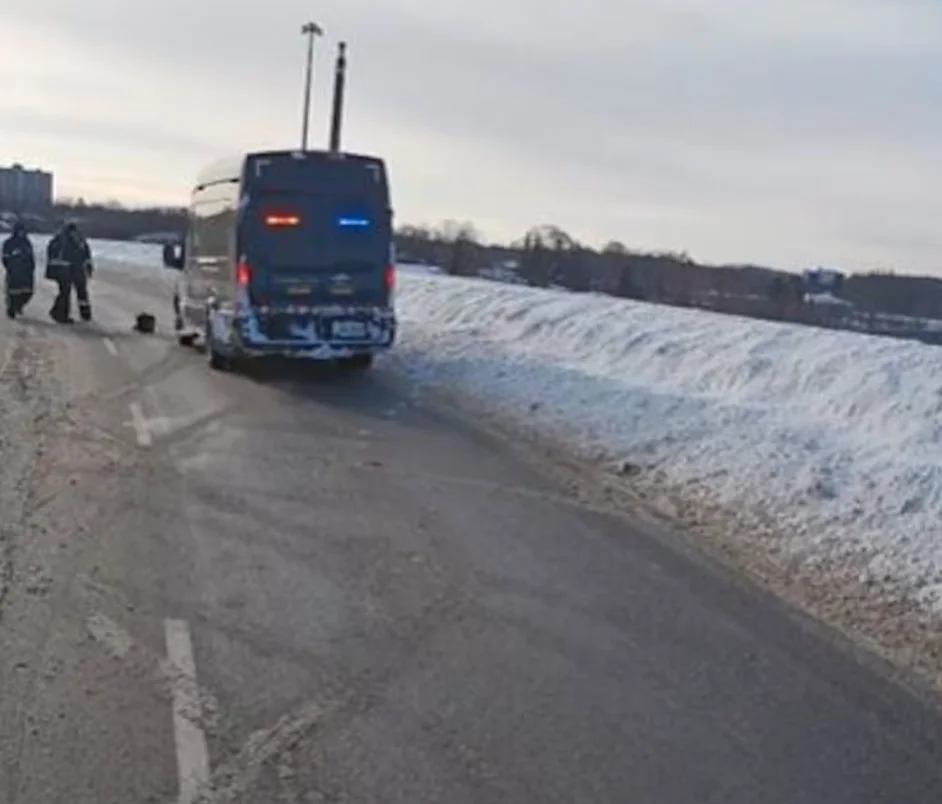
An image taken from a video posted to X, formerly Twitter, by the OPP shows snow piled to the edge of a flyover ramp on Highway 7 in Kitchener, Ont. A driver was killed when her vehicle flew over the embankment to Highway 8 below. (Ontario Provincial Police/X)
Sgt. Kerry Schmidt, spokesperson for the OPP's highway safety division, said the crashes occur due to drivers going too fast for the road conditions or not paying attention, and then losing control. He doesn't find the crashes surprising or unexpected.
"The snowbank is a consistent factor but I think, more importantly, is also driver error... a driver going too fast, losing control, either panicking, over correcting, ending up going sideways, going over the lanes onto the shoulder where the snowbanks are and onward onto the highway below or into the ditch," Schmidt said Tuesday.
"When that snow is there, obviously, it causes a blockage of that shoulder... When a vehicle approaches that area at sufficient speed, there's potential for that vehicle to be lifted up on top of that snow and continue right up over the wall," he said.
Roads can be slippery even if plowed, OPP says
Schmidt said when the temperatures are very cold, roads can be slippery even if they are plowed and drivers have winter tires.
RELATED: Driving Through the Storm: The vehicle we trust for Canada’s variable winters
"These collisions typically happen on on-ramps and off-ramps when there's a lateral movement or a turning motion with the vehicles. And if the tires don't have sufficient friction to keep the vehicle centred in the lane, or the drivers are not paying attention, that's when things go wrong," he said.
"Things can go wrong very quickly when you're going down the road at 100 km/h."

Sgt. Kerry Schmidt, spokesperson for the Ontario Provincial Police's highway safety division, says: 'Things can go wrong very quickly when you're going down the road at 100 kilometers per hour.' (Tom Howell/CBC)
Angelo DiCicco, president and CEO of Ontario Safety League, a traffic safety organization and a charity, said drivers need to learn to adapt to driving in snow.
"When it's all said and done, really, it's going to be up to you," he said. "As soon as you put in an external factor, such as excess speed, a tired or fatigued driver, impaired driver or snow or ice, then all bets are off."
In a statement on Tuesday, a spokesperson for the Ontario Ministry of Transportation, said maintenance contractors inspect and address roadside hazards, including snow accumulation along bridge barriers, following a storm.
"The Ministry of Transportation will review the circumstances surrounding these incidents, including police investigation reports, to determine whether additional measures may be warranted to further enhance public safety," Meaghan Evans said.
This article, written by Muriel Draaisma, was originally published for CBC News. With files from Naama Weingarten