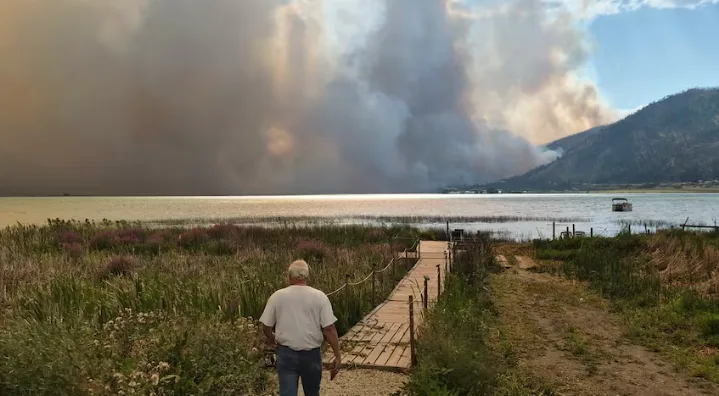
No major growth on wildfire near Vernon, B.C., but thousands remain evacuated

British Columbia wildfire officials say a fire burning west of Vernon that forced thousands of people from their homes over the weekend has seen little growth since Sunday morning.
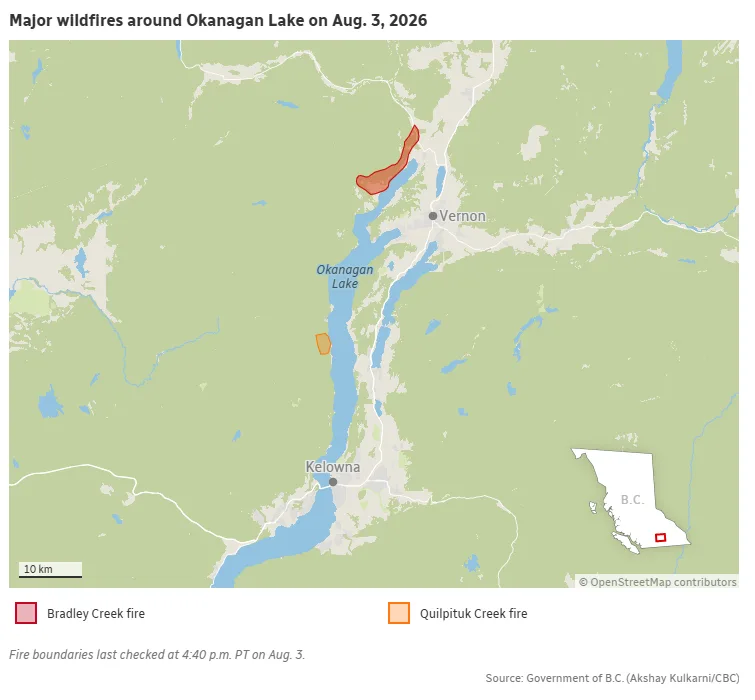
Discovered Friday, the fire quickly grew to 26 square kilometres, prompting evacuation orders Saturday in the main reserve of the Okanagan Indian Band (OKIB), the township of Spallumcheen and the Splatsin First Nation.
Multiple properties have been destroyed, but in a social media update posted Sunday, OKIB Chief Dan Wilson said officials still don't know the extent of damage in the community.
Keep up with the latest wildfire information at The Weather Network's wildfire hub.
"I also know many of you are seeing images, videos and reports shared on social media and in the news. Some of what you are seeing is upsetting, some of it raises more questions than answers," he said.
"We understand that, we are working to confirm information as quickly as we can and share it with our community as soon as it’s verified."
'Rollercoaster of emotions'
Amber Cardenas, who lives with her partner and their family on the OKIB reserve, is among those who lost their home.
She told CBC News the family thought they were "in the clear" on Friday, with the fire burning about 15 kilometres from their property.
But with a change in winds, the situation deteriorated rapidly, and by mid-day Saturday, firefighters were going door to door telling people to leave.
"When we saw that big plume of smoke ... you could see and hear the wind, that it wasn't going to slow down we were like, OK, we’ve just got to grab what we can," Cardenas said.

Amber Cardenas wipes away tears as she describes the impact of the Bradley Creek fire on her home. (CBC News)
She said they saved some irreplaceable family heirlooms, including baskets, moccasins and buckskins — but lost everything else.
"It wasn’t as much as we wanted. My partner is a jeweler and her jewellery bench and her tools and everything we had to leave," she said.
"To see and hear about other community members' houses that were lost close to ours as well, it’s pretty devastating. It’s a rollercoaster of emotions."
Wilson said officials still need to assess damage to utilities, roads and water systems before the band can look at a plan for evacuees to return.
Nearby wildfire grows
Earlier Monday, officials expanded an evacuation order related to another out-of-control wildfire burning on the west side of Okanagan Lake.
The Central Okanagan Regional District has ordered anyone in the Caesars Landing area, about 25 kilometres north of Kelowna to leave due to the Quilpituk Creek wildfire.
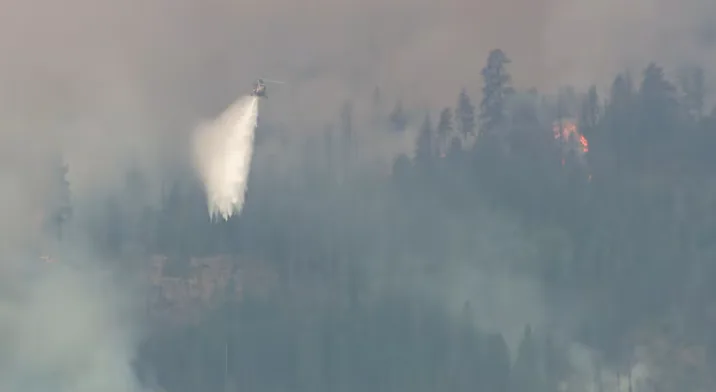
The Quilpituk Creek fire burns on Sunday, Aug. 2. (Nicholas Allan/CBC)
Properties in the Shelter Cove, Secret Point and Cinnabar Creek areas have been placed under evacuation alert.
That fire, discovered on Saturday, was last measured at 5.5 square kilometres, and has forced the evacuation of more than 2,200 properties in the area.
Highway 97 remains closed from Salmon River Road to the Highway 97A junction, and Westside Road is closed between Highway 97 and Shelter Cove, according to DriveBC.
The B.C. Wildfire Service said temperatures in the area were slightly cooler on Monday and that winds were significantly lower than on the weekend, allowing crews to get closer to the fires' edges.
However, fire information officer Nicole Bonnett said, the forecast remains clear and dry, and that fire activity was expected to pick up into Monday afternoon.
8 dogs, 2 cats and 5 people in 1 bedroom
More than 5,000 people were forced from their homes across the province over the weekend, as wildfire crews faced extreme winds and lightning.
Among them were Kerry Inness and Terry Chan, who convoyed out of the area with a group of neighbours.
Thanks to the kindness of a stranger who approached them in a parking lot in West Kelowna, the group has a roof over their head: a small Airbnb unit they were offered for free.
"They let us bring eight dogs, two cats and five people ... in a one-bedroom basement suite," Innes said.
"We were just crying and crying and hugging them because we couldn’t believe it."
Ed and Svetla Hladun weren't so lucky. After evacuating from the Westshore Estates area, they arrived in Kelowna too late to find a hotel room.
"It’s the first time in my life I’ve had to sleep in my car," 82-year-old Ed said.
"You try to feel younger, but it’s still uncomfortable," Svetla added, saying they've since found a place to stay.
No need for state of emergency: Parmar
Speaking at an event welcoming Mexican fire crews to B.C. on Monday, Forests Minister Ravi Parmar responded to calls for his ministry to declare a provincial state of emergency to address wildfires.
"If we needed the tools of a provincial state of emergency, we would call it," he said.
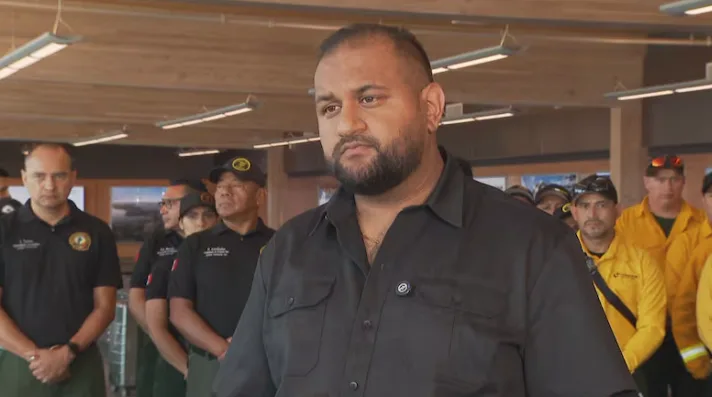
B.C. Forests Minister Ravi Parmar, seen here with Mexican wildfire crews that arrived on Monday to help fight B.C. wildfires, says there's no need for a state of emergency at this point. (Nav Rahi/CBC)
Declaring a state of emergency would grant the province extraordinary powers to restrict travel, use private property, acquire or ration supplies and conscript help.
Parmar said between the B.C. Wildfire Service and the support of out-of-province fire crews, B.C. already has the resources it needs.
"There are tons of crews on the ground, there are tons of resources in the air, but sometimes it's not safe for them to act," Parmar said.
"These are extreme fire conditions."
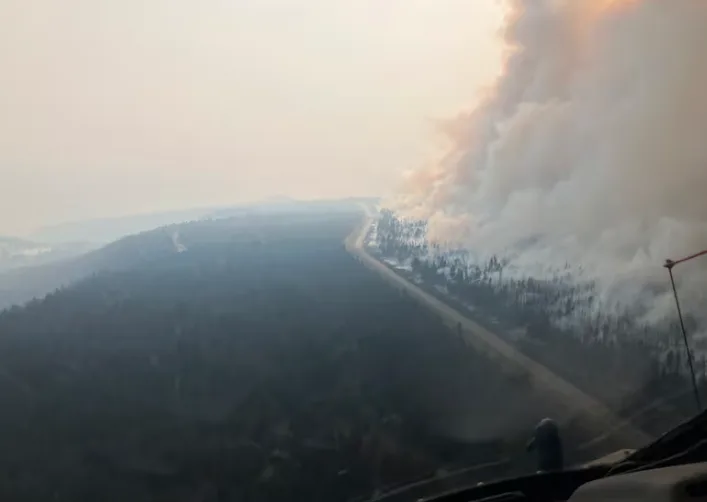
A planned ignition operation near the Pear Lake wildfire, close to Clinton, B.C., is seen on July 29. (B.C. Wildfire Service)
Elsewhere in B.C., the massive Pear Lake wildfire, which is threatening the communities of Clinton and 70 Mile House, grew to 1,152 square kilometres in size on Monday, while to the northwest, the French Bar Creek fire expanded to 371 square kilometres.
But there was good news for people living south of Lillooet.
While the Riley Creek wildfire continues to burn, the T’it’q’et First Nation, Lytton First Nation and Squamish-Lillooet Regional District have all downgraded evacuation orders to evacuation alerts within the last 24 hours.
Across the province, there were 126 wildfires burning on Monday afternoon.
As of 9:30 a.m., there were 4,700 properties under evacuation order in B.C., and another 3,600 under evacuation alert, according to the Ministry of Emergency Management and Climate Change.
This article, written by Simon Little, was originally published for CBC News. With files from Baneet Braich and Caroline Barghout