A Great Comet may shine along with meteor showers and bright planets this spring

Check your weather forecast for clear skies, so you don't miss the spectacular astronomical events occurring throughout the spring season.
Despite the nights getting shorter, the warming weather makes Spring one of the best times of year to get outside to view the night sky. In 2026, along with the usual meteor showers, we have bright planets clustering on both horizons, and a chance to spot a new Great Comet, which may grace our skies starting in early April.
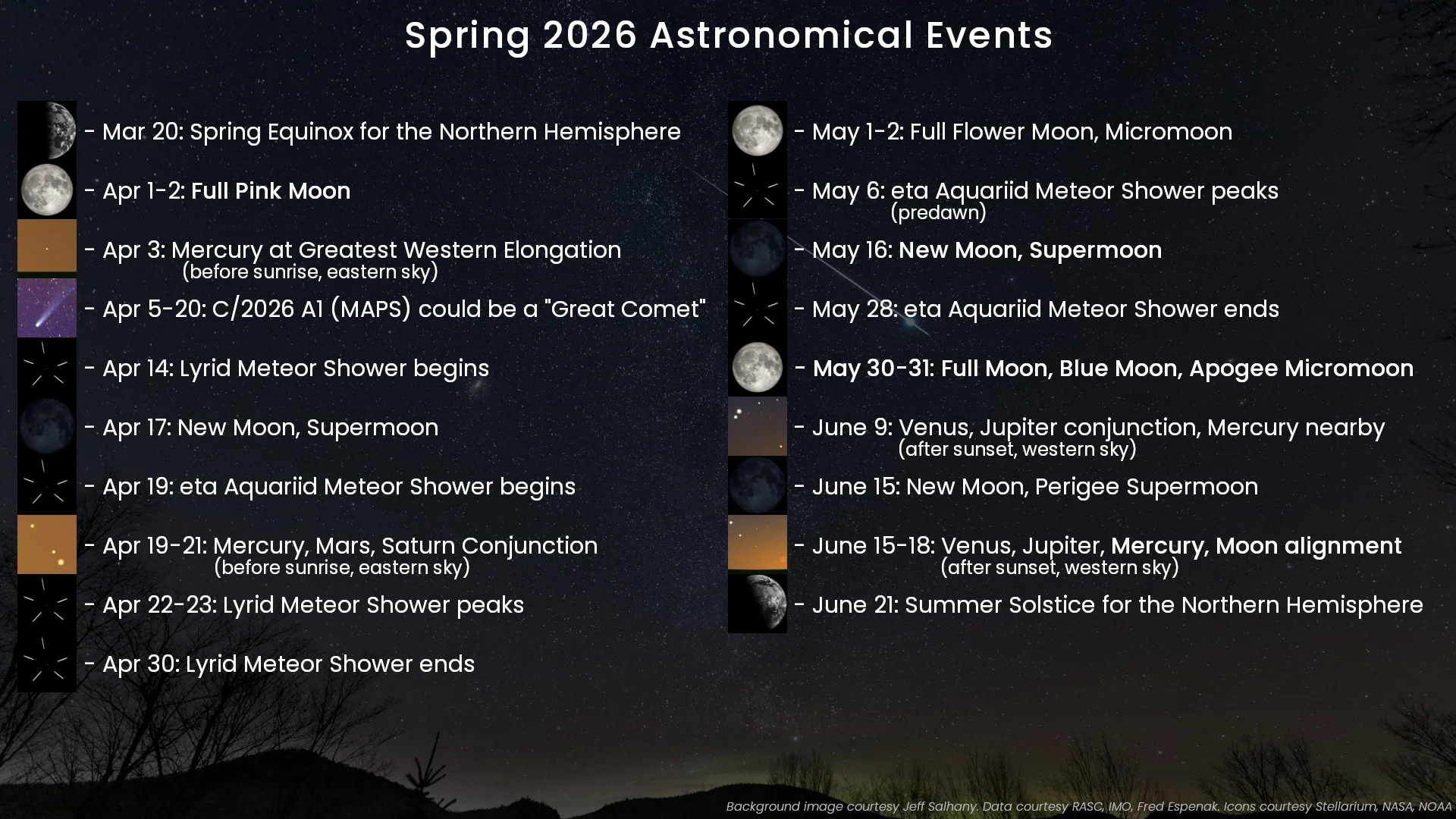
Here are the major astronomical events of Spring 2026:
Visit our Complete Guide to Spring 2026 for an in-depth look at the Spring Seasonal Forecast, tips to plan for it, and much more!
Vernal Equinox
On Friday, March 20, at exactly 10:46 a.m. EDT (12:16 p.m. NDT, 11:46 a.m. ADT, 9:46 a.m. CDT, 8:46 a.m. MDT/CST, and 7:46 a.m. PDT), the Sun will cross over the Celestial Equator, headed from south to north.
As the Sun's focus shifts away from the southern hemisphere, due to the tilt of Earth's axis, this signals the end of northern winter and the beginning of northern spring for 2026.
Keep an eye out for space weather alerts at this time of the year. Due to a phenomenon known as 'equinox cracks', solar storms and the solar wind can have a much stronger impact on Earth's geomagnetic field, resulting in bright displays of the Northern Lights over Canada.
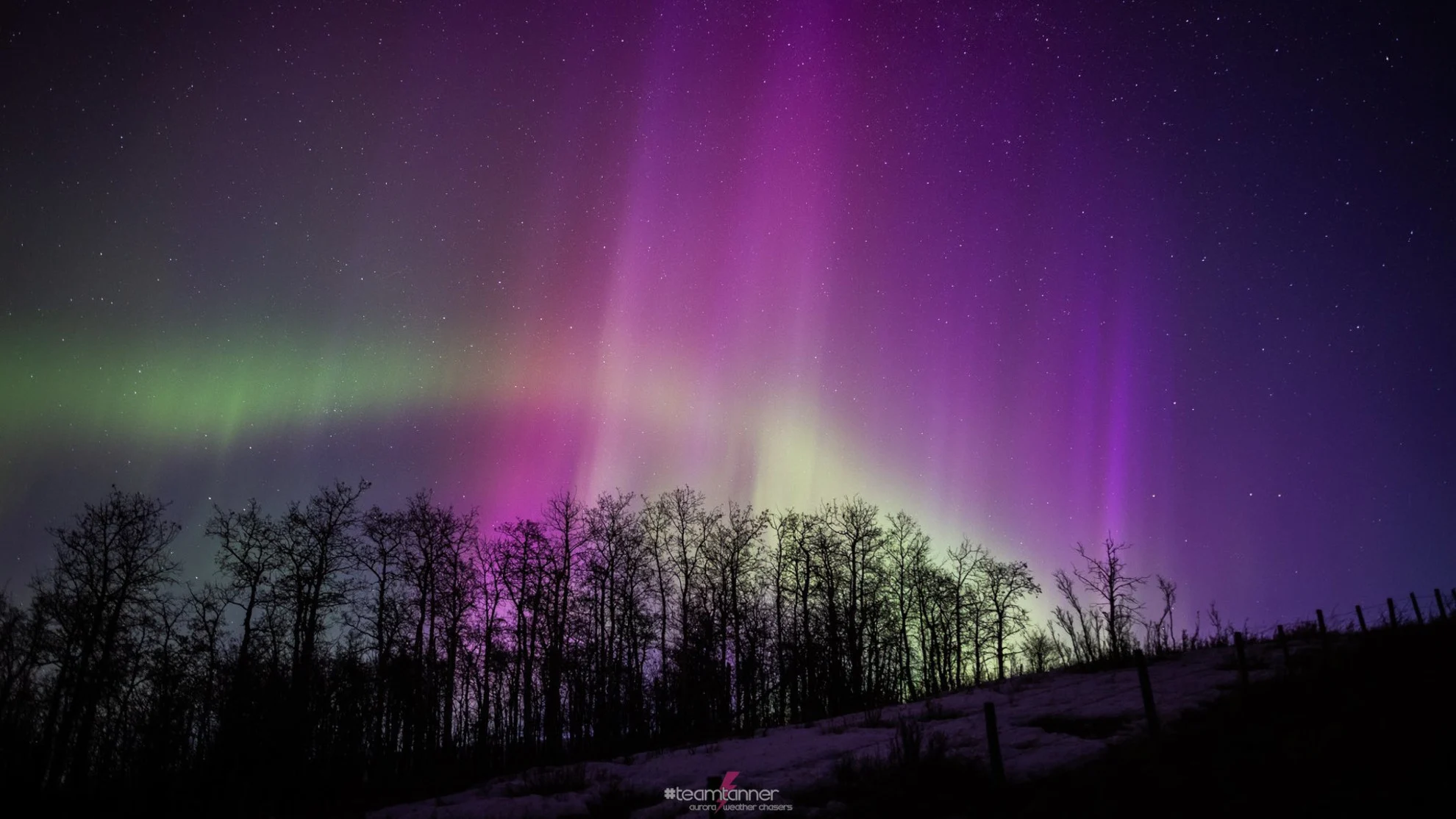
This colourful Northern Lights display was captured on March 23, 2023, from central Alberta. (TeamTanner)
SPACE WEATHER: Geomagnetic storms — When should we look up and when should we worry?
The Planets
Right from the start of the season, two of the brightest planets in the sky can be seen each night. Jupiter will be high in the southern sky among the stars of the constellation Gemini. Meanwhile, Venus will be the 'evening star', visible low in the western sky after sunset, and slipping below the horizon shortly after.
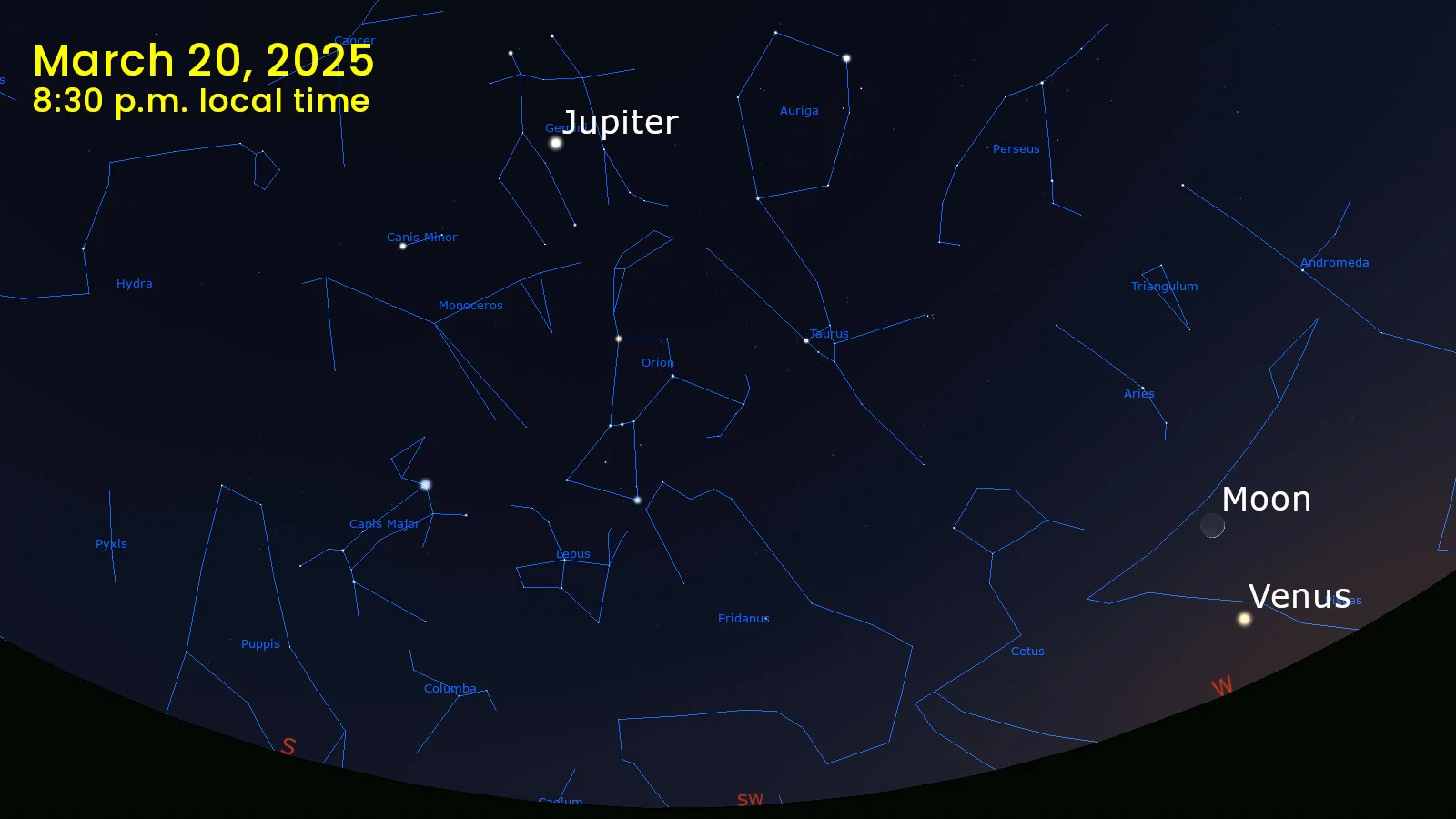
(Stellarium)
Each night after, we will find Jupiter shifted slightly farther west, while Venus will be slightly higher in the sky, with both planets easily spotted throughout the entire spring season.
Also, look closely at the eastern horizon each morning in late-March, before sunrise, and you may spot the planet Mercury. As it is still fairly close to the Sun, it may be challenging to spot in morning twilight. A pair of binoculars or a telescope will make it easier to see.
On April 3, Mercury reaches its "greatest western elongation" — its farthest distance from the Sun, and thus its highest position above the eastern horizon in the predawn sky.
After another week or so, scanning that same region of the sky, it will be possible to spot not only Mercury, but also Mars. Then, another week later, Saturn will join the pair, with the best mornings to see this on the 19th through the 21st.
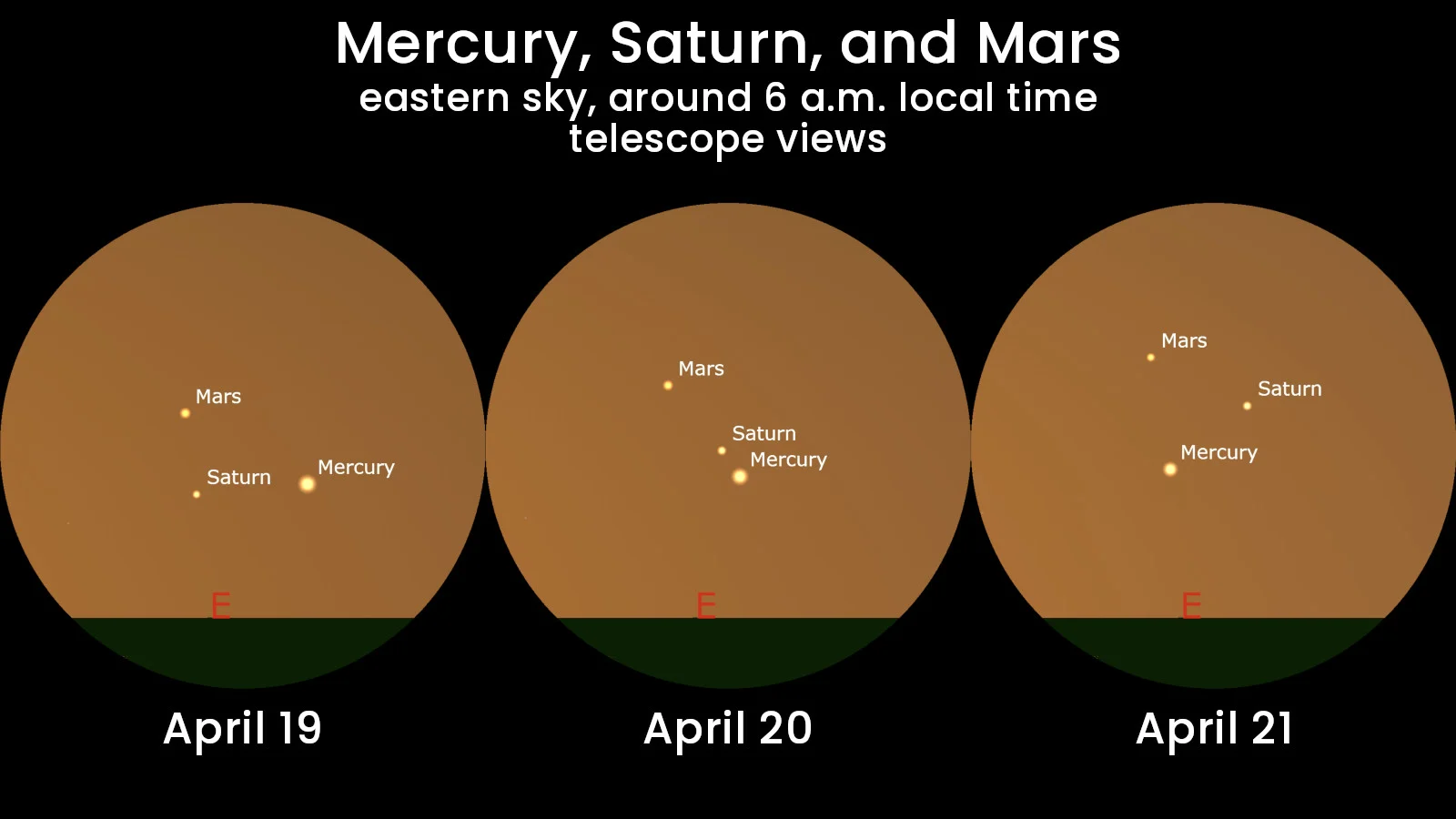
The positions of Mars, Saturn, and Mercury close to the eastern predawn horizon, on April 19, 20, and 21, 2026. (Stellarium/Scott Sutherland)
Spying these three planets will be a bit of a balancing act, as we try to catch them in the darkest sky possible, but also high enough above the horizon to make them easiest to see.
The trio will only be visible together for a short time, as Mercury will eventually disappear into morning twilight. However, Saturn and Mars will linger in the predawn sky throughout the rest of the season. Both will actually become easier to spot in May, as they rise earlier each morning, and are eventually visible before morning twilight begins.
Later in the season, turn your eyes to the western sky after sunset. As Jupiter and Venus get closer together in late May, Mercury will reappear above the western horizon.
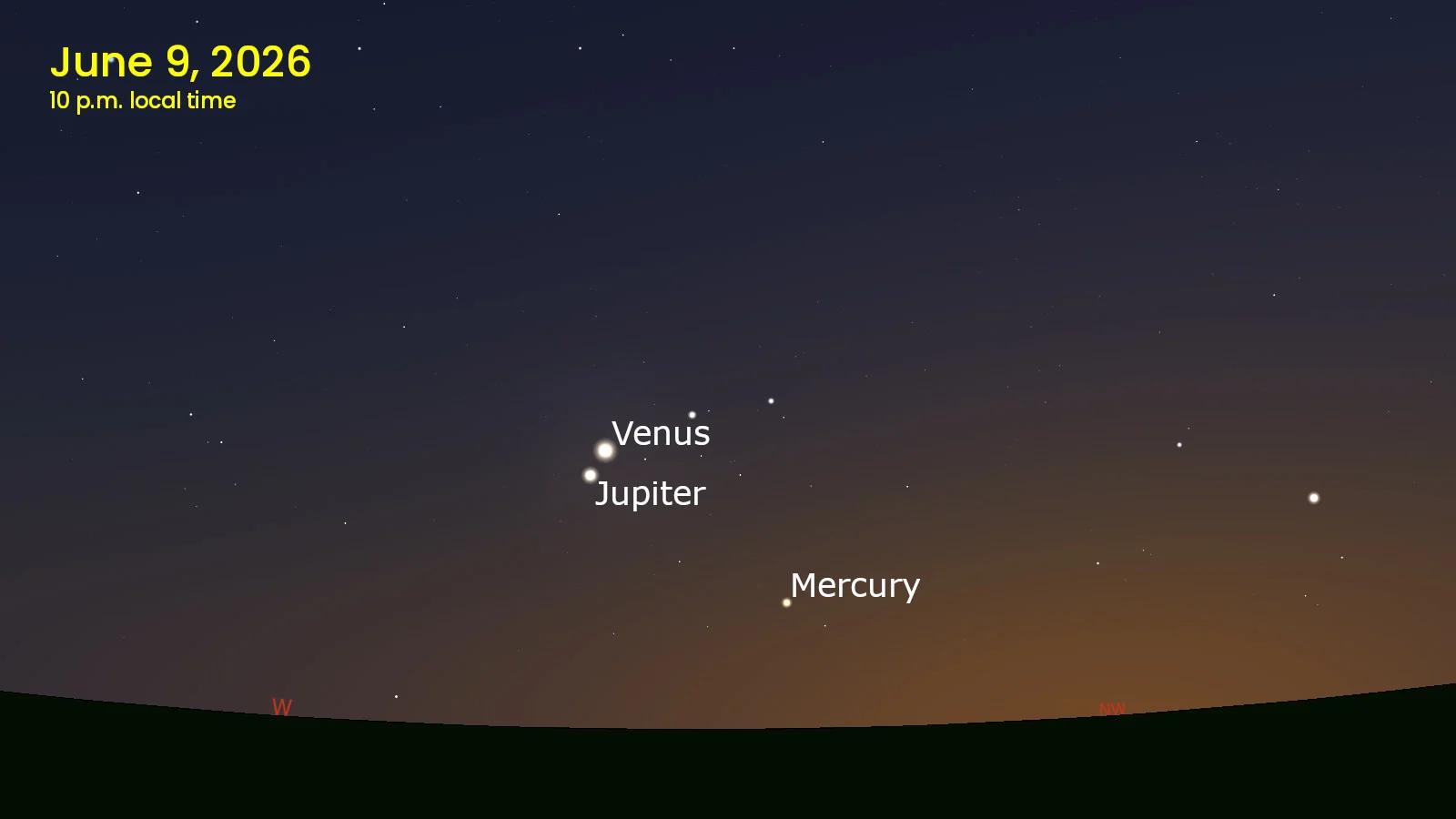
Venus-Jupiter Conjunction, June 9, after sunset. (Stellarium)
Then, on June 9, Jupiter and Venus make their closest approach to each other, known as a conjunction. The pair will be the brightest two objects in the western night sky at the time, with Mercury farther off to the northwest on that night.
Watch in the nights afterward, to see Venus, Jupiter, and Mercury form up into a line that will persist until the summer solstice. Catch the trio in alignment with a very young Waxing Crescent Moon starting on the night of June 15, and then watch the Moon pass through the trio on the nights after.
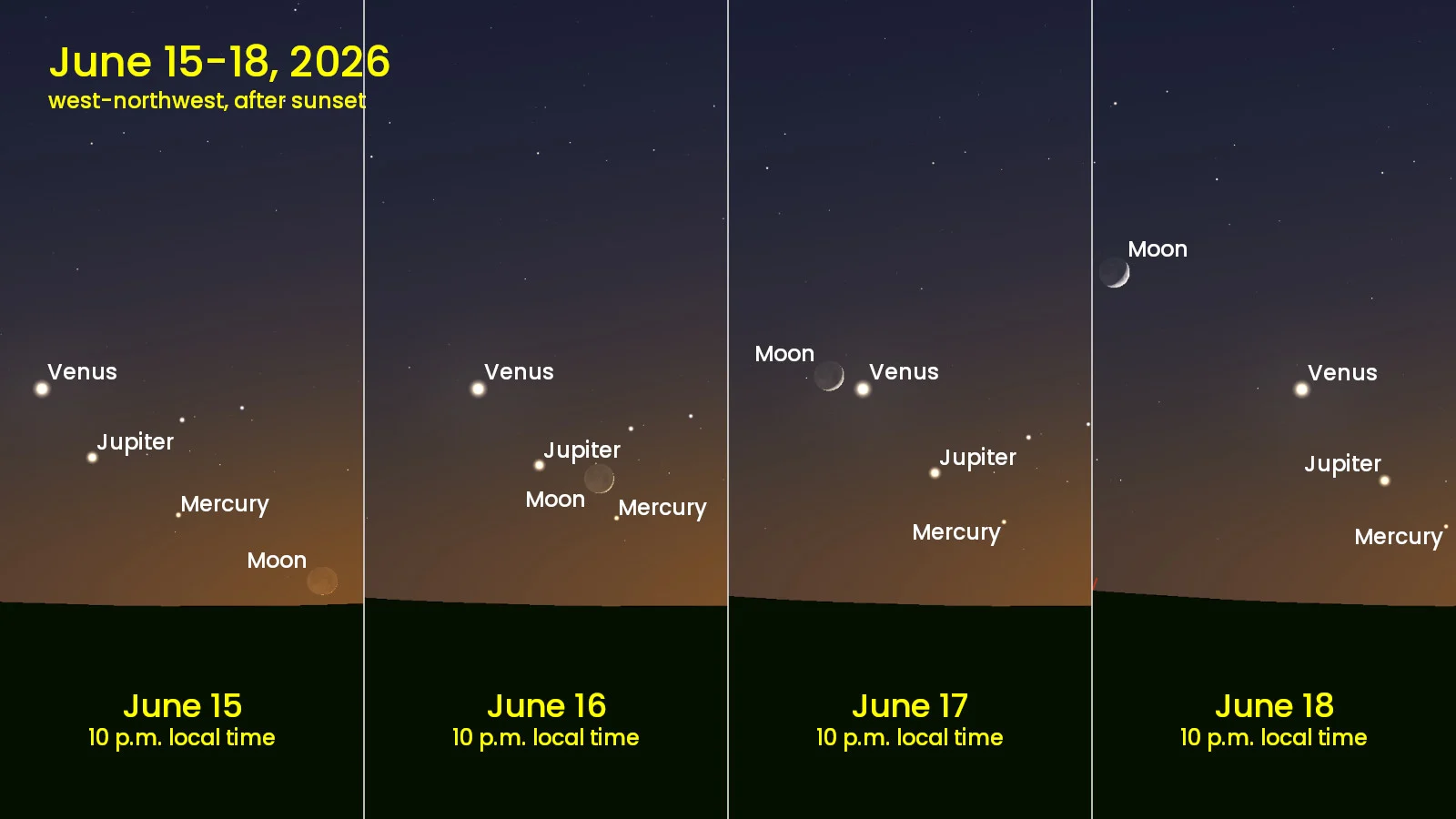
The alignment of Venus, Jupiter, Mercury, and the Waxing Crescent Moon from June 15-18. (Stellarium/Scott Sutherland)
DON'T MISS: Why are the Northern Lights so supercharged lately and how long will this last?
The Moon
As with any typical season, the spring of 2026 has three Full Moons. However, their timing is a bit 'off' compared to what we usually see.
Usually, the Full Moons of Spring will show up spaced out so there is one each month. Either we see them in the last few days of March, April, and May, or sometime within the first three weeks of April, May, and June.
For 2026, though, the Full Moons are clustered in only April and May. The first, the Pink Moon, will be on the night of April 1-2. After that, the Flower Moon will rise on the night of May 1-2. Then, rather than the next Full Moon being the June Strawberry Moon, it will instead occur on the last night of May.
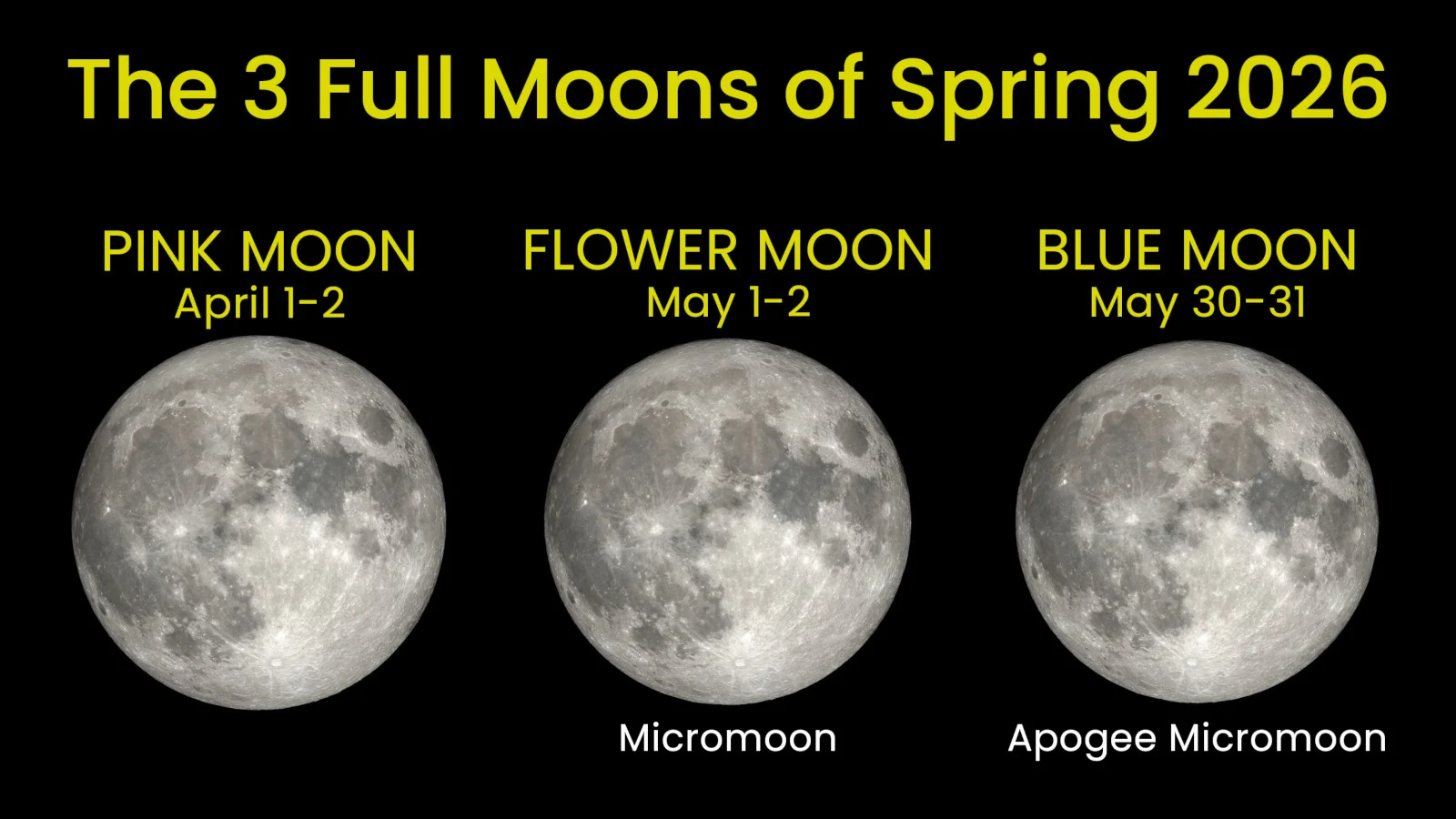
The Full Moons of Spring 2026, the Flower Moon and the Blue Moon will be two of the smallest of this year, with the Blue Moon being the apogee micromoon, the smallest and farthest of the year. (Scott Sutherland/NASA's Scientific Visualization Studio/Fred Espenak)
With two Full Moons occurring within the same month, on May 1-2 and May 30-31, the second of those is called a Blue Moon.
This type of Blue Moon — a 'calendar' Blue Moon — can happen in any month that is longer than the 29.5-day synodic lunar month. Thus, we'll see one in any month except February, with a frequency of one every 2.5 to 3 years. The last one was on August 31, 2023, and the next one (after May of this year) will be on December 31, 2028.
During a year with a calendar Blue Moon, instead of the normal 12, we will see a total of 13 Full Moons between January 1 and December 31. Since we have 12 popular names for Full Moons, this is truly an 'extra' one, and as a result, it is only named the Blue Moon.
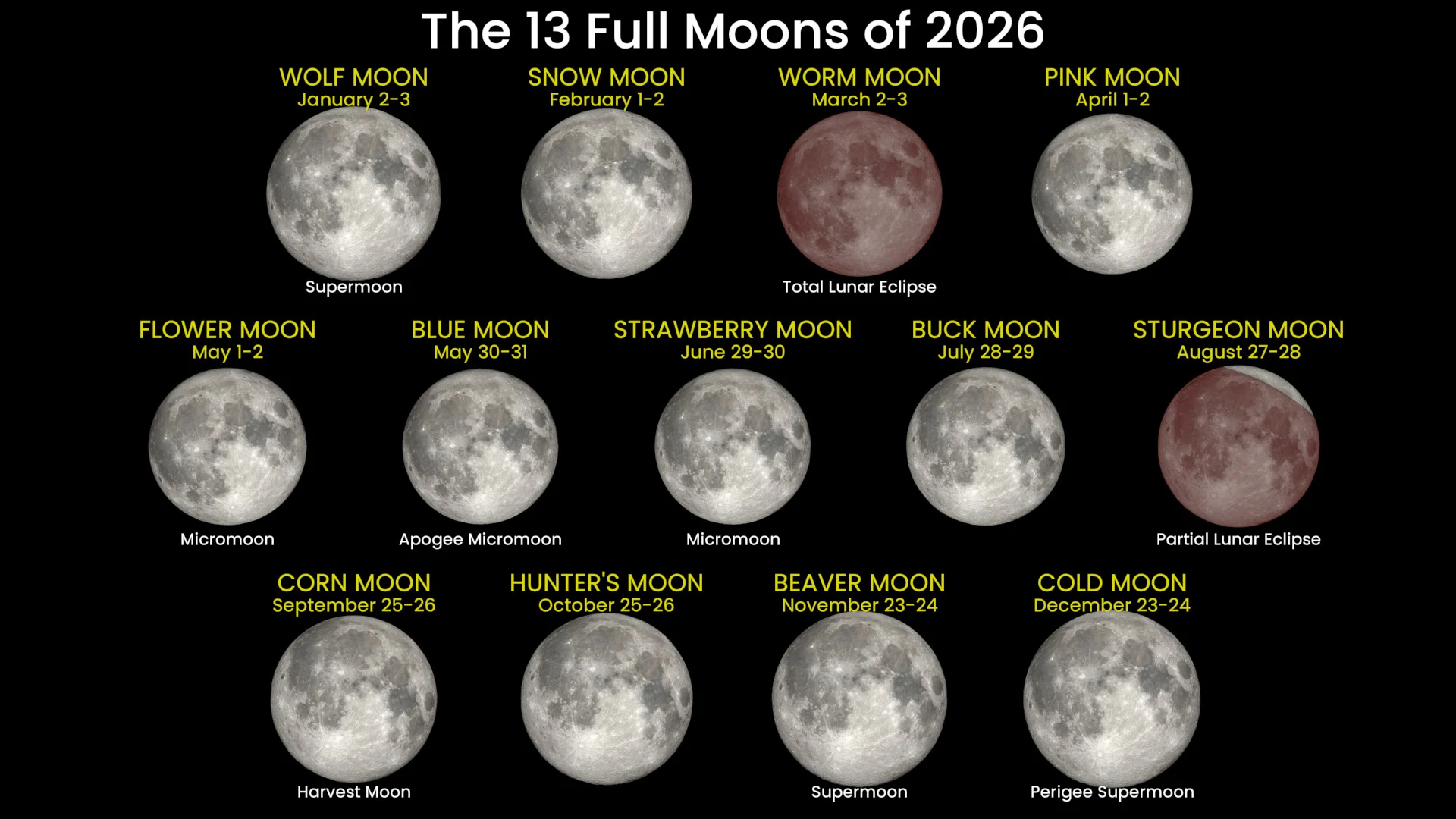
The 13 Full Moons of 2026, with their popular names, and any remarkable aspects (supermoon, micromoon, Harvest Moon, lunar eclipse, etc). (Scott Sutherland/NASA's Scientific Visualization Studio/Fred Espenak)
In contrast, there is also the 'seasonal' Blue Moon, which is when we have 13 Full Moons in the course of 4 seasons (aka a Tropical Year). This gives us three seasons with three Full Moons each, and one season with four. This is the original meaning of the term, as the calendar "13th Full Moon of the year", mentioned above, was a misinterpretation of the rule published in the Maine Farmers' Almanac back in 1937.
Which Full Moon ends up being the Blue Moon in that year depends on their exact timing. A Full Moon will occur within the first few nights after the start of a season, and due to the timing of the ones that come after, there will be a total of four Full Moons before the season ends. The third of those four is the Blue Moon, with "Blue" being added to its popular name. Thus, since this occurs mostly in spring, summer, and fall, it usually results in either a Blue Flower Moon in May, a Blue Sturgeon Moon in August, or a Blue Beaver Moon in November.
Now, it is possible to have a winter seasonal Blue Moon, also known as a Blue Snow Moon, which would occur in February. However, this is much more rare.
The challenge comes down to fitting three complete lunations (an average of 88.5 days) into the shortest season of the year, which is typically only 89 days long. The exact time fits, of course. However, it comes down to the exact timing, where the first Full Moon of winter must be just hours after the solstice to get a fourth Full Moon occurring just before the March equinox. Add in the facts that the timing between Full Moons changes slightly, orbit to orbit, and that the times and dates of the solstices and equinoxes change year to year, and it becomes clear that it's not easy to have everything line up.
The last Blue Snow Moon was on February 19, 2000, which had a bit of extra help fitting due to the leap year. Before that, they happened in Feb. 1981, Feb. 1905, and Feb. 1886. Looking forward, though, we have quite a long wait, as the next Blue Snow Moon apparently doesn't occur until February 19, 2258!
RELATED: Why does the Moon look so big? What is the mysterious Moon Illusion?
Will a new Great Comet appear?
On January 13, 2026, a new comet was discovered that could put on quite a good show in our skies.
Belonging to a special group of comets known as Kreutz sungrazers, C/2026 A1 (MAPS) has a highly elliptical orbit that brings it very, very close to the Sun.
In general, Kreutz sungrazers mostly go unnoticed, only spotted in images taken by the NASA/ESA Solar and Heliospheric Observatory, as the spacecraft's coronagraph camera watches for eruptions from the Sun. Also, many of them vapourize, either as they approach or just after they pass through their closest distance to the Sun.
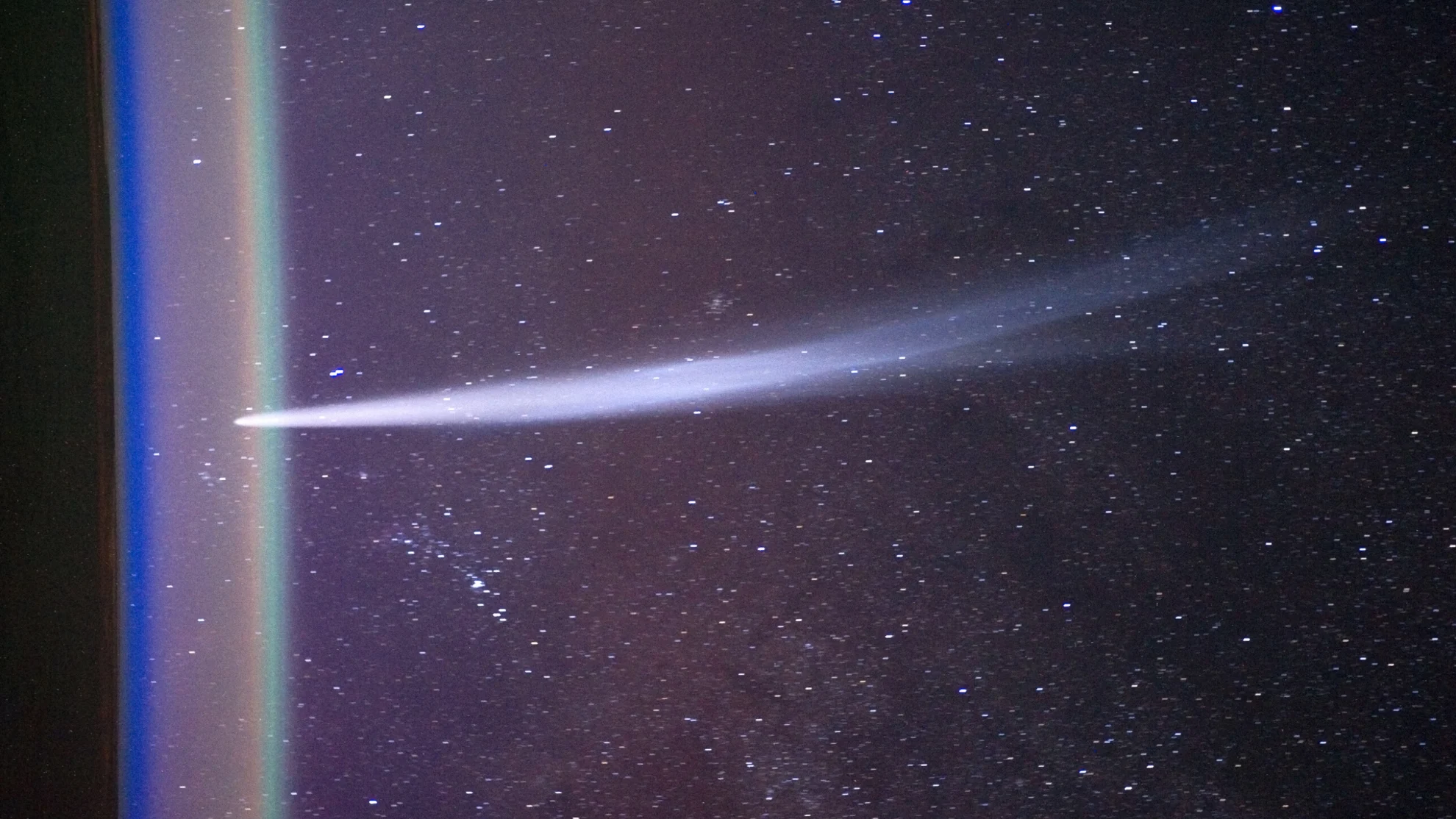
However, a few have become quite famous, even earning the name Great Comet, as they turn out to be some of the brightest we've ever seen from Earth. One example of this is Comet Lovejoy, from 2011.
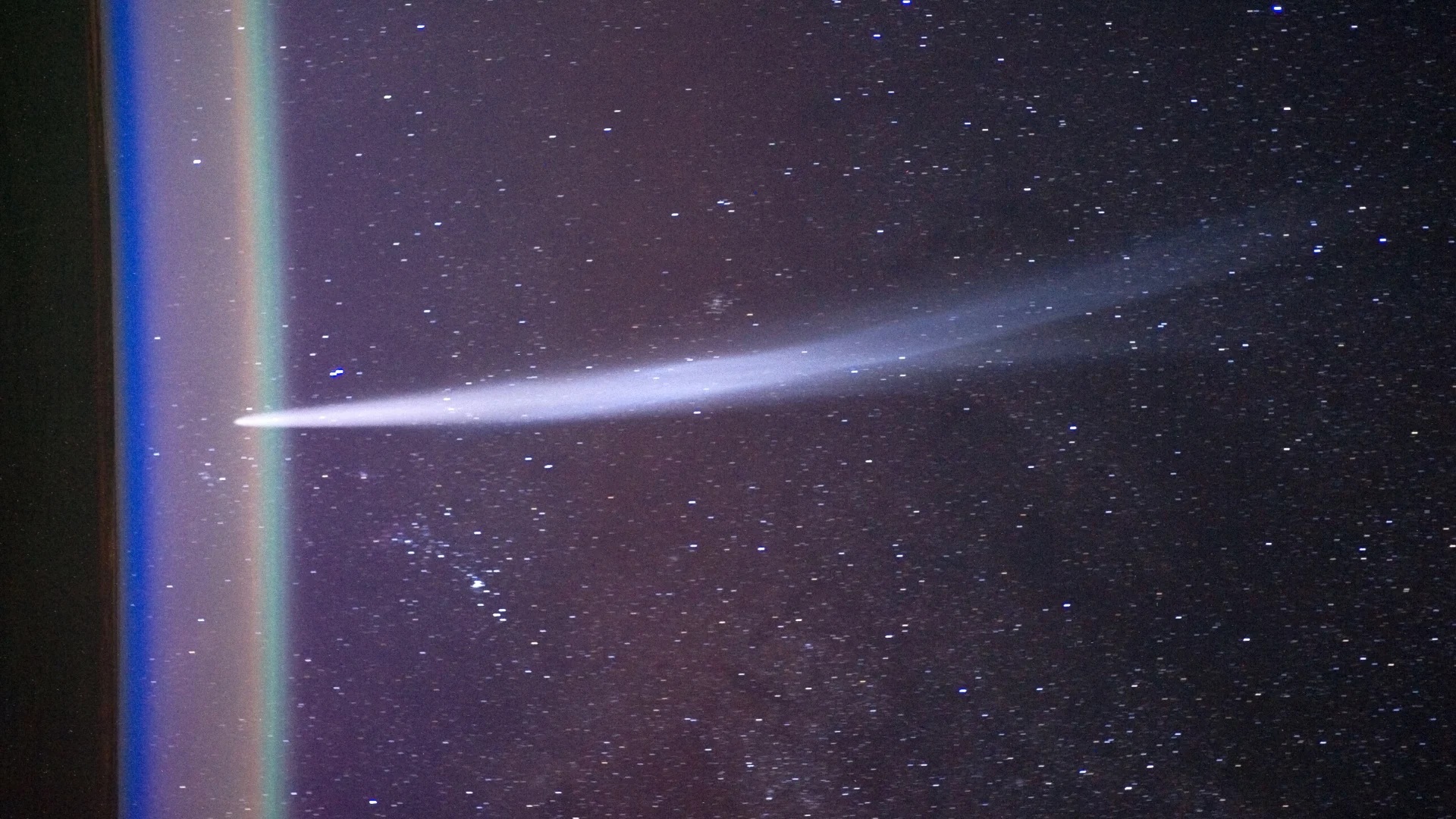
Comet Lovejoy, captured from the International Space Station on Dec. 22, 2011. (NASA/Dan Burbank)
Comets are notoriously unpredictable. Thus, there is no guarantee that C/2026 A1 (MAPS) will match the performance of Lovejoy, or any other Great Comet. However, there is some hope.
At the time of its discovery, the comet was over 300 million kilometres away from the Sun, or roughly twice the distance between the Earth and the Sun. That's a record-setting discovery distance, beating out 1965's Comet Ikeya–Seki, which is known as the brightest comet of the 20th century.
While our telescope and survey technology has improved since then, it does imply that C/2026 A1 (MAPS) is one of the larger Kreutz sungrazers. Thus, on April 4, as it skims the surface of the Sun at a distance of just 120,000 km, it may be big enough to survive.
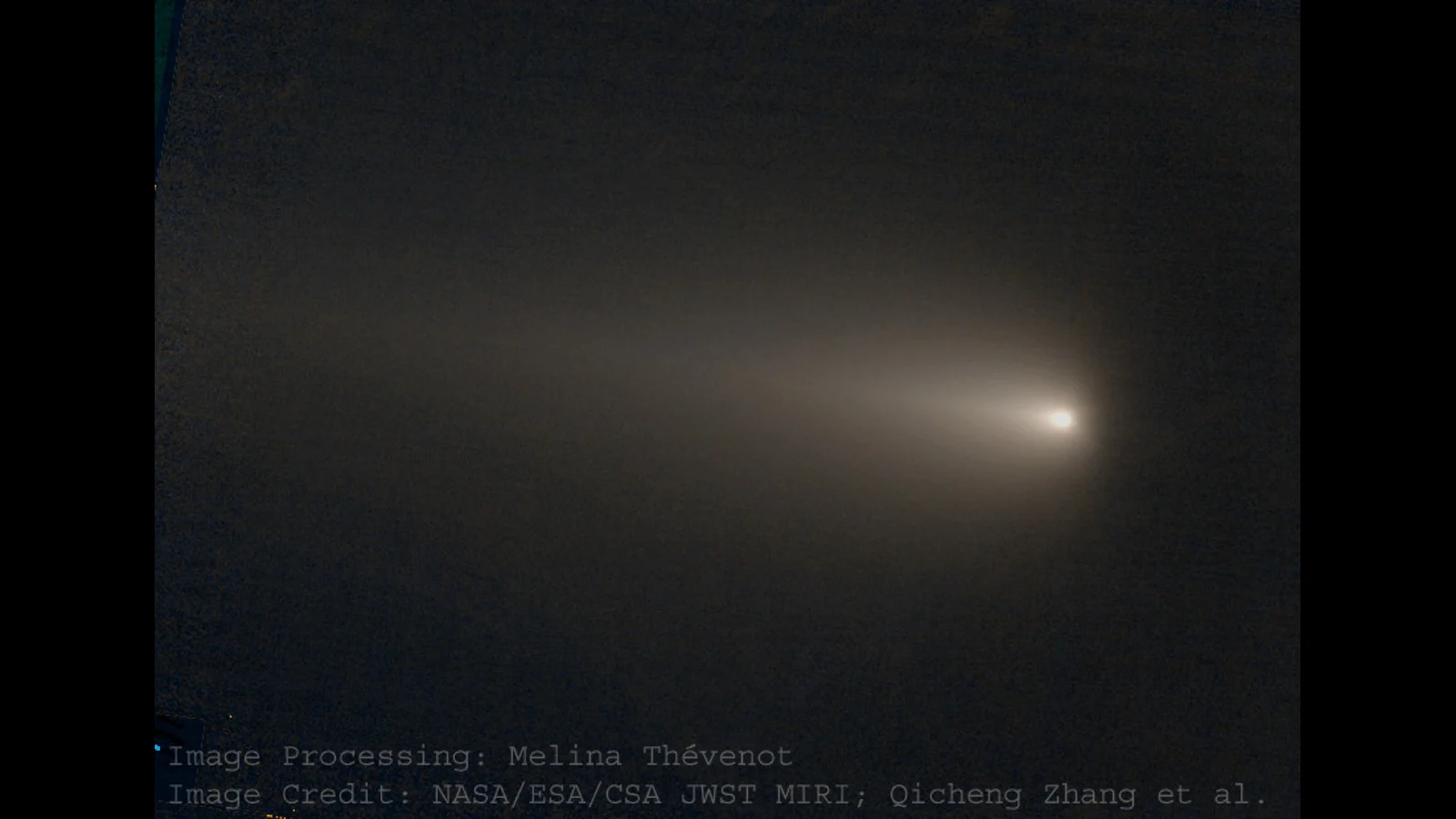
Comet C/2026 A1 (MAPS) imaged by the James Webb Space Telescope on February 7, 2026. (Image processed: Melina Thevenot, Image credit: NASA/ESA/CSA/Qicheng Zhang et al. (CC BY-SA 4.0))
According to Jonti Horner, a professor of astrophysics at the University of Southern Queensland, if it emerges intact on April 5, it could be a spectacular sight to see.
"If it holds together, it might get bright enough to be visible in broad daylight. Even if that doesn't happen, the SOHO spacecraft will provide great images of the comet," Horner wrote in an article on The Conversation.
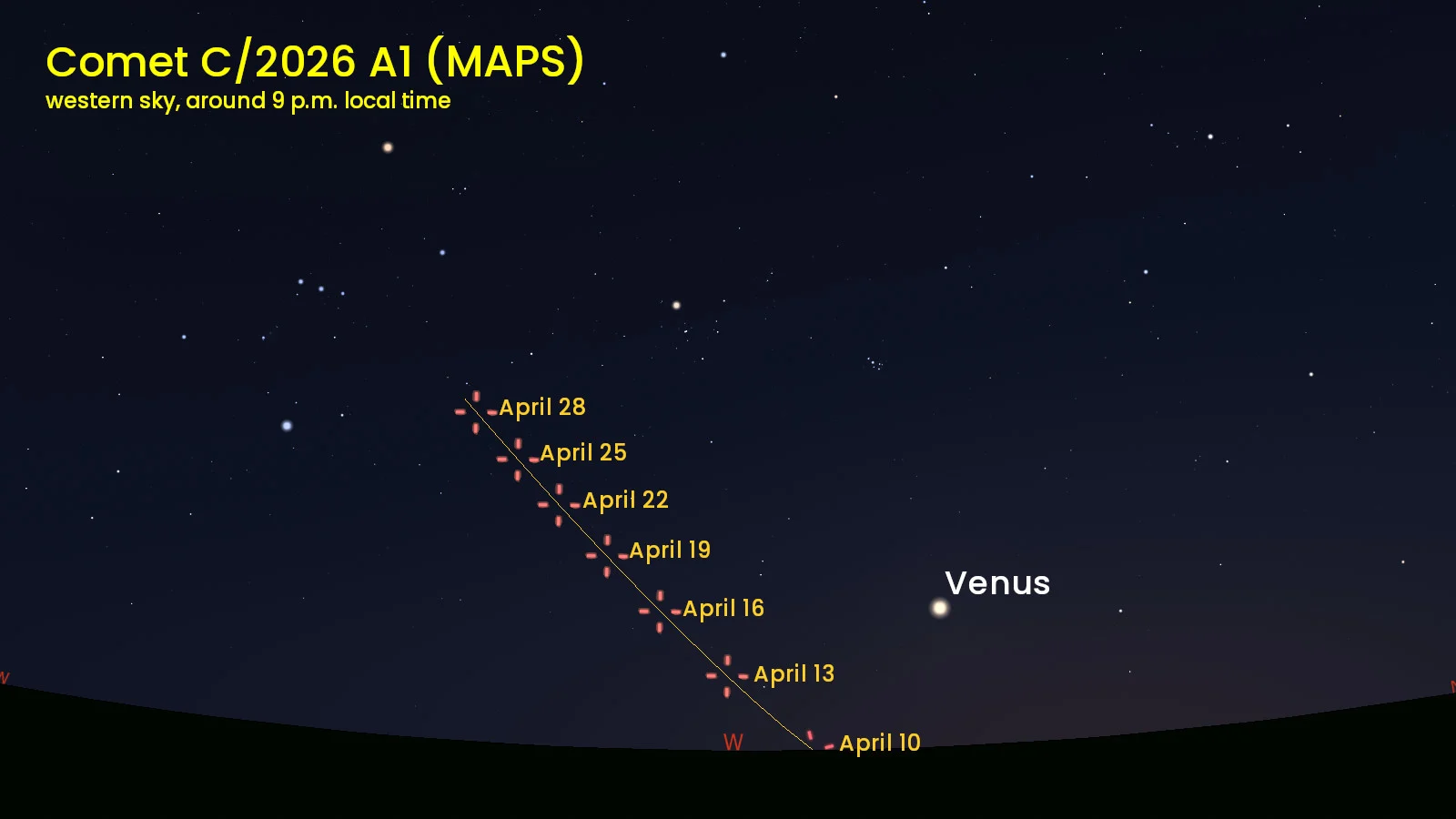
The expected location of comet C/2026 A1 (MAPS), along or above the western horizon, at 9 p.m. on April 10 to 28. Every third night is highlighted with a reticule, with the comet located along the orange line on the nights in between. (Stellarium/Scott Sutherland)
The above plot of C/2026 A1 (MAPS)'s location in the sky assumes that we will need to wait for a dark sky before we can see it. However, based on estimates from the Comet Observation database, it could be visible much earlier in the day, and observers with a telescope or binoculars might even spot it while the Sun is still in the sky.
Watch for updates on this after the season starts.
COSMIC FOMO: 5 astronomical events happening after we’re gone
Meteor showers
Scanning across the sky above on any clear night, there's a chance you could spot a meteor streak by overhead. Technically, these are known as sporadics, with each due to some random meteoroid being swept up by Earth's atmosphere as we travel around the Sun.
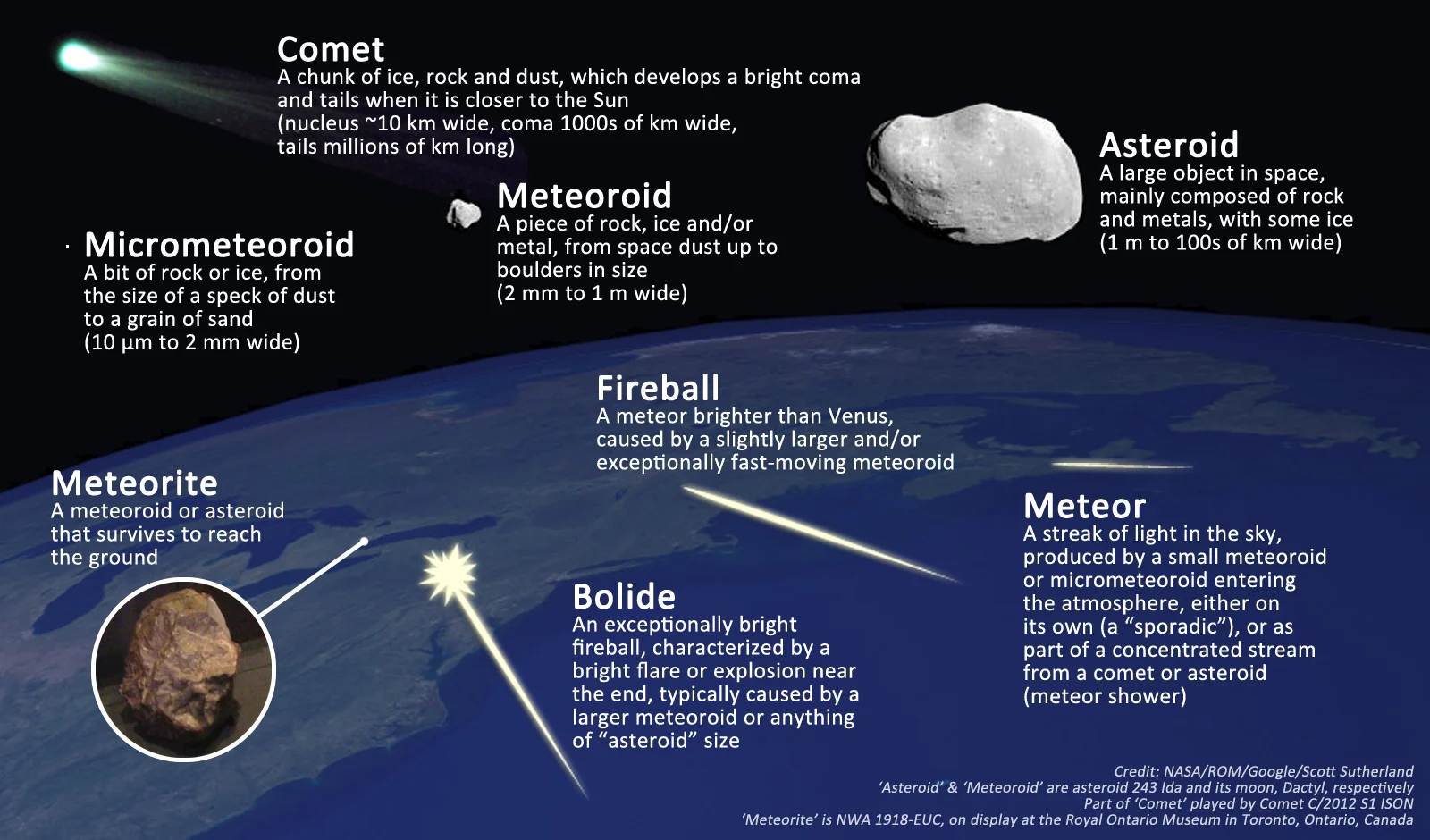
However, there are specific nights of the year when dozens or even hundreds of meteors flash by overhead. These are known as meteor showers, and they occur as our planet passes through concentrated streams of meteoroids left behind by either an asteroid or a comet.
There are over three dozen known meteor showers that occur in our skies each year. Most are barely noticeable compared to the typical rate of random sporadics. However, just over a dozen get special attention, with two of those occurring in springtime.
The first is the Lyrids, which peak in late April, while the second, the eta Aquariids, peak in early May.
The Lyrid Meteor Shower
The Lyrid meteor shower begins around April 14 and lasts until April 30, as Earth crosses the stream of debris left behind by a long-period comet known as C/1861 G1 Thatcher.
This year, we are expected to encounter the densest part of Comet Thatcher's debris stream on the night of April 22-23. That will mark the peak of the Lyrids, which typically delivers up to 20 meteors per hour throughout the night.
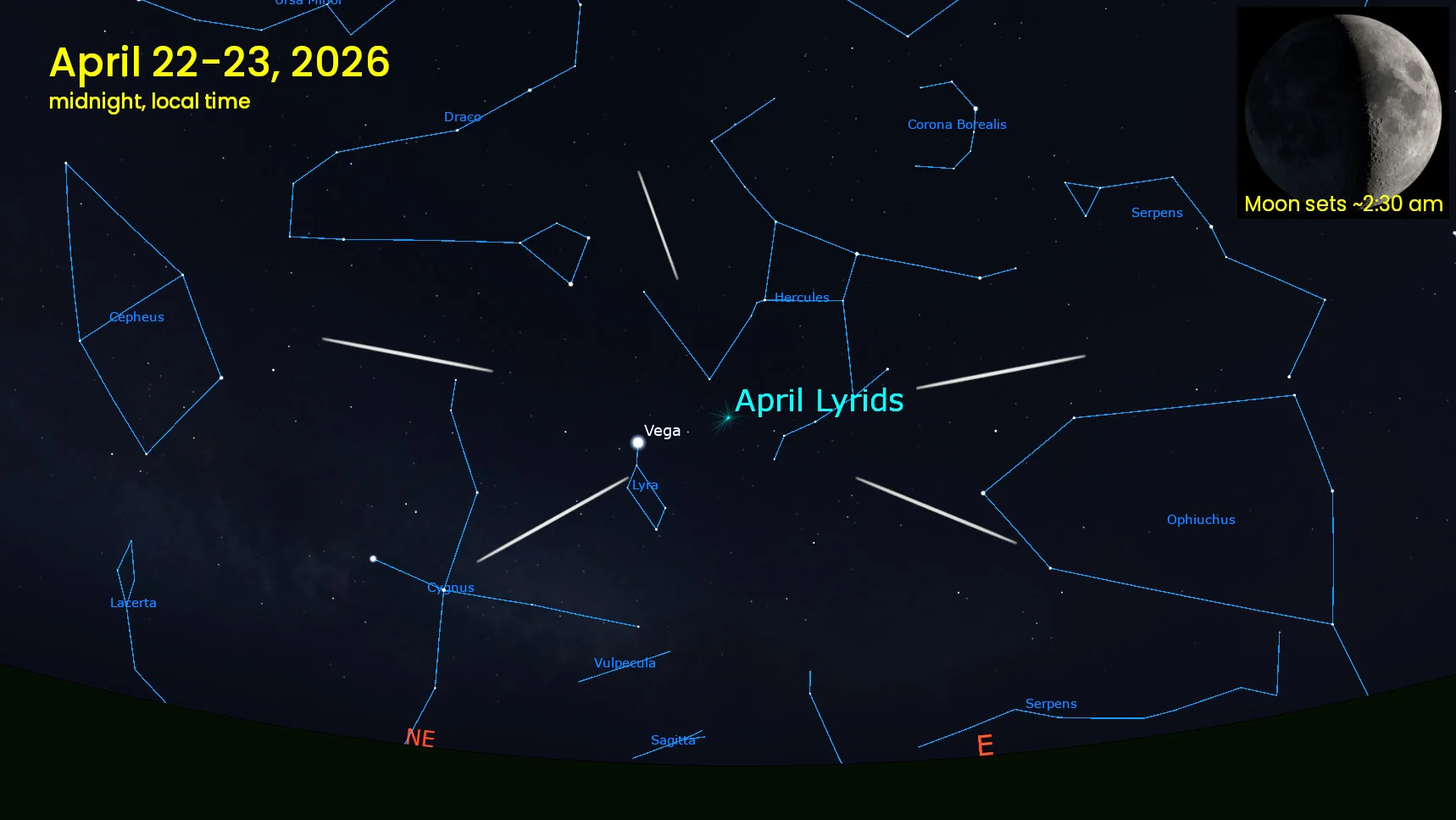
The radiant of the Lyrid meteor shower in the eastern sky on the night of April 22-23. A Waxing Crescent Moon will be in the western sky that night (inset, top right). (Stellarium/Scott Sutherland)
With the timing of the lunar cycle in 2026, the peak of the Lyrids will occur with a Waxing Crescent Moon in the sky. It will be off to the west as the meteor shower radiant rises late on the 22nd, and will set around 2:30 a.m., local time. Thus, it shouldn't add any significant light pollution to the sky, giving a good chance at spotting meteors.
Additionally, with the meteoroids from Comet Thatcher hitting the top of the atmosphere at speeds of around 100,000 km/h, any of them larger than a grain of dust will tend to produce a bright fireball flashing across the sky!
The eta Aquariid Meteor Shower
Beginning around April 19, and continuing through May 28, Earth will enter a second stream of debris — this one from 1P/Halley, one the most famous comets in the world. This results in the eta Aquariid meteor shower, which reaches its peak early in the morning on May 6.
Due to the shape and angle of Halley's orbit around the Sun, this is actually the first of two passes our planet makes through the comet's debris stream. The second takes place in October, producing the Orionid meteor shower.
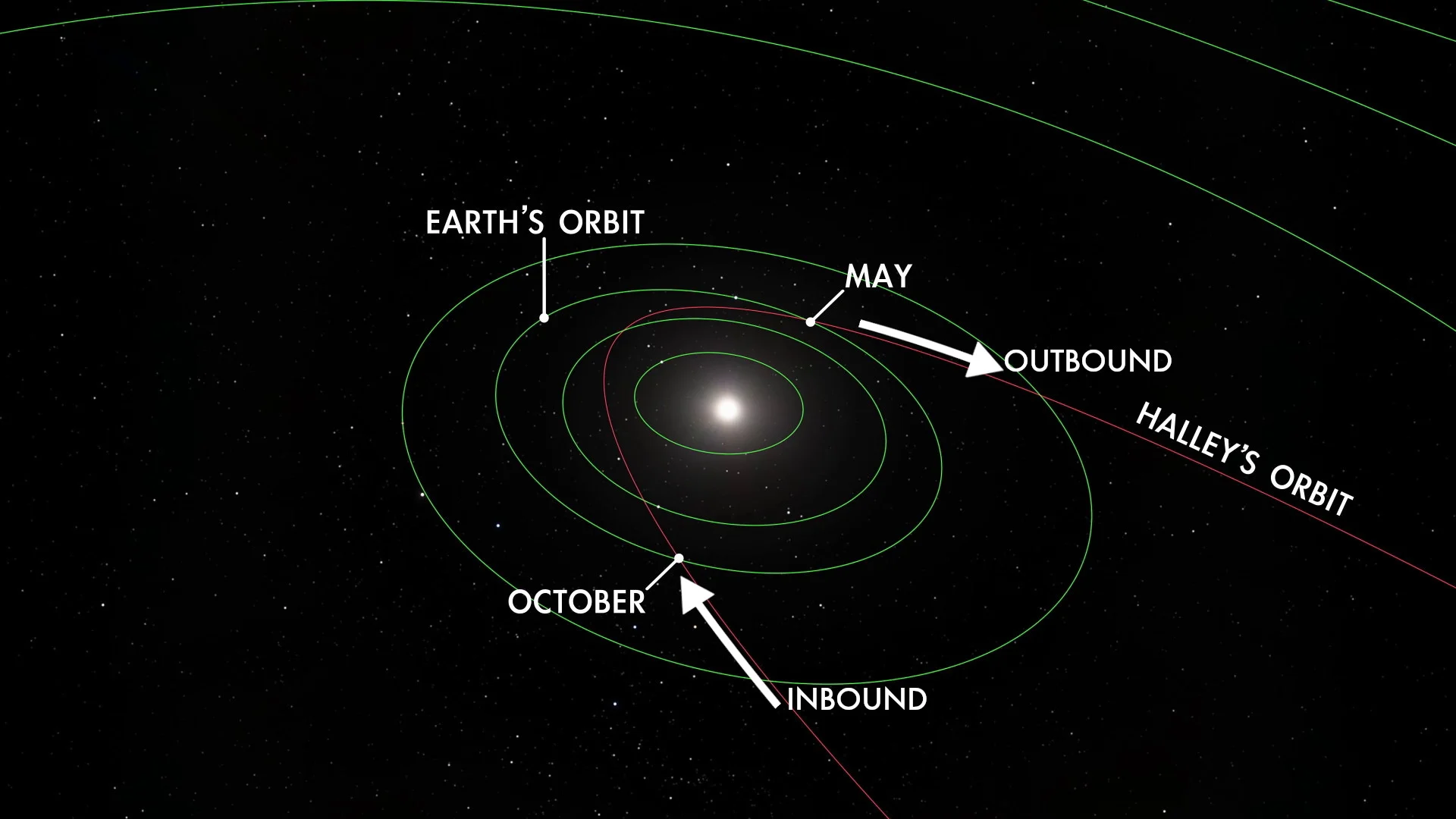
Comet Halley's path through the inner solar system reveals how we see two meteor showers from just one comet, with the 'outbound' part of the stream causing the eta Aquariids in April and May, and the 'inbound' part resulting in the Orionids in October. (NASA/JPL)
Meteors from the eta Aquariids appear to originate from the constellation Aquarius. Since Earth is passing through the 'outbound' part of Halley's debris stream at this time, we only see these meteors show up for a few hours just before dawn.
The best time to see the eta Aquariids is during the May 6 peak. The meteor shower's radiant will rise in the east just after 3 a.m. local time. Given that the meteors are streaking through the atmosphere very high up in the atmosphere, though, they will start to become visible at least half an hour before the radiant crests the horizon.
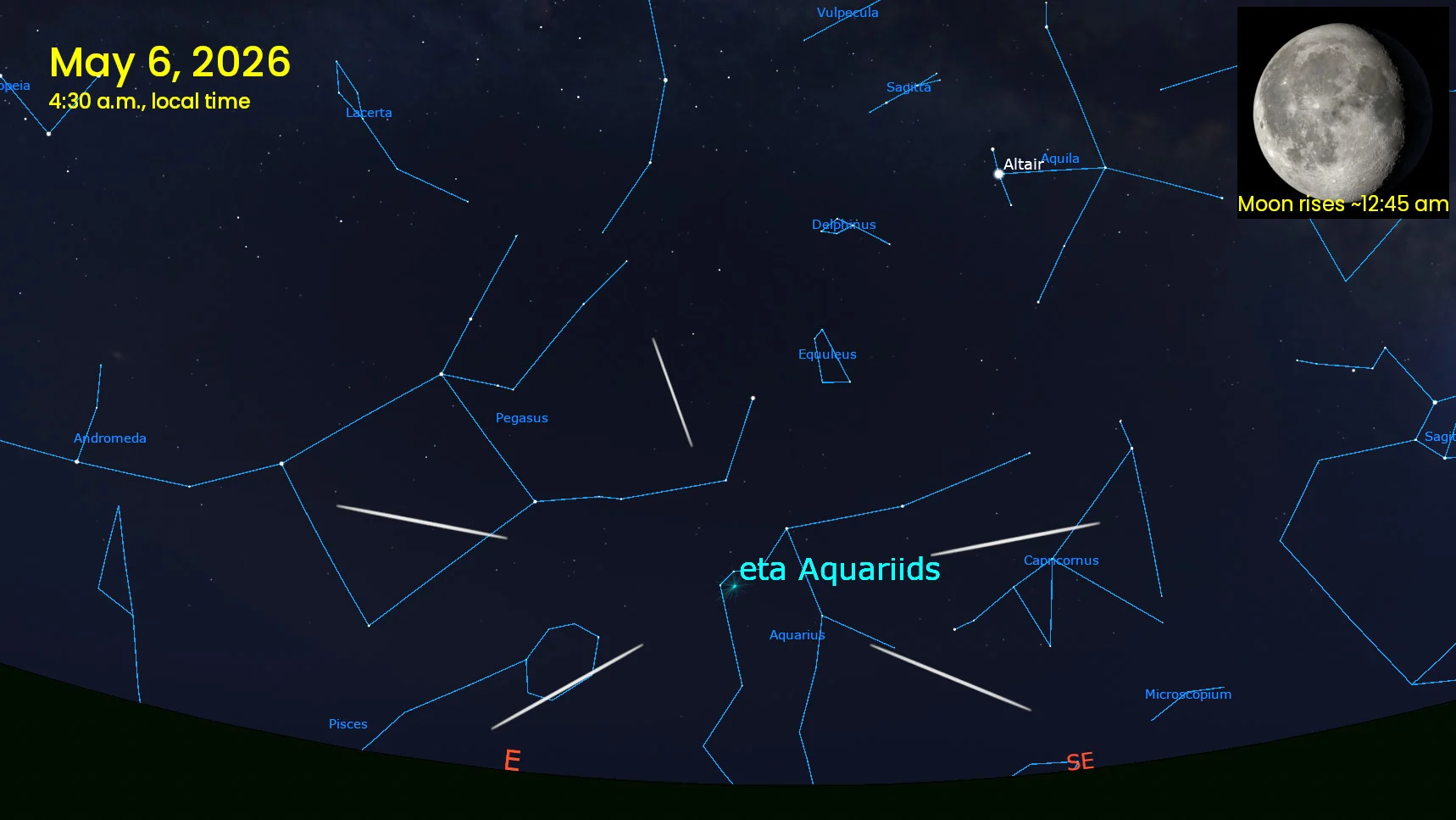
The radiant of the eta Aquariid meteor shower in the predawn hours of May 6, 2026. Credit: Stellarium/Scott Sutherland
The phase of the Moon will not be the most favourable that morning, as a Waning Gibbous Moon will rise just after midnight and be up in the sky until well past dawn. It will have moved off into the southern sky by the time the meteor shower starts, though. Thus, it shouldn't spoil the show too much, as long as observers keep it out of their direct field of view.
The eta Aquariids typically produce around 50 meteors per hour on the night of the peak. Simply because we cannot focus on the entire sky at the same time, the average observer tends to spot about half that number under ideal conditions (clear, dark skies).
Unlike the Lyrids, this meteor shower isn't known for its fireballs. They do, however, produce an even more fascinating phenomenon, known as persistent trains.
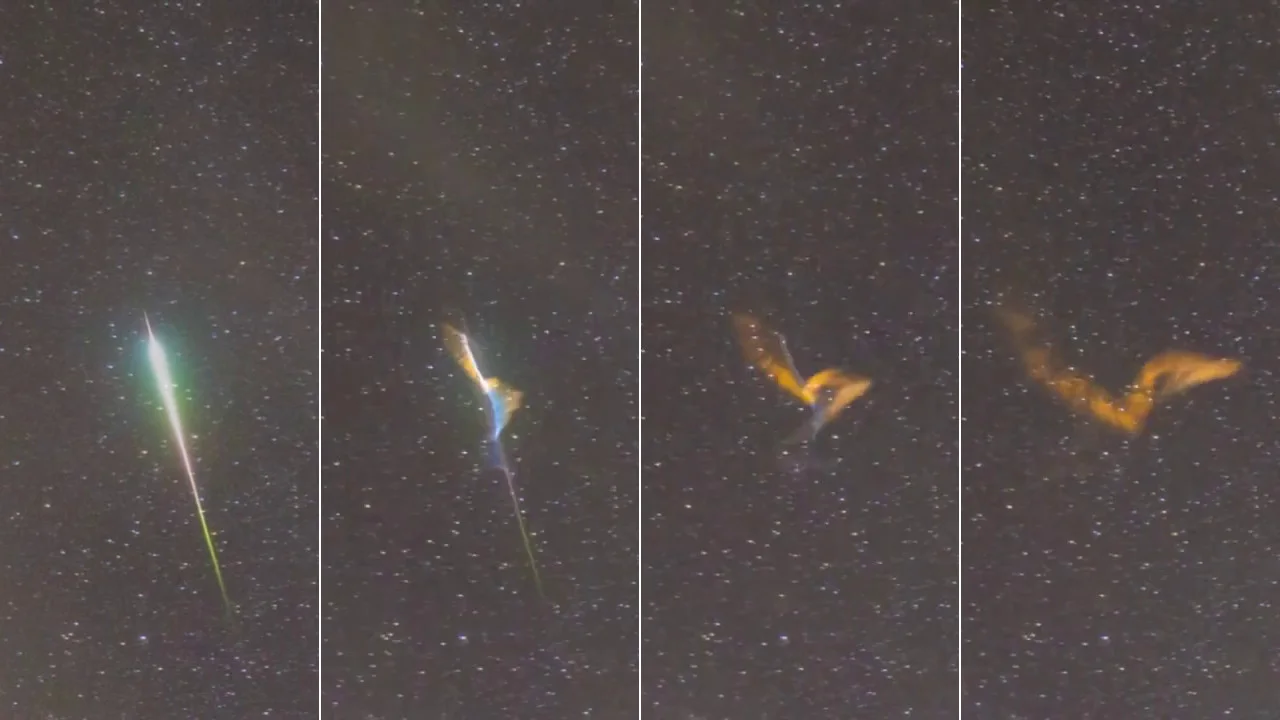
Four frames taken from a persistent train video, shot on October 21, 2022, show the initial Orionid meteor flash, and three views of the persistent train that developed in its wake. Credit: Brenda Tate/Tim Doucette/UGC
A persistent train is a glowing trail left behind in the wake of a meteor, caused by how the meteoroid interacts with the air molecules along its path. They have been seen to last anywhere from minutes to even hours after the meteor flash has gone out.
READ MORE: How to get the most out of meteor showers and other night sky events
Solstice
On June 21, the Sun will reach its highest point in our sky for the year, marking the exact moment of the summer solstice, and ushering in astronomical summer for Canada and the rest of the northern hemisphere.
The exact timing of the summer solstice is:
5:54 a.m. NDT,
5:24 a.m. ADT,
4:24 a.m. EDT,
3:24 a.m. CDT,
2:24 a.m. MDT/CST, and
1:24 a.m. PDT.
Due to the timing of this solstice, both June 20 and June 21 will be tied for longest day of the year for anyone from Quebec through British Columbia. In New Brunswick, PEI, Nova Scotia, and Newfoundland, June 21 will be the longest day, beating June 20 by just a single second.