Frigid -16C or muggy 28C? Super Bowl weather through history

Holding the mammoth championship game in the middle of winter poses a unique set of challenges for the competing teams
The Super Bowl is one of the world’s biggest events, packing stadiums with tens of thousands of roaring fans while millions more watch and party from home.
Weather is an underrated player in these championship games. How do you protect 73,000 people from temperatures in the minus double digits? And how is it that the coldest Super Bowl on record unfolded on the Gulf Coast?
DON’T MISS: The Great Lakes freezing over is good news for Ontario
The Super Bowl started in 1967
The National Football League (NFL) started its iconic championship game on Jan. 15, 1967. Thermometers reached a toasty 22.2°C that evening at the Los Angeles Coliseum when the Green Bay Packers powered to win the inaugural title over the Kansas City Chiefs.
This weekend will see Super Bowl LX unfold in Santa Clara, California as the Seattle Seahawks and New England Patriots face off to earn the coveted rings.

A persistent ridge of high pressure over western North America heading into this weekend will keep the weather nice and calm across the Bay Area on the big day.
Holding a mammoth event in the middle of the winter is a risky gamble. The NFL usually gets around that pesky seasonal worry by holding the Super Bowl in warm southern cities—or in northern cities that have indoor stadiums.
California hosted the warmest Super Bowl
Given the weather this time of year, it’s no wonder that 42 of the 60 championship games have been played in Florida (17), California (14), or Louisiana (11).
The warmest big game on record was Super Bowl VII on Jan. 14, 1973, which saw the Miami Dolphins score a decisive victory over the team from Washington, D.C.
Temperatures at kickoff that mid-January day reflected sunny southern California’s climate, coming in at a cozy 28.8°C according to the Pro Football Hall of Fame.
Louisiana and Minnesota held the coldest games
Out of all the northern cities in which they’ve held the Super Bowl—including Minneapolis, Indianapolis, and just outside New York City—it turns out that this year’s host city once hosted the coldest outdoor title game.
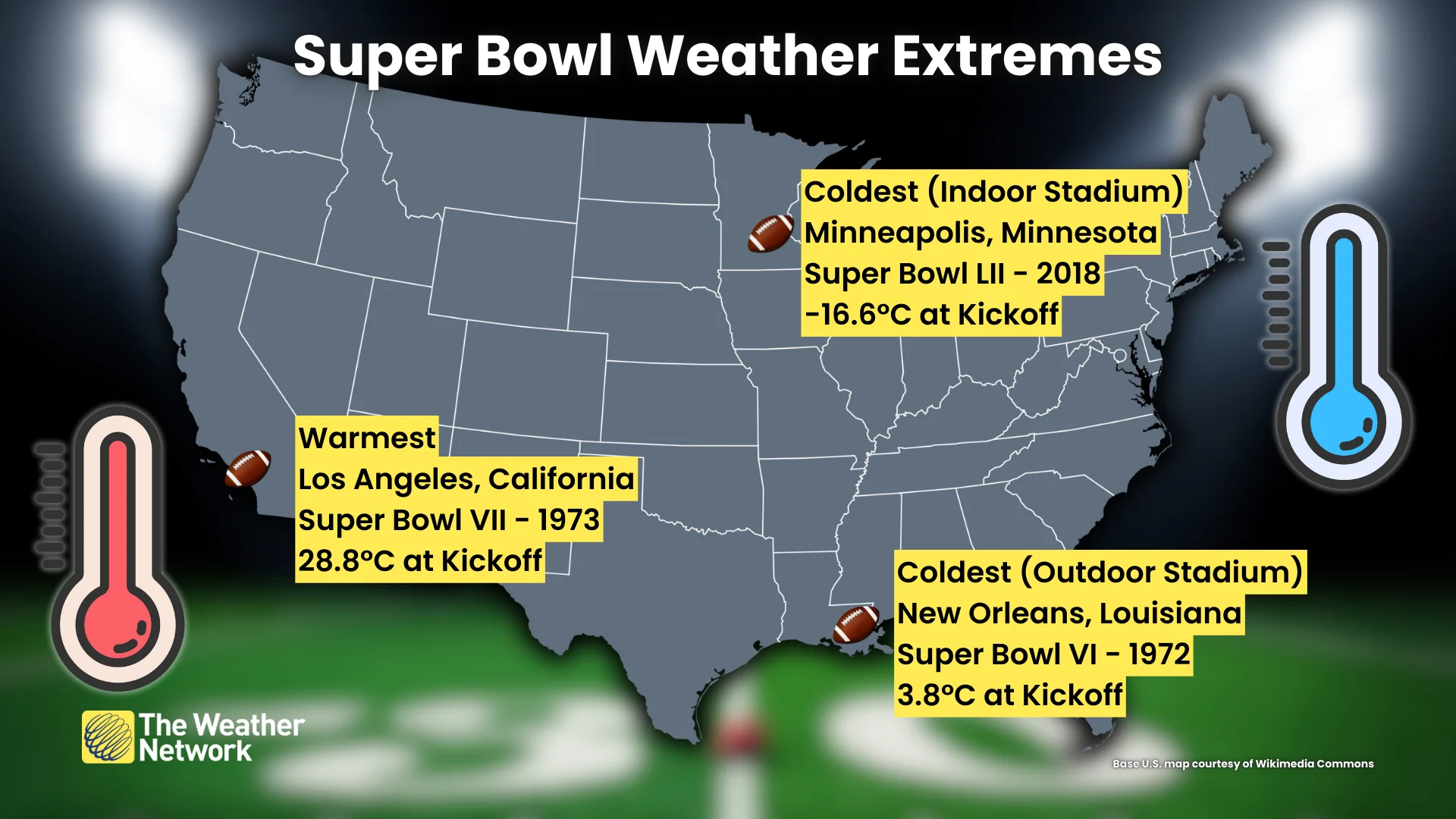
Super Bowl VI unfolded on Jan. 16, 1972 at New Orleans’ old Tulane Stadium, an open-air arena that exposed visitors and players alike to the elements.
RELATED: From blizzards to bats: 6 games played in ridiculous weather
A cold snap gripping the U.S. that day sent morning temperatures plunging to -26°C in Chicago and -11°C in Atlanta, with subfreezing readings all the way to the Gulf Coast. Kickoff in New Orleans that evening saw temperatures dip to 3.8°C, making for the coldest outdoor game in history.
It’s been even colder on Super Bowl Sunday. Fans shivered on their way to watch Super Bowl LII in Minneapolis, Minn., on Feb. 4, 2018. Conditions inside U.S. Bank Stadium came in at a comfortable 21.1°C despite readings outside the stadium falling to -16.6°C by kickoff.
Santa Clara is in California’s Bay Area
Founded by Spanish missionaries in the 1700s, Santa Clara is a suburb of San Jose that sits about 60 kilometres southeast of downtown San Francisco.

The city and its 120,000 residents enjoy a temperate climate throughout the year, with seasons characterized more by rainfall than big temperature differences.
The Bay Area’s rainy season begins in the late fall and runs through early spring, with the region averaging precious little precipitation during the summer months.
Nearby San Jose Airport averages 342 mm of rain per year, which is exactly equal to Calgary’s annual average rainfall. San Francisco’s wettest season on record saw 1005.3 mm of rain fall between October 1997 and September 1998.
Header image created using graphics and imagery from Canva.