Rapidly strengthening winter storm takes aim at Ontario to end 2025

Another, stronger storm is taking aim at the province as we close out 2025. This is likely to be a high-impact event, so be sure to keep a close eye on your local weather alerts and check back frequently for forecast updates.
Hot on the heels of Ontario's Boxing Day storm, the atmosphere is primed to deliver another storm in the form of a Colorado low as a deep trough shifts southeast, out of the Pacific Northwest, and merges with the same moisture-packed subtropical jet stream that brought deadly floods to California over the past week.
To add to the setup, the polar jet stream, which brought record-setting cold to Canada's North, will collide with the intense moisture to the south, resulting in a rapidly strengthening storm that will pack a dangerous mess to much of Ontario.
SEE ALSO: The polar vortex is on the move! Canada's winter forecast update
The system will approach the Great Lakes on Sunday, possibly reaching 'weather bomb' criteria as the centre of the low rapidly decreases in atmospheric pressure. Warm, moist air sitting above the cold surface air will start the event off with periods of freezing rain across southern Ontario through the day Sunday.
By Sunday night, we'll see the major storm impact Ontarians in multiple different, yet hazardous, ways.
Prolonged freezing rain threatens the east
Eastern Ontario, including Ottawa, will be eyeing up an ice storm event as the cold air is forecast to hold its ground over the region. Up to 10 hours of freezing rain is possible, bringing 5-15 mm of ice accretion to the region.
Manitoulin Island and areas east of Georgian Bay are also likely to experience the prolonged freezing rain.

In addition to the slippery conditions this will create, winds are also forecast to pick up, which increases the risk of power outages as the ice builds up on trees and power lines.
Blizzard risk builds in the northeast
Strong north-northeast winds over northeastern Ontario, as well as heavy snow, are forecast to bring whiteout conditions across the region into Monday morning. Areas east of Lake Superior are also at risk of seeing blizzard conditions, making highway travel downright dangerous, especially around Wawa, Chapleau, and Timmins.
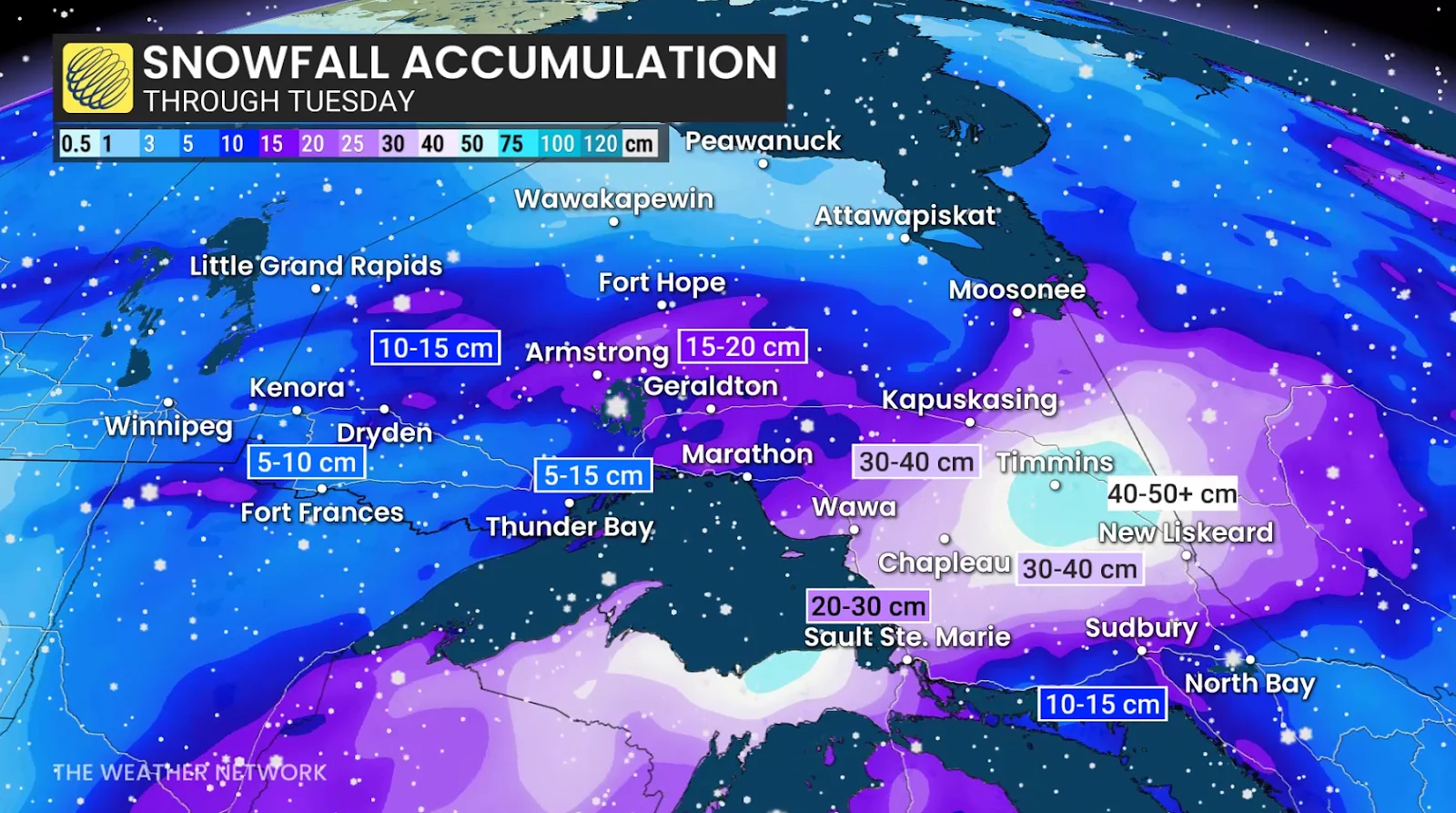
Areas hardest hit by the heavy snow could see up to 40 cm by the time the storm passes. There is the potential for 50+ cm of snowfall around the Timmins area. Folks should expect some road and highway closures.
DON'T MISS: Your winter storm preparation checklist
Those near and south of Sault Ste. Marie are forecast to see more of a wintry mix, with ice pellets and freezing rain adding to the hazardous snow and winds.

Heavy rains threaten flooding in southern Ontario
Warmer temperatures over southern Ontario paired with the high atmospheric moisture should bring heavy late-December rains to the region late Sunday.
While monthly rainfall averages across the south in December stay around 40-50 mm, we could see 50+ mm of rain locally north of Lake Erie, including the Grand River watershed, in a 12-hour period.

However, due to recent cold temperatures, the ground across much of the region is frozen, which will significantly limit the amount of rainfall absorbed into the ground and increase the the risk of flooding.
Along the Humber River watershed, we're looking at the threat of ice jams due to repeated freeze-thaw cycles, increasing the risk of damaging floods.

Damaging winds, flash freeze risk builds Monday and Tuesday
After Sunday night's rainfall across southern Ontario, we will see a rush of cold air move into the region on Monday. Communities in and around Hamilton and Niagara could see temperatures drop by as much as 10°C in just one to two hours.
This is a red flag signalling the risk of a flash freeze as the ponding water on the ground and roads suddenly freezes up and forms a layer of slick ice.
RELATED: Winter storm aftermath: How to prevent ice dams and roof leaks
As the low lifts over Georgian Bay on Monday, we'll also see winds begin to pick up to damaging levels along the Great Lake shorelines.

Winds are forecast to blow southwest over Lake Erie, gusting between 90-110 km/h. The Niagara region will bear the brunt of this wind before it shifts to the northwest later in the day.
By late Monday, we'll see the winds gusting northwest off of Lake Huron and Georgian Bay, with peak gusts between 70-110 km/h.
The damaging winds will also persist on Lakes Erie and Ontario, as well as throughout Prince Edward County, despite the shift in direction.
Folks should be prepared for some power outages with these winds, as they could knock down tree limbs and damage power lines.
Waves could reach up to 5 metres on the lakes as well, with 6-8 metre waves possible on southern Lake Superior. Folks along the shores should keep an eye out for sudden ice shoves.
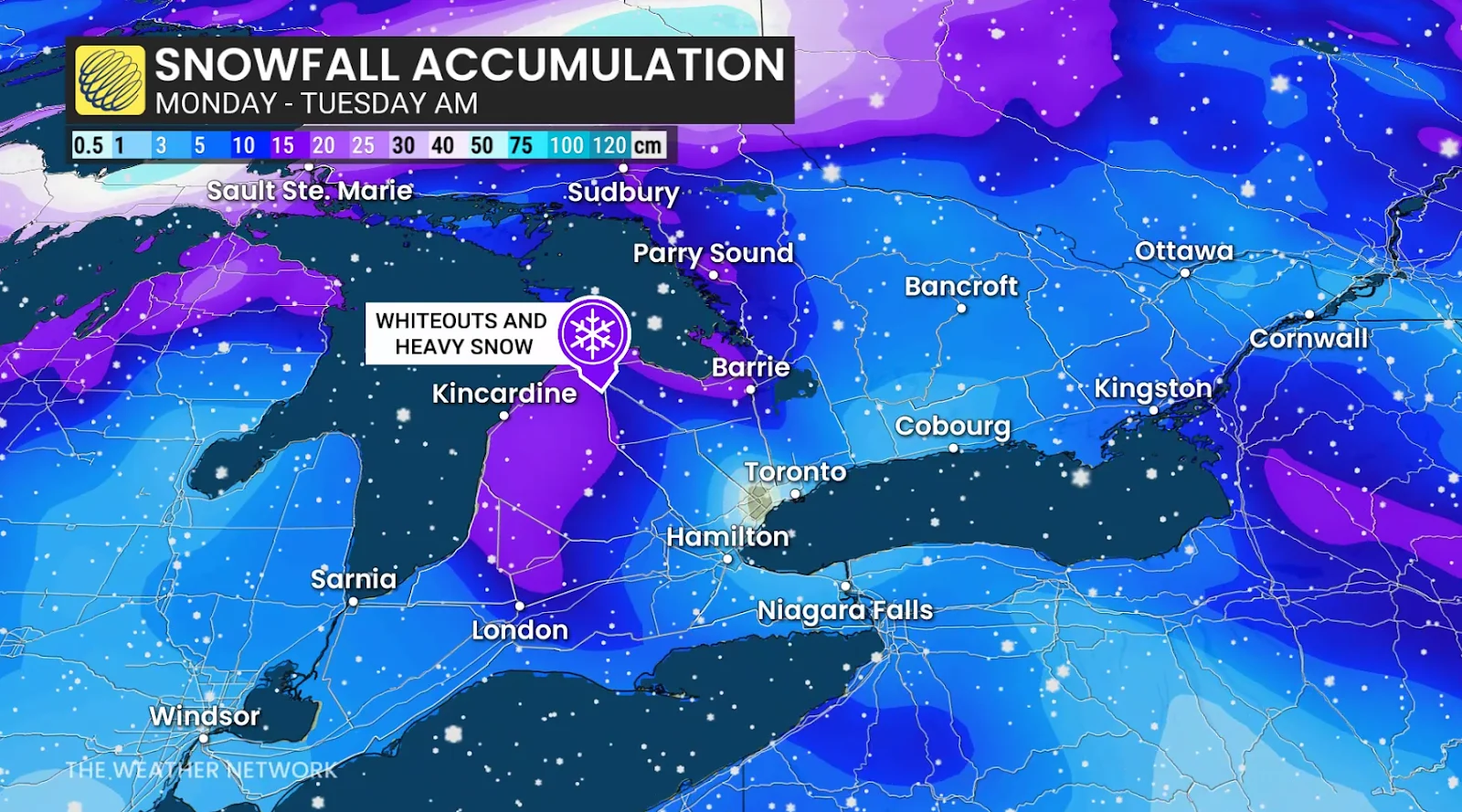
The winds will continue through the night and into Tuesday. As temperatures continue to drop across southern Ontario overnight, lake-effect snow squalls could create whiteout conditions throughout the snowbelt regions.
As the gusty winds linger through Tuesday, we could see blowing snow continue to bring hazardous conditions for folks travelling to celebrate the New Year.
Stay with The Weather Network for more information and updates on this developing storm in Ontario.