
Another day of school closures as heavy snow hits Atlantic Canada

Travel will remain difficult in parts of Atlantic Canada on Thursday as snow continues to push across, with a further 10-20 cm possible for some areas
An abundance of cold air has been pouring across the Atlantic Ocean thanks to Arctic air from the North Pole. This acts like storm fuel, enhancing the development of low pressure systems south of Atlantic Canada.
As a result, a potent low brought a swath of heavy snow to parts of the Maritimes on Wednesday, and will continue into Thursday for Newfoundland. Some areas could see an additional 10-20 cm of snow, with another day of school closures reported amid the deteriorating conditions.
RELATED: Plane slides off tarmac after landing in heavy snow at Halifax airport
Roads and walkways will likely be difficult to navigate due to accumulating snow. There may be a significant impact on rush-hour traffic. Local utility outages are possible, as well.
Snow spreads into Newfoundland Thursday, schools close another day in Nova Scotia
Light snow will stick around for eastern parts of the Maritimes through the first half of Thursday. The system passed south of Nova Scotia Wednesday into Thursday, leaving up to 25 cm of snow in some areas. Schools across the province remained closed Thursday as crews worked to clear the heavy snowfall.
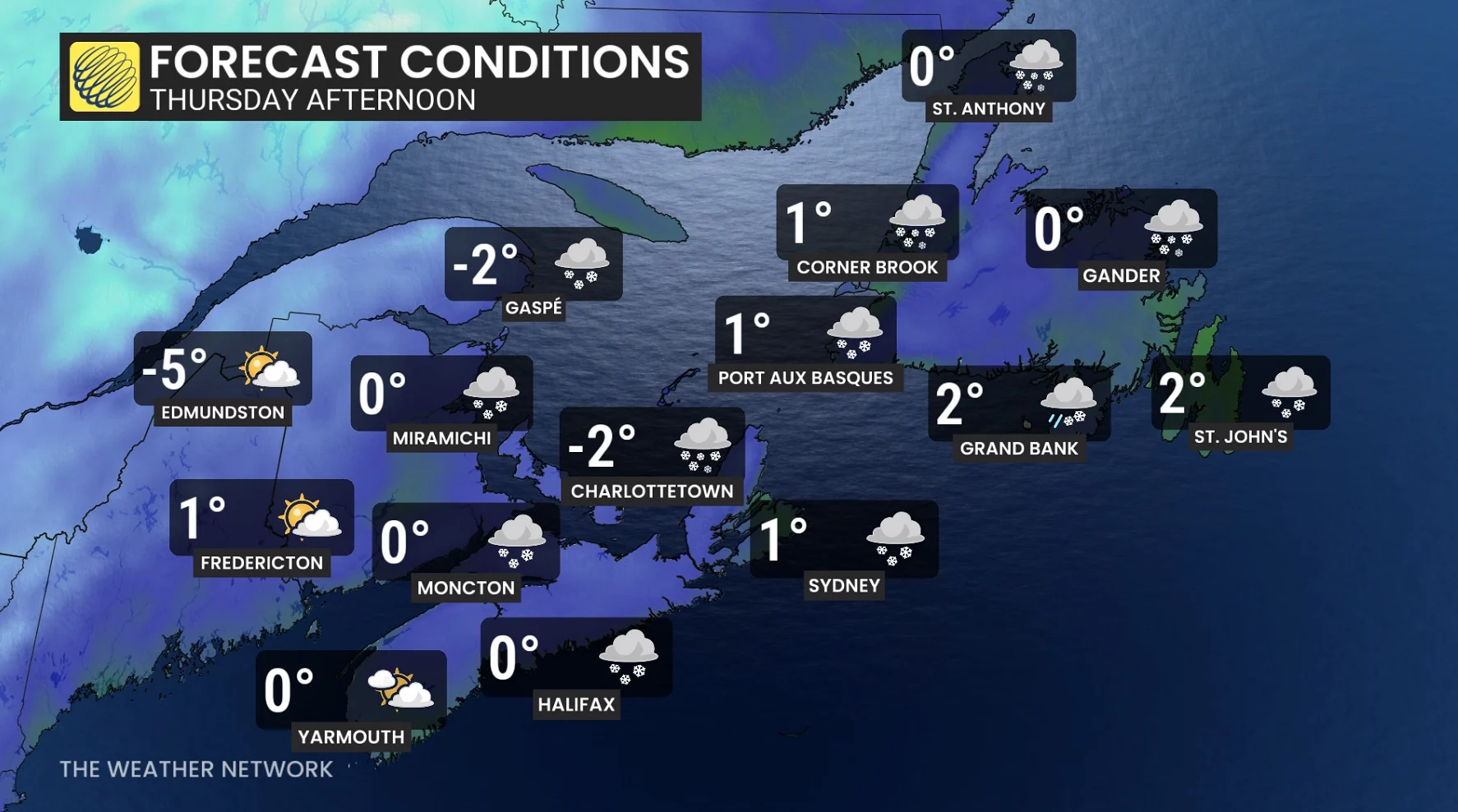
Snow will spread across Newfoundland during the day, with the chance for some wet mixing for southern and eastern parts of the island, limiting snowfall totals.
Winds are not forecast to be especially strong, but coastal communities with fresh snow may experience some blowing and drifting snow. Wind gusts of 50-70 km/h are expected, especially to Atlantic coastal regions and through the Gulf of St. Lawrence.
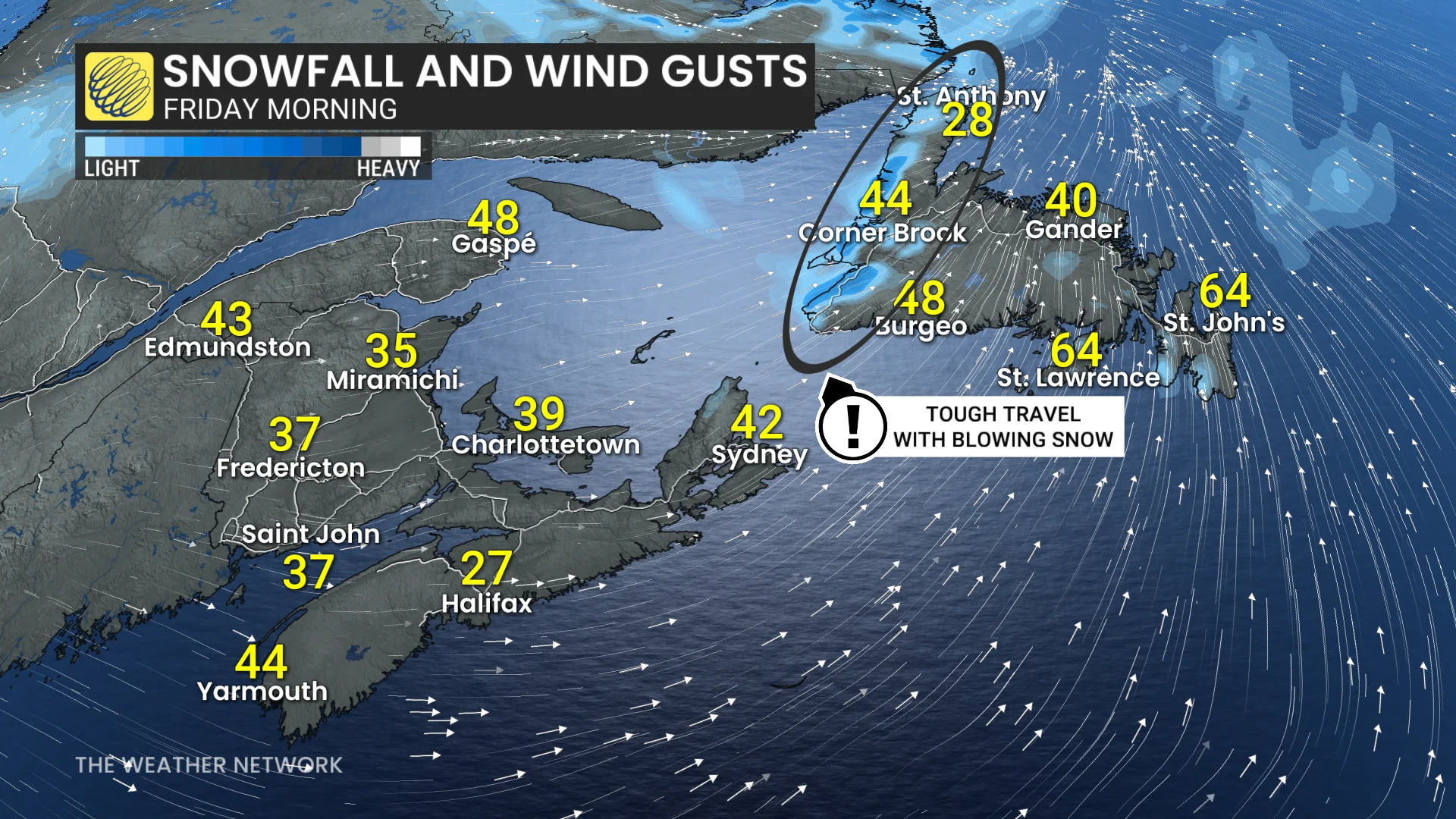
Sea-effect snow is expected to taper off by Friday morning along the Gulf shores of the Maritimes, while persisting in western Newfoundland.
DON'T MISS: -50ºC reading returns to Canada; here's where
Most areas in Newfoundland can anticipate 5-10 cm of snow from the system through Thursday. However, the western highlands, including sea-effect snow, may see accumulations of up to 25 cm by Friday.

Beyond, we are closely watching the track of a Texas low, but it appears that the storm track will stay well south of the region with minimal impact.
However, a more active pattern is expected for the second half of next week and into the following week with a couple of significant and messy systems. Temperatures are expected to be changeable with the more active pattern, but overall, they will be near or above seasonal.
WATCH: Check out the deepest low on Earth this week
Stay with The Weather Network for all the latest East Coast forecast updates.