
NASA rover hears tiny crackles of thunder and lightning on Mars

Listen as a dust devil sweeps past the Perseverance rover, producing tiny pops of thunder as it generates sparks of static electricity in the dry Martian air.
A microphone on the 'head' of NASA's Perseverance rover has recorded the sounds of dust devils whirling by, but it also picked up a surprise — distinct snaps and pops indicating that tiny sparks of lightning were discharging from the dusty vortices as they passed.
Here on Earth, there is an average of 100 lightning discharges every second around the world. These are most commonly produced by thunderstorms, and are the result of a charge buildup in the clouds due to ice crystals and snow pellets brushing past each other as they flow along the updrafts and downdrafts of these storms.
The exact same effect can occur in dust storms, though, due to friction between the tiny dust particles swirling around in the air. This is known as the triboelectric effect.
Given how dusty Mars is, and how frequently the planet experiences dust storms and dust devils, scientists figured that this must be going on all the time there.
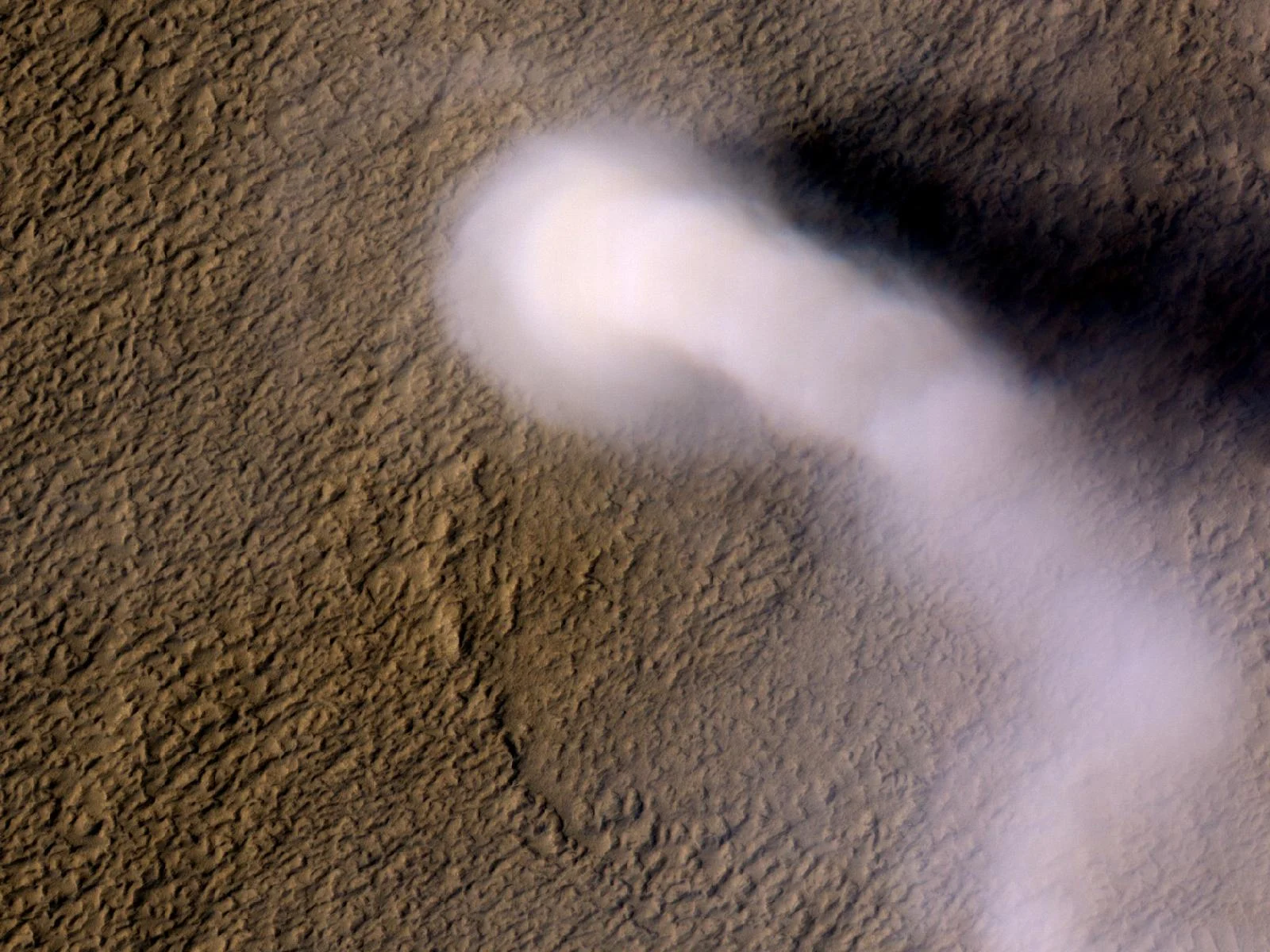
This 20-km-high dust devil was spotted swirling across the Martian surface by NASA's Mars Reconnaissance Orbiter on March 14, 2012. (NASA/JPL-Caltech/UA)
"Triboelectric charging of sand and snow particles is well documented on Earth, particularly in desert regions, but it rarely results in actual electrical discharges. On Mars, the thin atmosphere makes the phenomenon far more likely, as the amount of charge required to generate sparks is much lower than what is required in Earth’s near-surface atmosphere," Baptiste Chide, a Perseverance science team member at L'Institut de Recherche en Astrophysique et Planétologie in France, said in a NASA press release.
Up until now, the idea of electrical activity in the atmosphere of Mars was purely hypothetical, as there was really no way of knowing for sure if these tiny sparks of lightning actually occurred. Even though rovers and landers have imaged dust devils and dust storms, these discharges are extremely fast and very tiny.
According to NASA, they would be on the scale of the spark generated between your hand and a metal doorknob after walking across the carpet in socks. Thus it would be very unlikely for them to be picked up in imagery.
However, besides its numerous cameras, Perseverance also has a microphone, which is installed as part of the SuperCam instrument, located on the rover's head.
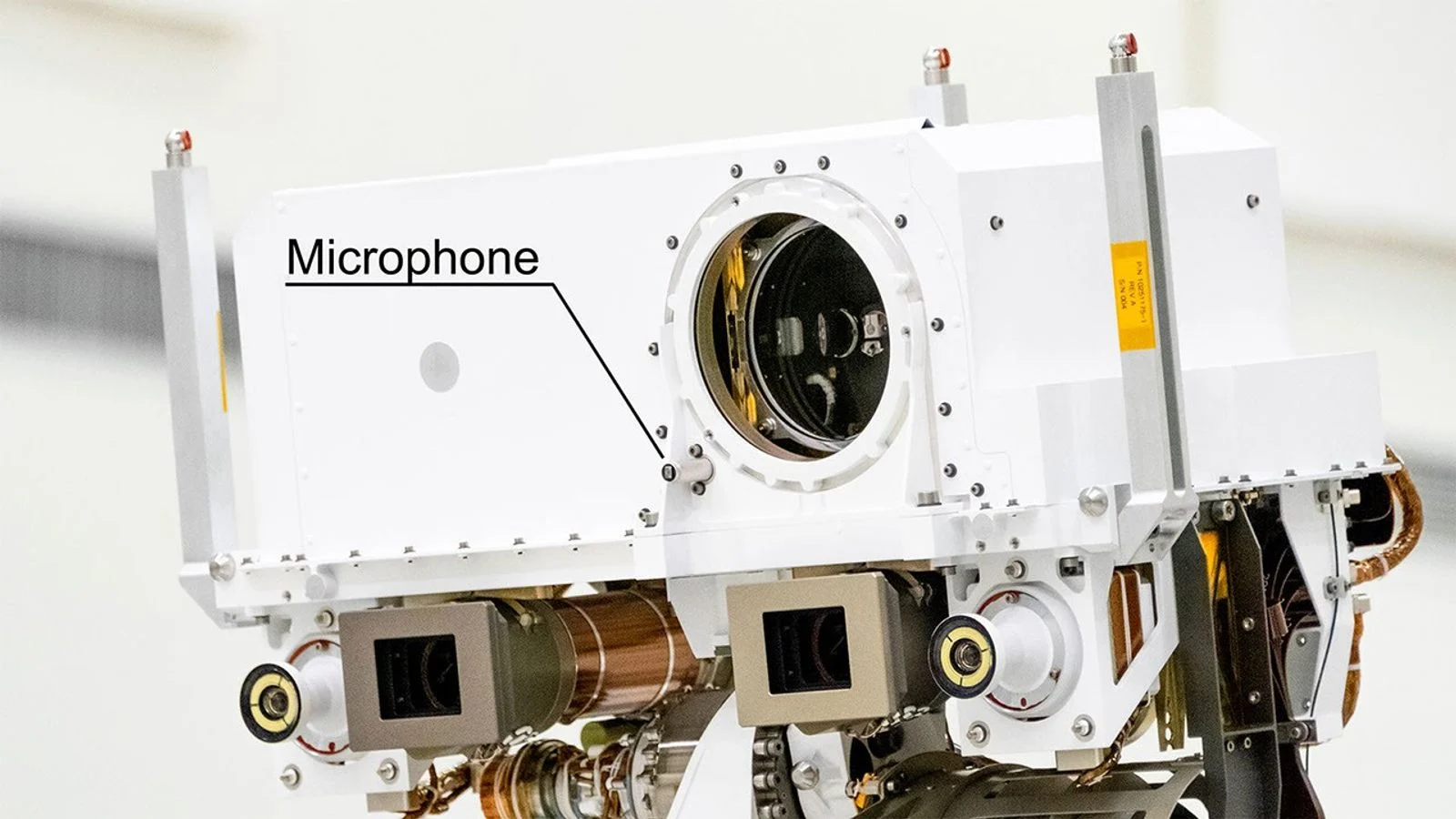
The SuperCam microphone, located on the mast of the Perseverance rover. (NASA/JPL-Caltech)
The microphone's primary function is to listen as the SuperCam zaps target rocks with a laser. It has also recorded some other novel sounds, such as the whirring of Ingenuity's rotors during one of the drone's many flights, as well as the first audio of Martian winds and dust devils swirling past.
Now, the SuperCam microphone has also revealed evidence of these triboelectric discharges, as it detected tiny crackles of thunder originating from equally tiny sparks of lightning.
Listen below: Perseverance's SuperCam mic picks up evidence of lightning on Mars
In the audio recording embedded above, Perseverance picked up the sounds of wind as a dust devil swept past it on October 12, 2024 (Sol 1,296 of the mission). From 9-10 seconds in the sample, though, three distinct electric crackles can be heard, just as the leading wall of the dust devil passes the microphone.
"We got some good ones where you can clearly hear the 'snap' sound of the spark," coauthor Ralph Lorenz, a Perseverance scientist at the Johns Hopkins Applied Physics Lab, told NASA. "In the Sol 215 dust devil recording, you can hear not only the electrical sound, but also the wall of the dust devil moving over the rover. And in the Sol 1,296 dust devil, you hear all that plus some of the particles impacting the microphone."

Two images snapped by Perseverance on September 6, 2025 (Sol 1,616) have been combined here. The primary view is a colour image taken by the rover's NavCam. The inset image is taken from a different set of NavCam images, originally grayscale, which captured a large dust devil passing by. (NASA/JPL-Caltech)
"Thirty-five other discharges were associated with the passage of convective fronts during regional dust storms," NASA said. "These fronts feature intense turbulence that favour triboelectric charging and charge separation, which occurs when two objects touch, transfer electrons, and separate — the part of the triboelectric effect that results in a spark of static electricity."
This confirmation of electrical discharges in the Martian atmosphere will help scientists with their study of the planet's environment, especially considering how these discharges can influence chemical reactions. This could account for the abundance of perchlorates in Martian surface dust (chemical compounds that are very destructive to organic molecules and could threaten the health of future human explorers). It could also explain how methane vanishes so quickly in the Martian atmosphere.
Additionally, the researchers say that this opens up a whole new field of study, which may lead to brand new atmospheric models for Mars that take into account these lightning sparks, and possibly better protection against electrical discharges for future Mars missions — both robotic and those involving human explorers.