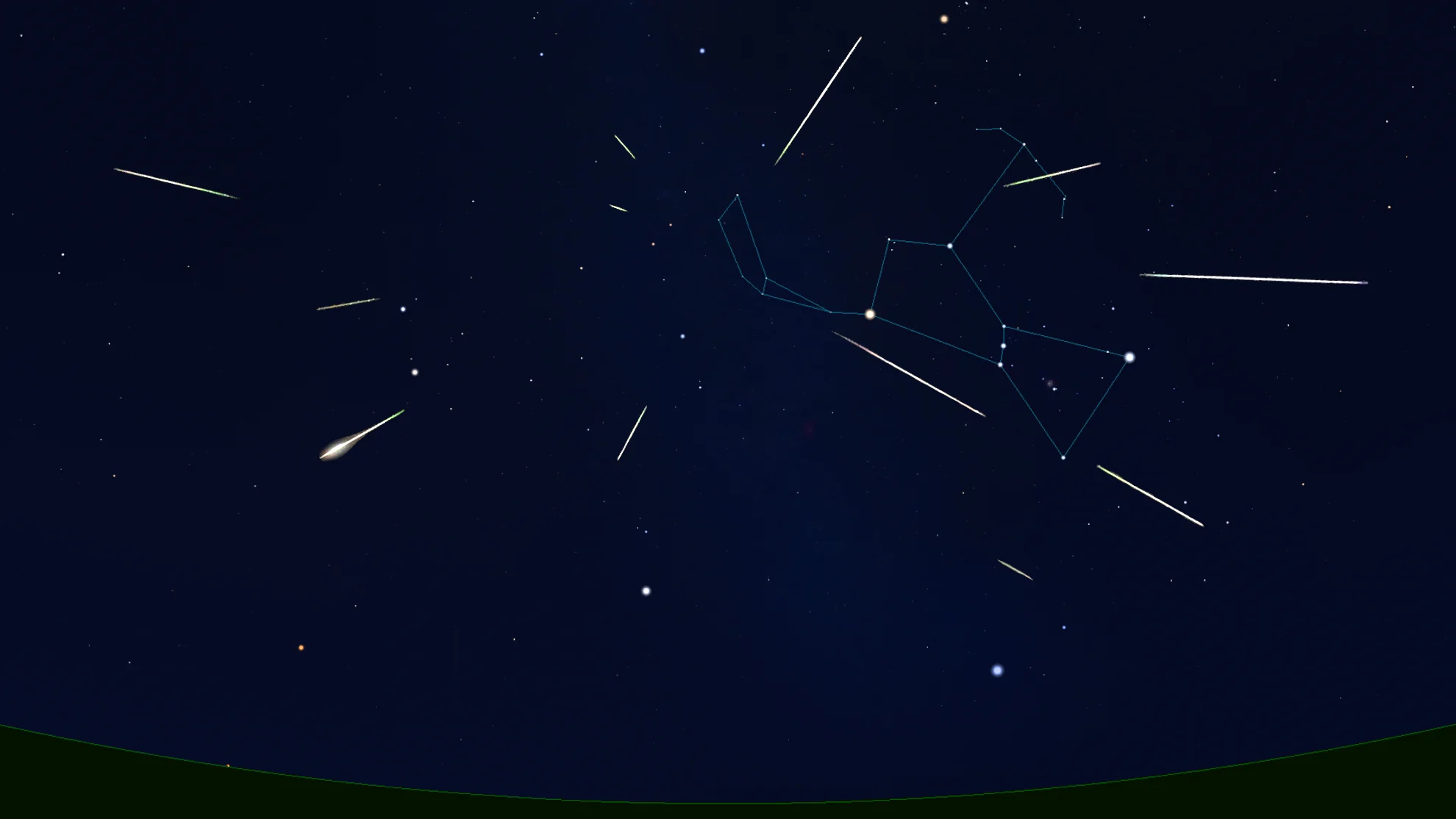
Halley's Comet meteors flash across the sky in October

Two meteor showers peak in October, but the Orionids, from Halley's Comet, are with us all month long!
Keep a close watch for clear skies in your weather forecast for this month, as we have a chance to see meteors from two different comets, plus Saturn at its brightest, Jupiter passing behind the Moon, and one of the biggest and brightest Full Moons of the year.
Here is the Astronomical Guide for October 2026:
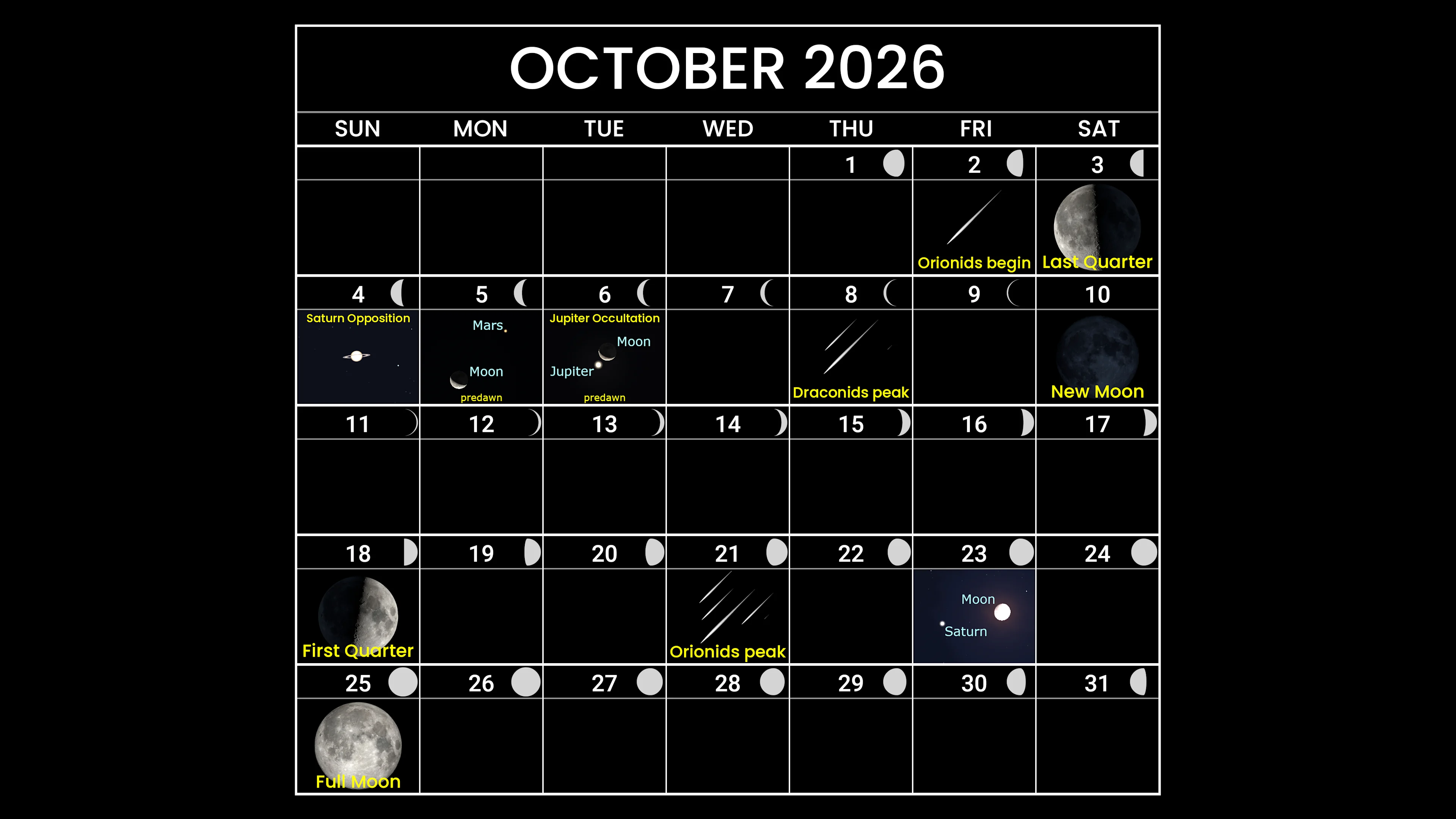
Click here for a zoomable version of the above calendar.
Visit our Complete Guide to Summer 2026 for an in-depth look at the Spring Seasonal Forecast, tips to plan for it, and much more!
The Moon
On the first two nights of the month, the Waning Gibbous Moon will rise well after sunset, at around 10 p.m. on the 1st and 11 p.m. on the 2nd, leading up to the Last Quarter Moon rising near midnight on the night of the 3rd to 4th.
Watch for the Waning Crescent Moon in the east, in the hours between midnight and dawn as it rises closer and closer to sunrise from the 5th to the 9th. Additionally, the last few days of the Waning Crescent Moon are the best for spotting the phenomenon known as Earthshine — where sunlight reflected off the surface and atmosphere of Earth will dimly illuminate the Moon's dark side.
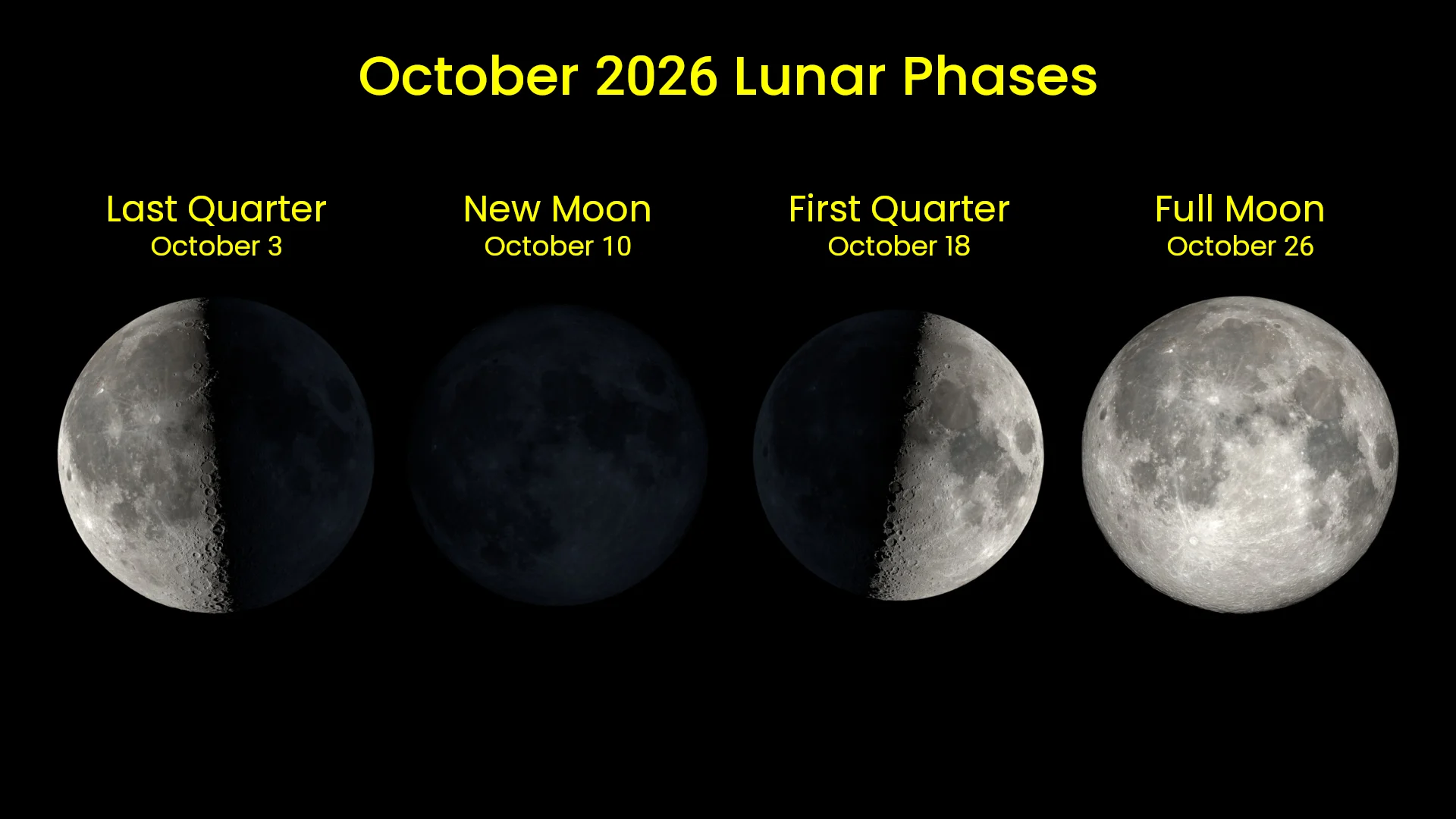
The phases of the Moon for October 2026. (NASA's Scientific Visualization Studio/Scott Sutherland)
The New Moon rises and sets with the Sun on the 10th. That makes the nights of the 9th-10th and 10th-11th the best time of the month for stargazing.
The Waxing Crescent Moon will reappear in the western sky just after sunset on the 11th, and will rise later, and thus be higher in the sky and growing fuller with each sunset up until the 17th.
As with the Waning Crescent, the first few days of the Waxing Crescent Moon are also great for spotting Earthshine!
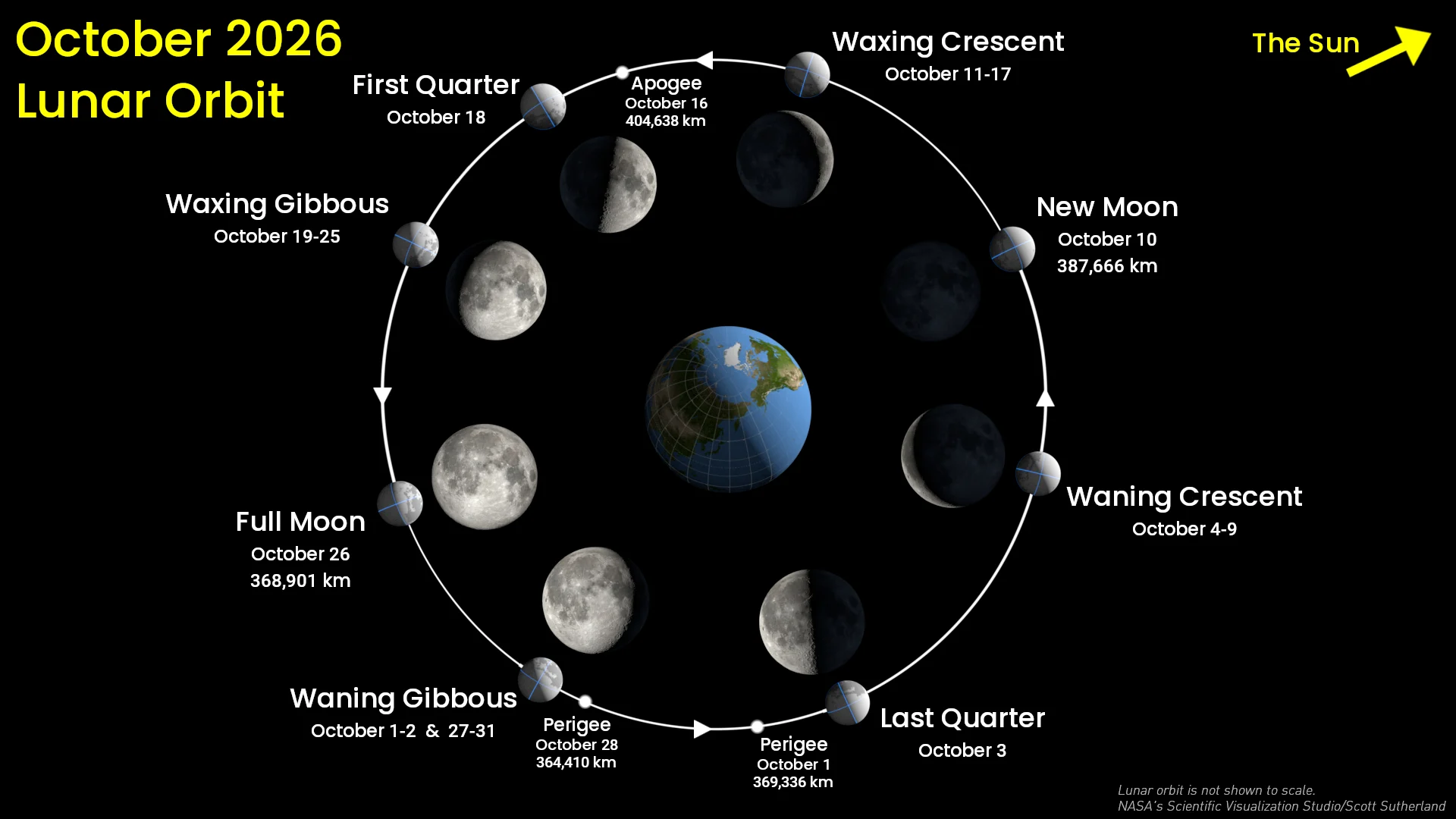
The Moon's orbit around Earth for October 2026, along with the different phases it presents to us at the various positions along that orbit. (NASA's Scientific Visualization Studio/Scott Sutherland)
The First Quarter Moon rises in the afternoon and sets around midnight on the 18th. Then, from the 19th to the 24th, the Waxing Gibbous Moon rises closer and closer to sunset, while setting closer and closer to sunrise.
The Full Hunter's Moon will shine throughout the night of the 25th to 26th, rising as the Sun is setting, and then setting just after sunrise. This particular Full Moon reaches its fullest at 4:12 UTC, or 12:12 a.m. EDT on the 26th.
Afterwards, we will again see a Waning Gibbous Moon that will rise later and later, and set in the hours after sunrise the next day, to finish out the month.
It is also worth noting that, except for a few days around the New Moon, it is possible to spot the Moon in the daytime sky.
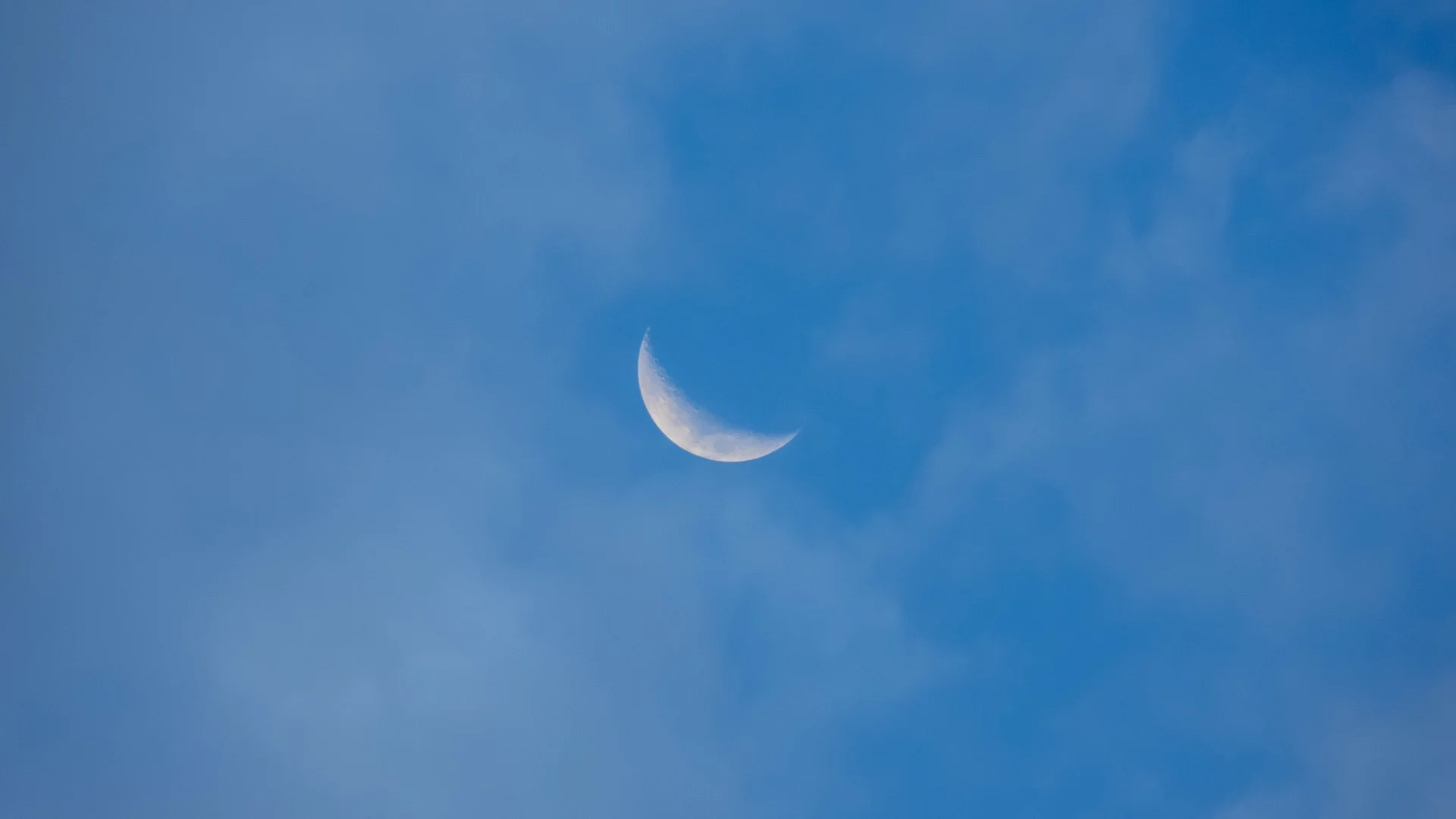
The Waxing Crescent Moon from November 18, 2012, is captured in this image, as it was visible from Brisbane, Australia, at 5:46 p.m. local time, in the blue, daylit sky. (John Robert McPherson/Wikimedia Commons (CC BY-SA 4.0))
From the 1st until the 7th or the 8th, it can be located in the sky to the west of the Sun. Then, from the 12th or 13th until the 24th, it will be in the sky to the east of the Sun, and after the Full Moon, it switches back to being west of the Sun.
MORE FROM SPACE: NASA satellite spots a new once-in-a-century crater on the Moon
The Planets
Five planets can be found in the sky to start off October this year, but only three stick around for the entire month.
In the predawn sky, Mars will be situated roughly between the bright stars Pollux, of the constellation Gemini, and Procyon, of the constellation Canis Minor. The planet rises at roughly 1:30 a.m. on the 1st, and then earlier and earlier as the month progresses.
Jupiter will follow along after Mars each morning, cresting the horizon around 3 a.m. on the 1st, and also rising earlier and earlier each day.
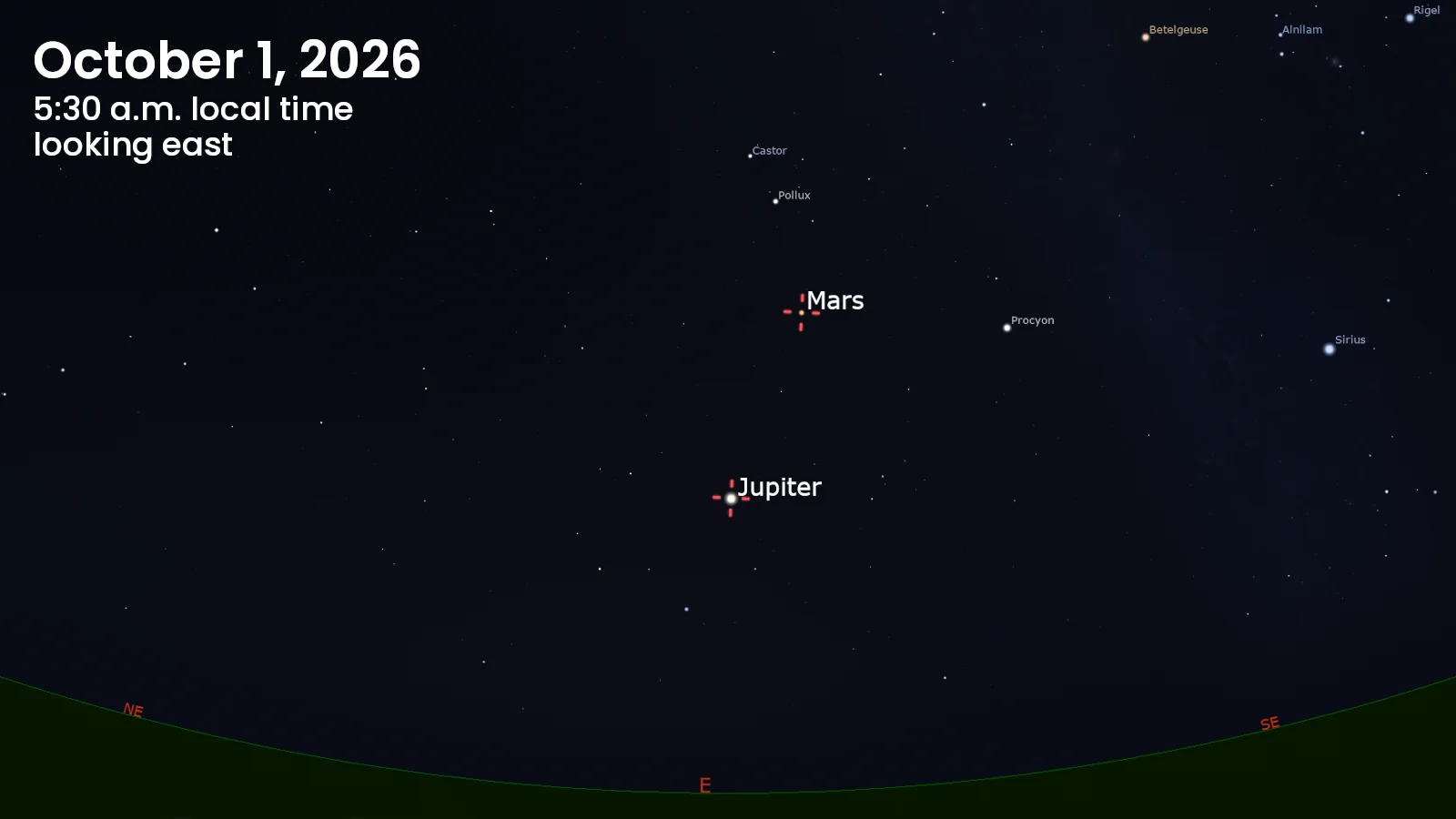
Mars and Jupiter in the predawn sky on October 1, 2026 (Stellarium)
Look for the Waning Crescent Moon to pass by Mars on the morning of the 5th, and then Jupiter on the morning of the 6th.
Also, observers in the eastern half of the country, from Manitoba to Atlantic Canada have a chance to catch Jupiter ducking behind the Moon on the 6th. This 'occultation' occurs at roughly the same time for all observers, so be mindful of what time zone you are in.
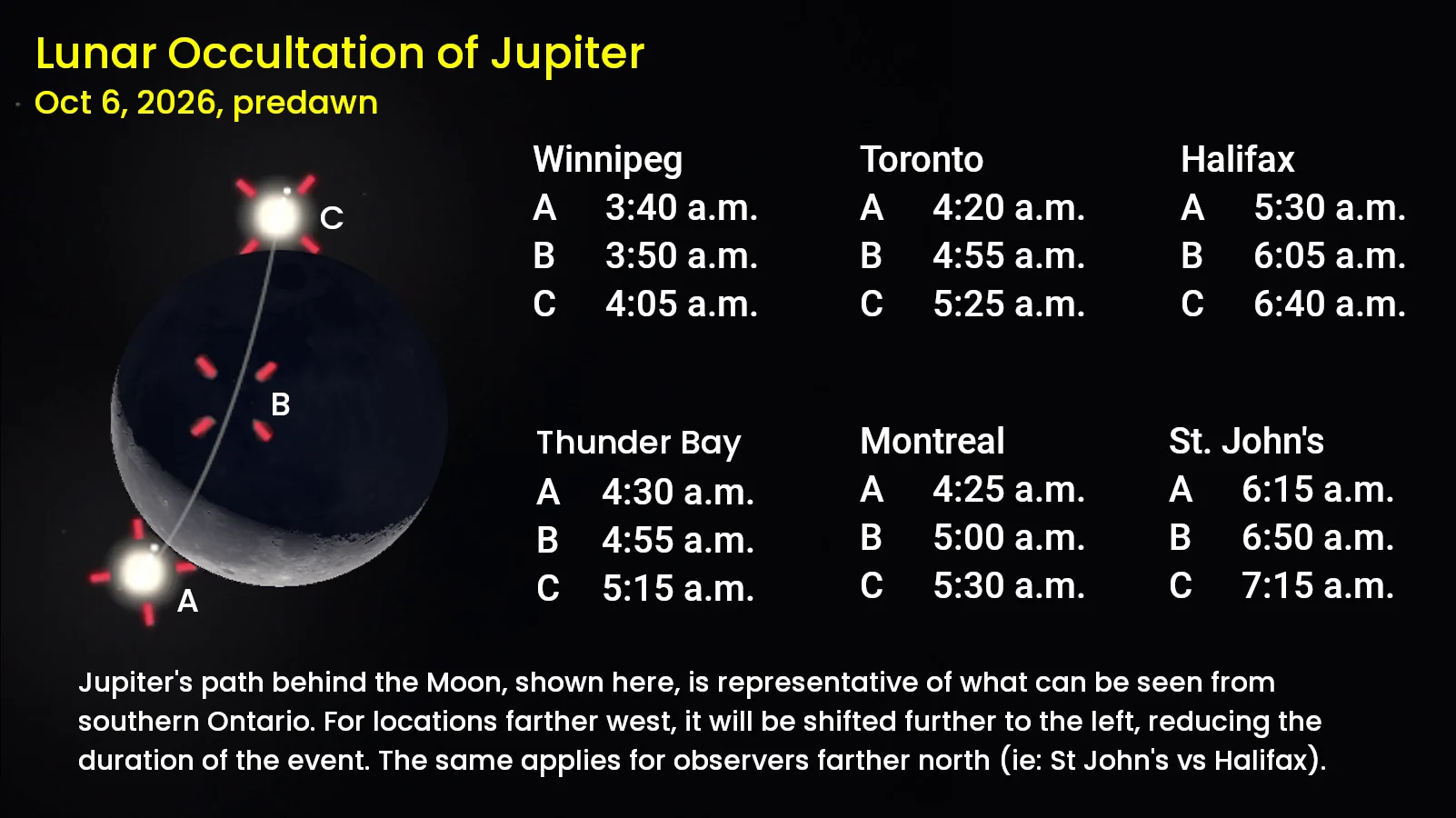
The occultation of Jupiter by the Moon on October 6, 2026. (Stellarium/Scott Sutherland)
Additionally, watch these two throughout the month as each morning they draw closer together, as if Jupiter is rushing to catch up with Mars. This is leading up to a close conjunction of the pair in mid-November!
In the west, if you take a very close look at the horizon, right after the Sun sets on Oct. 1, you may spot Mercury and Venus fairly close together there. A pair of binoculars or a telescope will help with finding them in the evening twilit sky.
Both planets will fairly quickly be lost in the glare of the Sun, and will only reappear in the predawn sky towards the end of the month.
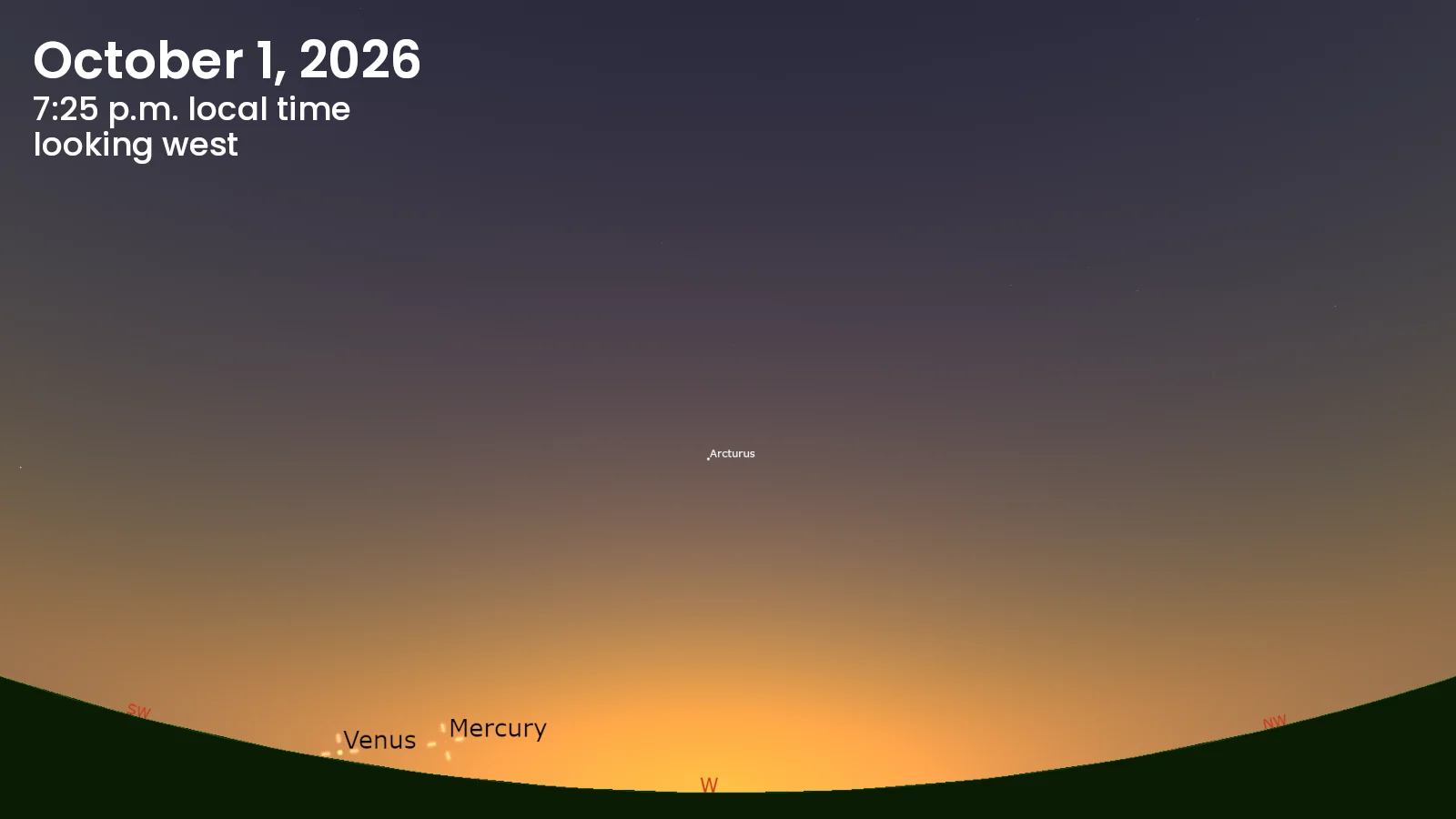
Mercury and Venus in the evening twilit sky on October 1, 2026 (Stellarium)
Meanwhile, Saturn can be found in the eastern sky after sunset each night.
Right now, the Ringed Planet is at its brightest, as it reaches Opposition on the night of the 3rd-4th.
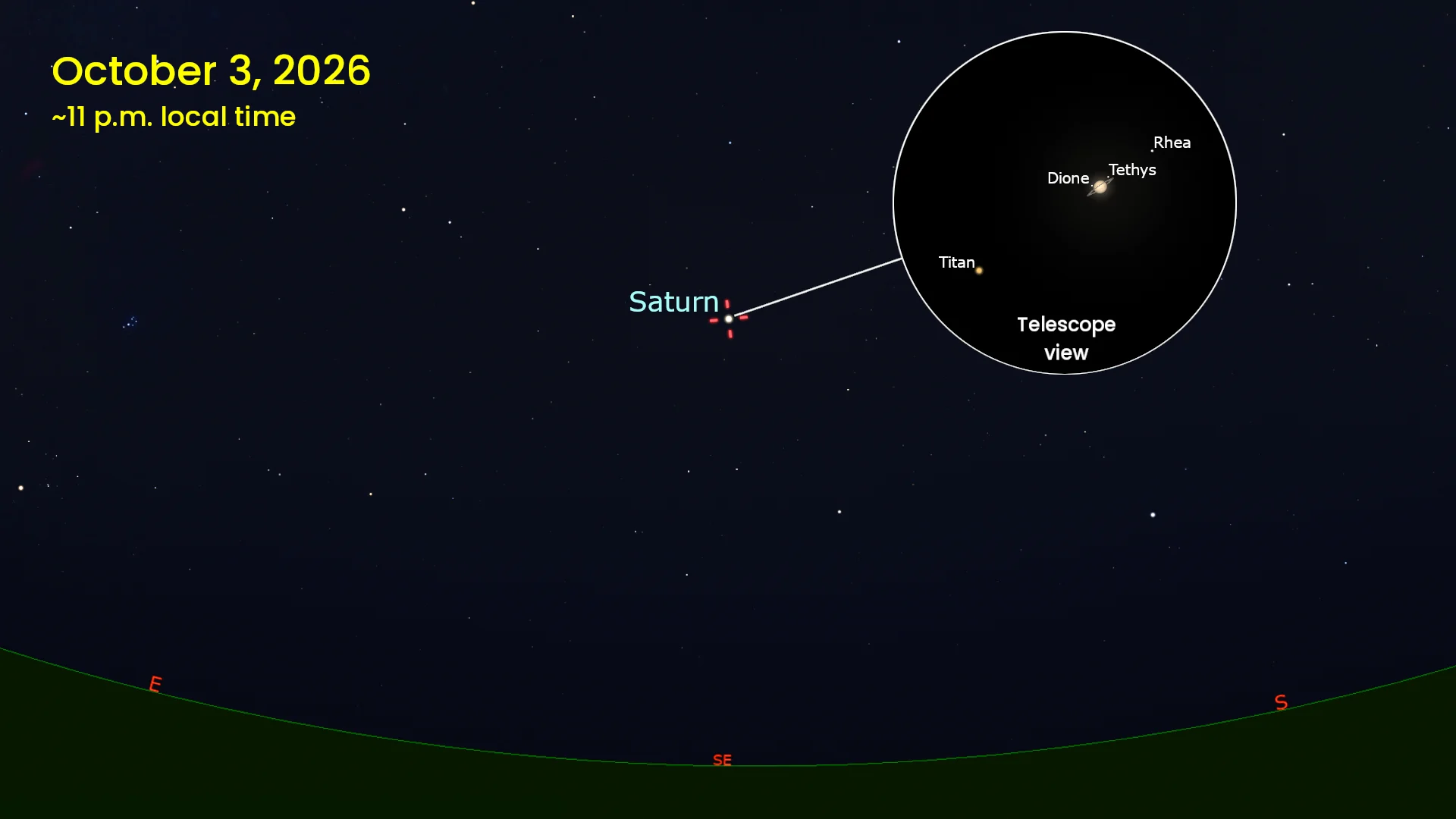
Saturn, located in the southeastern sky at 11 p.m. local time on October 3, 2026. Inset: a telescopic view of Saturn and its brightest Moons visible at that time. (Stellarium/Scott Sutherland)
This is when Saturn is on the exact opposite side of Earth from the Sun, and it rises with sunset and sets with sunrise on that night.
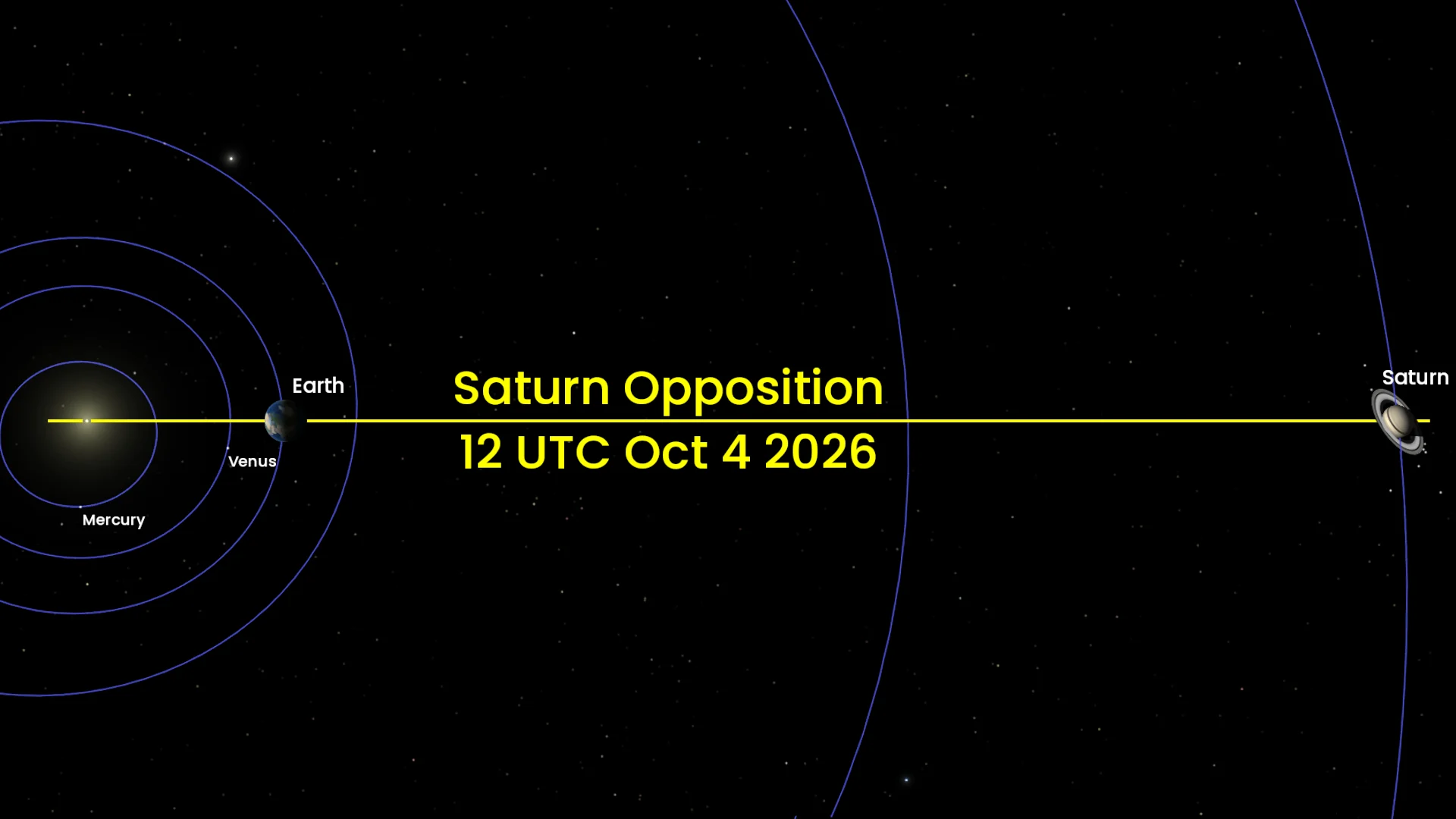
The positions of the planets early on October 4, 2026, showing the alignment of the Sun, Earth, and Saturn. (Celestia/Scott Sutherland)
That also puts the planet at its closest distance to Earth, and thus its brightest in our sky until mid-October of next year.
DON'T MISS: What is the mysterious Moon Illusion?
Meteor showers
During the month of October, a total of 4 different meteor showers send streaks of light across our night skies. However, only two of those reach their peak, the Draconids and the Orionids.
The Draconids stream out of the constellation Draco, in the northern sky, from October 6-10. The meteoroids that cause the shower originate from a comet known as 21P/Giacobini-Zinner
This shower only delivers 1-2 meteors per hour on each of those nights, except during its peak on October 8-9.
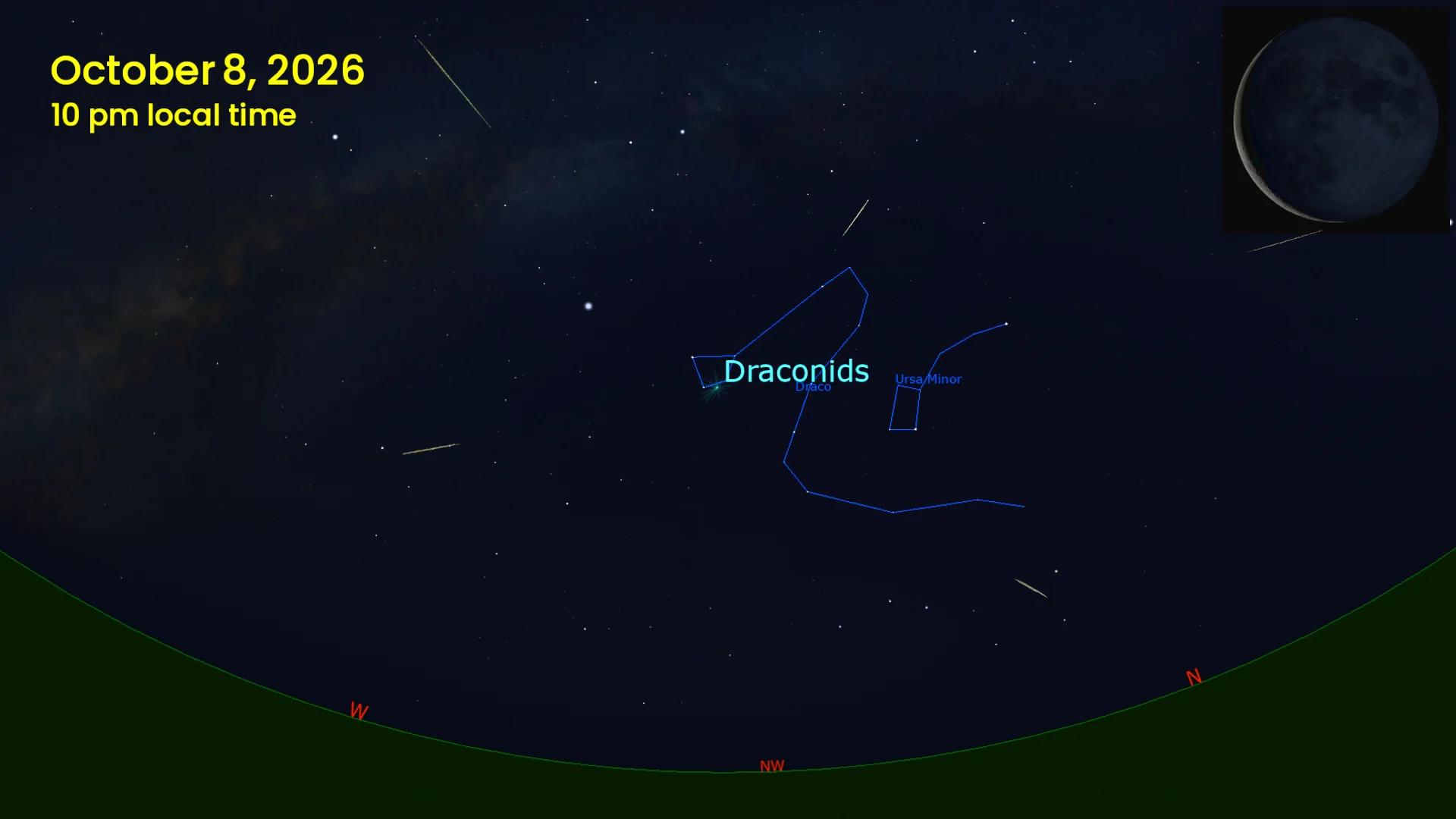
The radiant of the Draconid meteor shower in the northern constellation Draco, on October 8-9, 2026. (Stellarium/Scott Sutherland)
On that night, specifically, from dusk until dawn, the Draconids typically produce around 5 meteors per hour, but are sometimes capable of far more!
The Orionid meteor shower overlaps with the Draconids, starting on October 2 and lasting until around November 7.
This is the second of two annual meteor showers that result from Earth passing through debris left behind by Halley's Comet. Despite the comet currently being far out in the solar system, and not due back until 2061, we still get these two reminders every year.
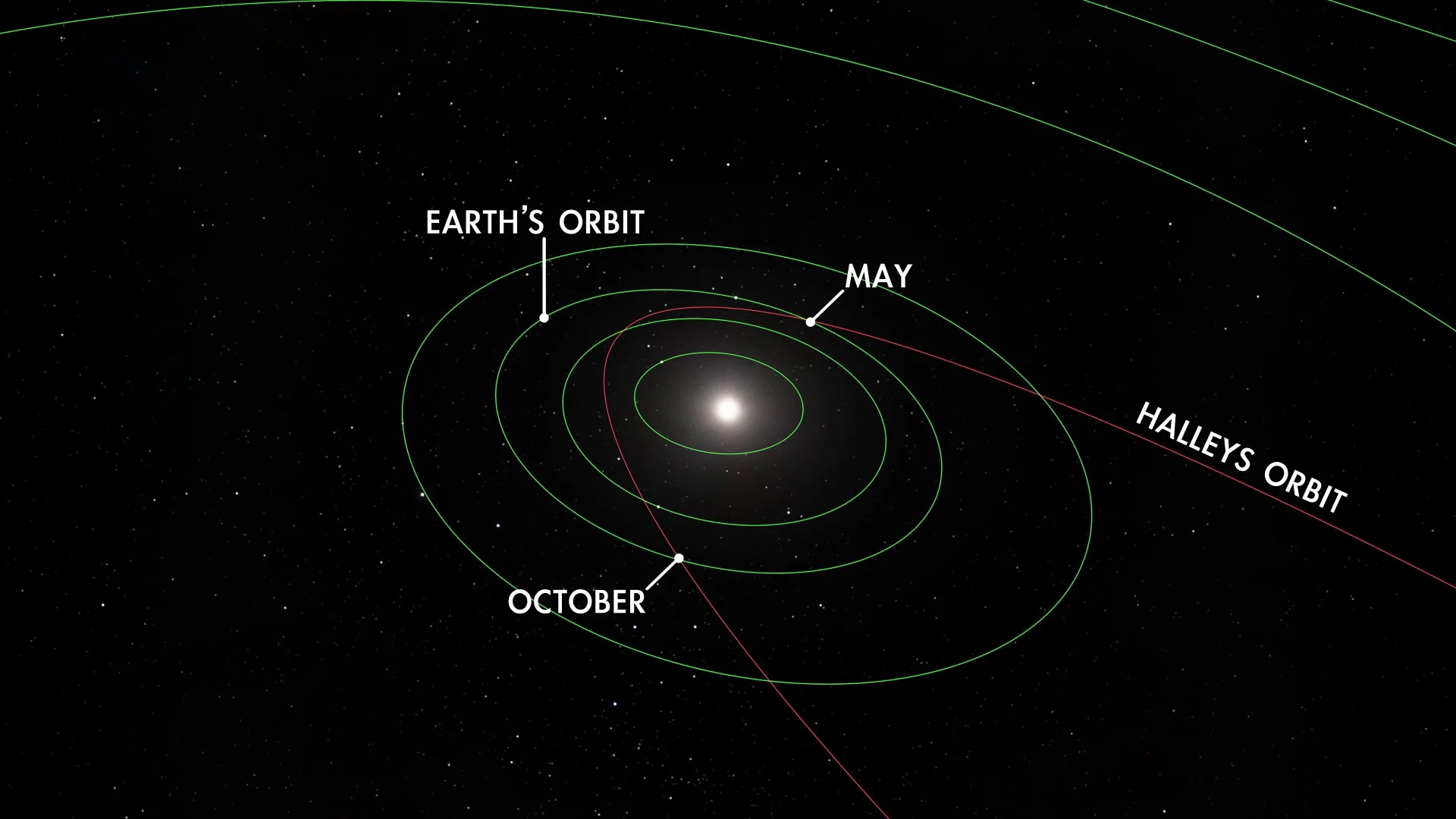
Earth's orbit intersects with the orbit of Halley's Comet in two places, first where we are in May, and then again in October, producing two meteor showers - the eta Aquariids and the Orionids. (NASA JPL)
The Orionids are fairly weak for most of its run, delivering one or two meteors per hour each night. However, during its peak, on the night of October 21 and especially in the predawn hours of October 22, we tend to see around 20 meteors per hour.
Orionid meteors begin showing up around 10:00 p.m., local time, each night, including during the peak. The best time to watch, though, is in the hours before sunrise, when the shower's radiant is highest in the sky.
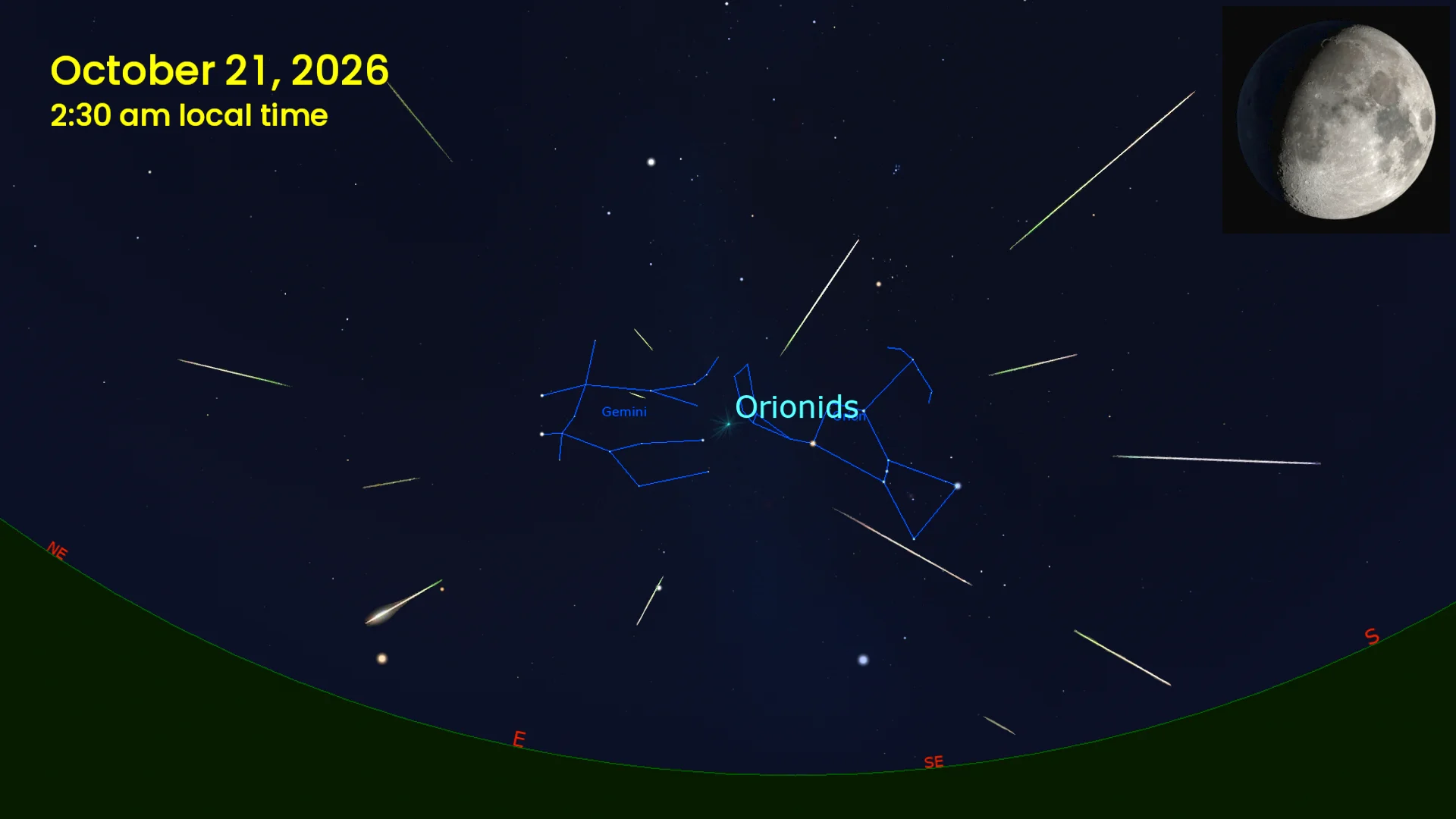
The best viewing for the Orionid meteor shower will be in the hours before sunrise on Oct 22, 2026. (Stellarium/Scott Sutherland)
This is especially true in 2026, as we will have a Waxing Crescent Moon crossing the sky on the night of the Orionids peak. So, bright moonlight may limit the number of meteors we see for the first part of the night.
However, with the Moon in the southern sky as the Orionids radiant rises on the 21st, and setting at around 3:30 a.m., keeping our gaze fixed on the eastern sky until the Moon sets will help mitigate its effects.
READ MORE: How to get the most out of meteor showers and other night sky events
The Constellations
The constellations of fall dominate the sky this month.
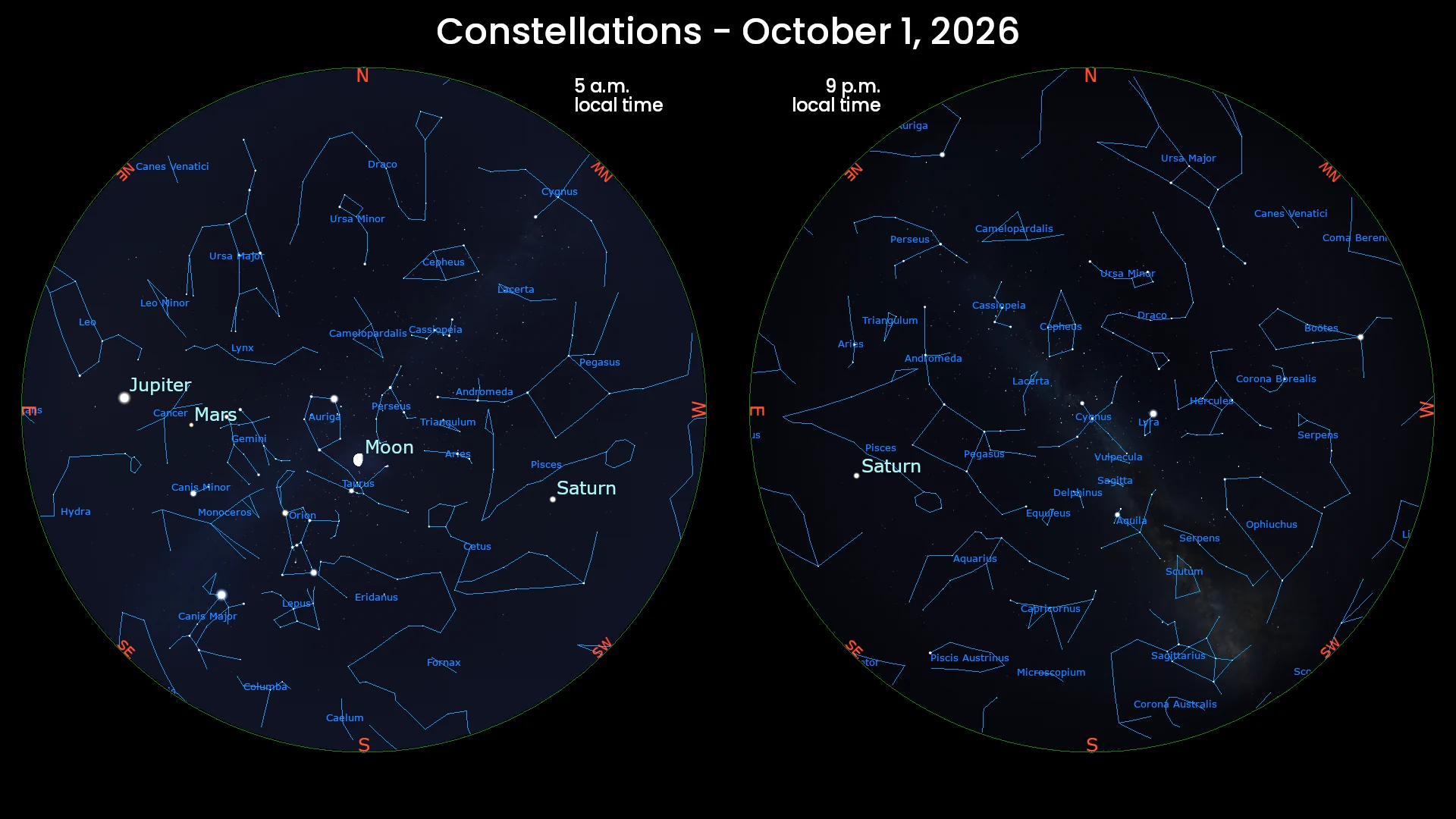
(Stellarium/Scott Sutherland)
At the start of October, Pegasus and Andromeda, Aries, Triangulum, Perseus, Auriga and Taurus, Gemini, Cancer and Leo stretch from west to east across the zenith (overhead). Around the southern sky will be Pisces, Cetus, Eridanus, Lepus, Orion, Canis Major, Canis Minor, and Hydra along the southeastern horizon. To the north, we have Cassiopeia, Cepheus, Cygnus, Draco, Ursa Minor, and Ursa Major.
In the evening, Boötes, Corona Borealis, Hercules, Lyra, Cygnus, Pegasus, and Pisces are arrayed across the zenith. Serpens, Ophiuchus, Aquilla, Sagittarius, Capricornus, and Aquarius are most prominent in the southern sky. Ursa Major, Draco, Cepheus, Ursa Minor, Cassiopeia, and Perseus dominate in the north.
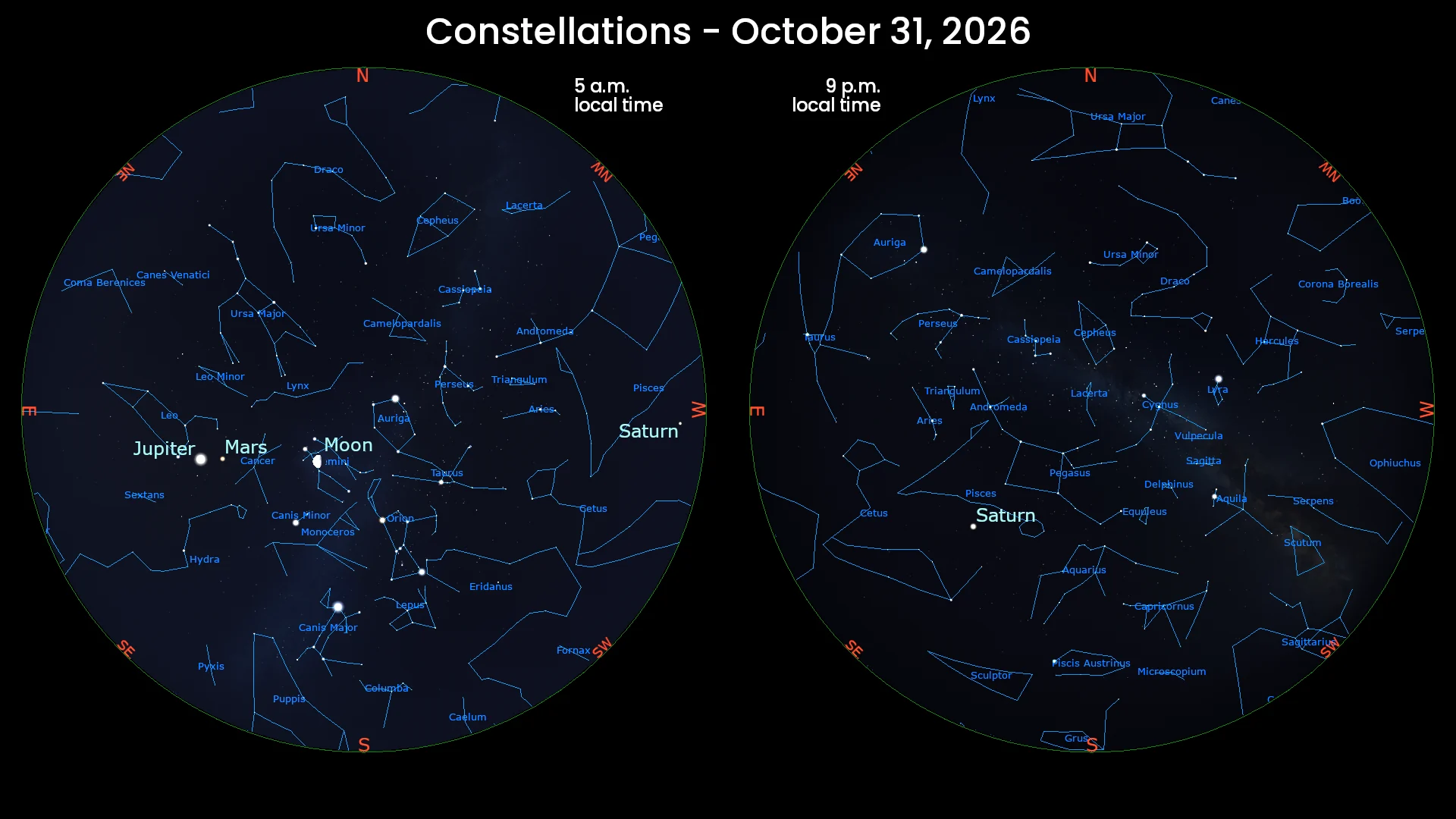
(Stellarium/Scott Sutherland)
By the end of the month, our view of the sky shifts slightly as we continue along our orbit of the Sun.
Pisces, Aries, Triangulum, Perseus, Auriga and Taurus, Gemini, Cancer, and Leo occupy the zenith from west to east.
Cetus, Eridanus, Orion, Lepus, Canis Major and Canis Minor, as well as Hydra are the prominent southern constellations. Pegasus and Andromeda, Cassiopeia, Camelopardalis, Ursa Major and Ursa Minor, Cepheus, and Draco, still shine in the north.