Look up! The Moon takes a bite out of the Sun across Canada tomorrow

This will be the last solar eclipse visible from Canada until 2028, so here's our guide for how to watch this astronomical alignment from across the country and anywhere on the planet!
Put your eclipse glasses on and turn your eyes to the sky tomorrow, for a chance to see the Moon taking a bite out of the Sun! Alternatively, tune in online to catch the total solar eclipse as it happens from northern Spain.
On Wednesday, August 12, 2026, the Sun, Moon, and Earth will line up perfectly to produce a total solar eclipse.
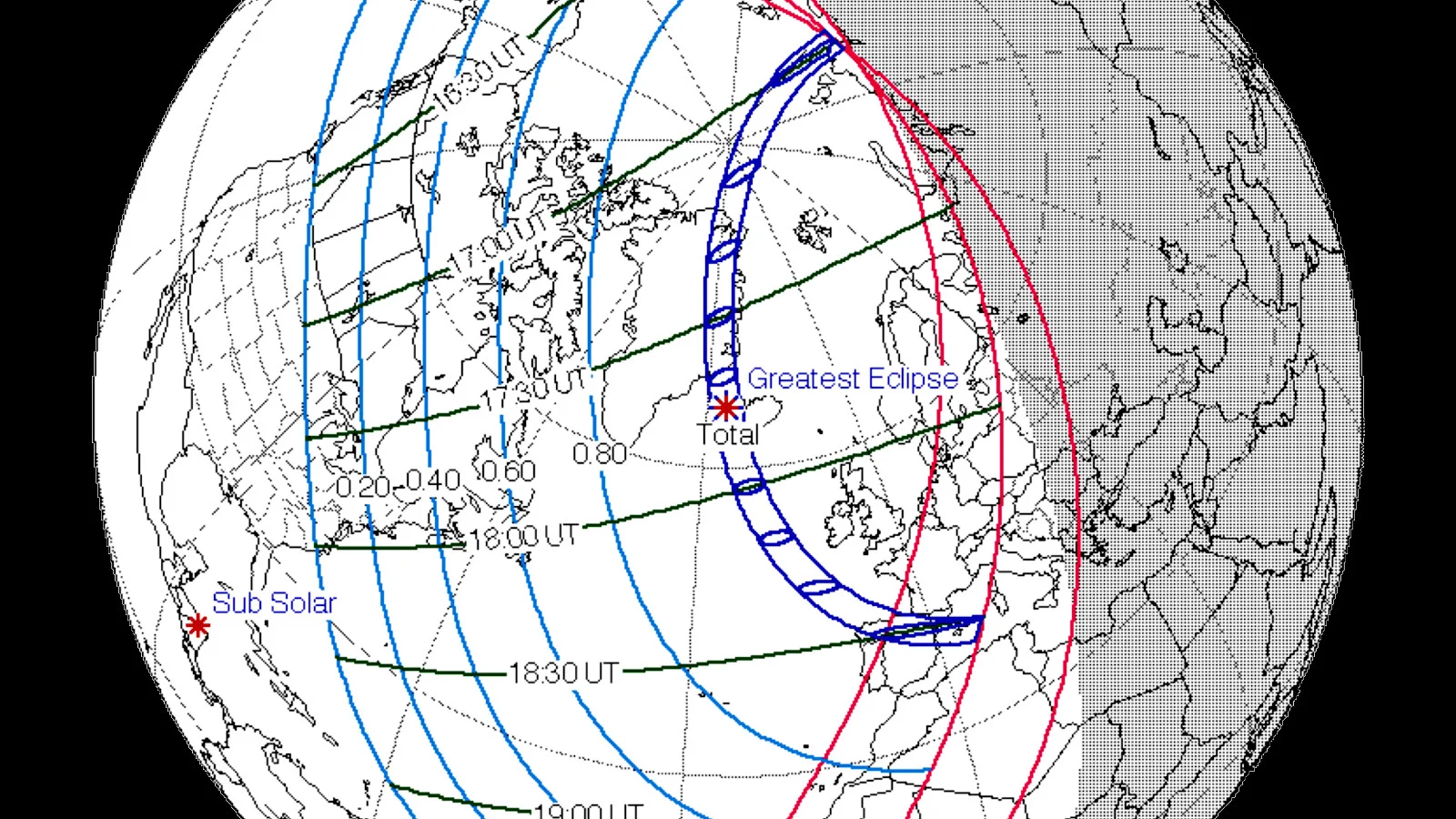
The path of totality of the August 12, 2026 solar eclipse is shown in this diagram, in dark blue. The lines extending away from the path denote where the partial solar eclipse will be visible. (NASA/Fred Espenak)
However, the only places on Earth where the Moon will completely block the Sun (aka 'totality') will be in the Arctic, eastern Greenland, the western tip of Iceland, the north Atlantic Ocean, as well as northern Portugal and Spain, and the Balearic Sea in the Mediterranean.
Here in Canada, we will completely miss the total eclipse. The next total solar eclipse that passes over Canada doesn't occur until August 22, 2044.
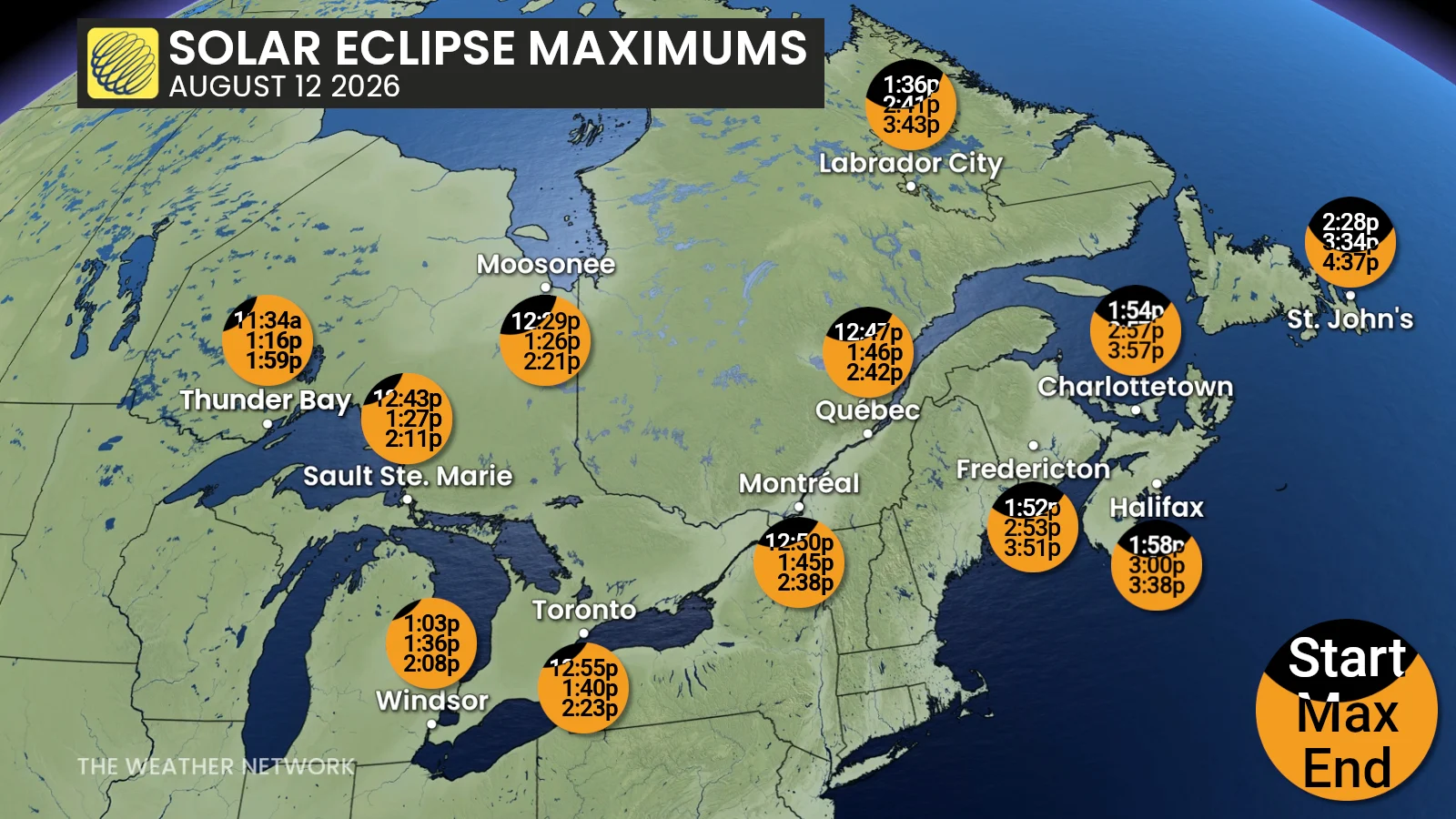
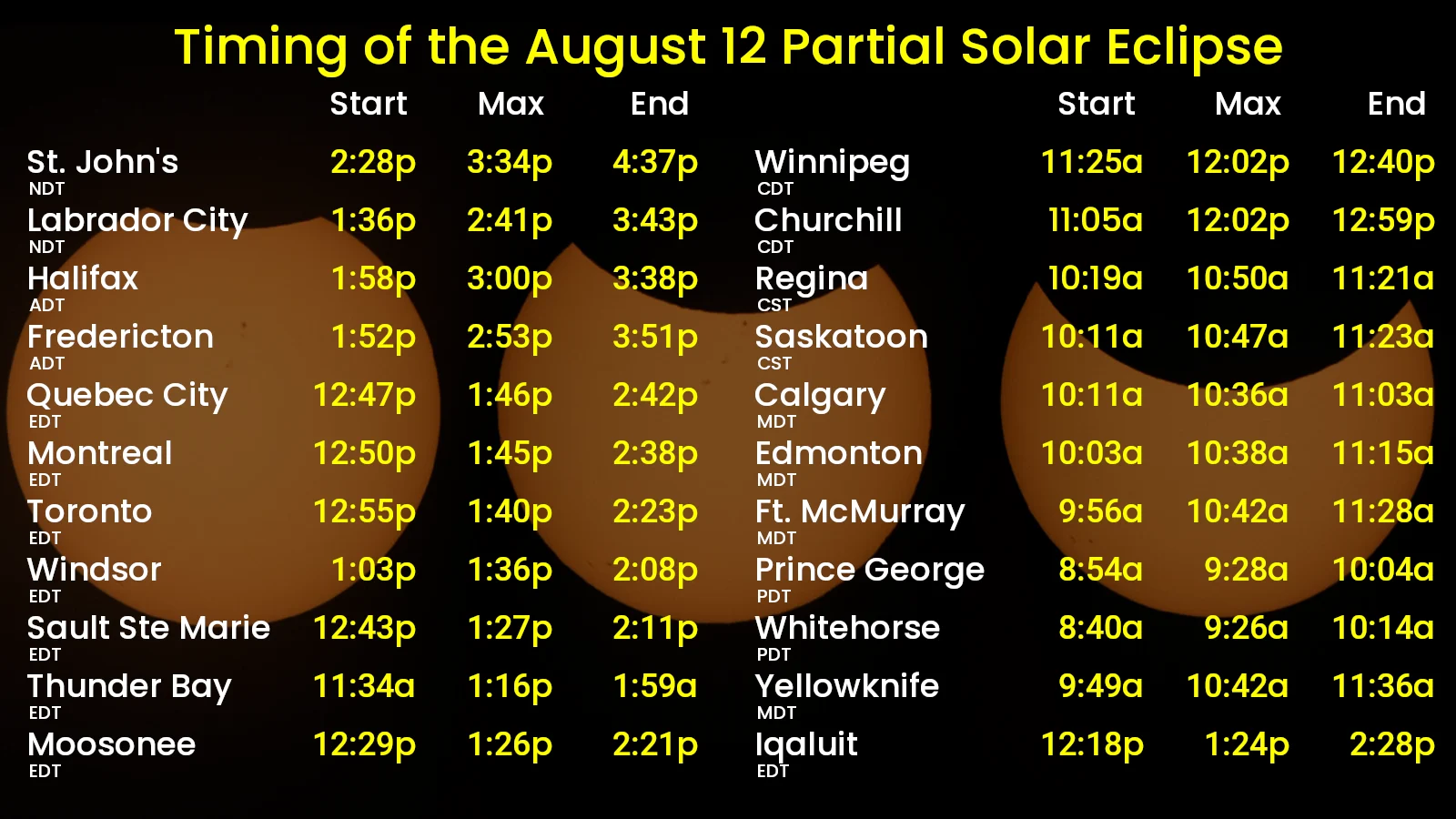
The timing and maximum partial eclipse for locations across eastern Canada.
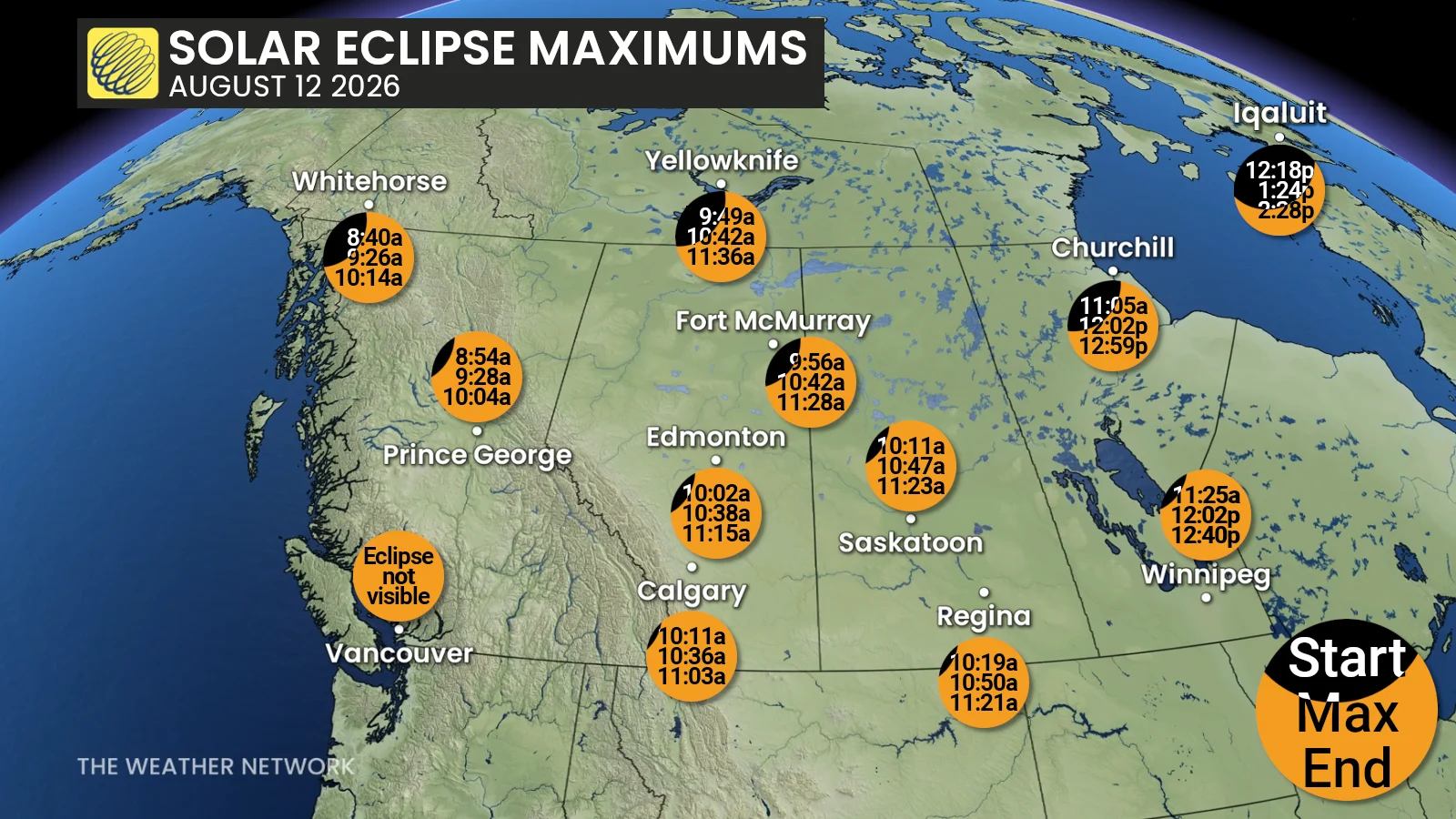
The timing and maximum partial eclipse for locations across western Canada.
Instead, most of us have a chance to see a partial solar eclipse in the sky. The 'magnitude' of this eclipse — how much of the Sun is covered by the Moon — is greatest in the northeast and through Atlantic Canada. Only southwestern British Columbia — specifically around Vancouver and the southern half of Vancouver Island — misses out.
Even in those areas that will only see a sliver of the Sun covered, the eclipse can still last for more than an hour, as the edge of the Moon slowly slides across the edge of the Sun.
It's worth getting out to see this eclipse for yourself, as this will be the last solar eclipse visible in Canadian skies until January of 2028. On the 26th of that month, another partial eclipse will be visible, focused again on the eastern half of the country. The following year, on January 14, 2029, another partial solar eclipse will be concentrated across western Canada.
DON'T MISS: Look up! This week's Perseid meteor shower peak could be the best in years
What will we see?
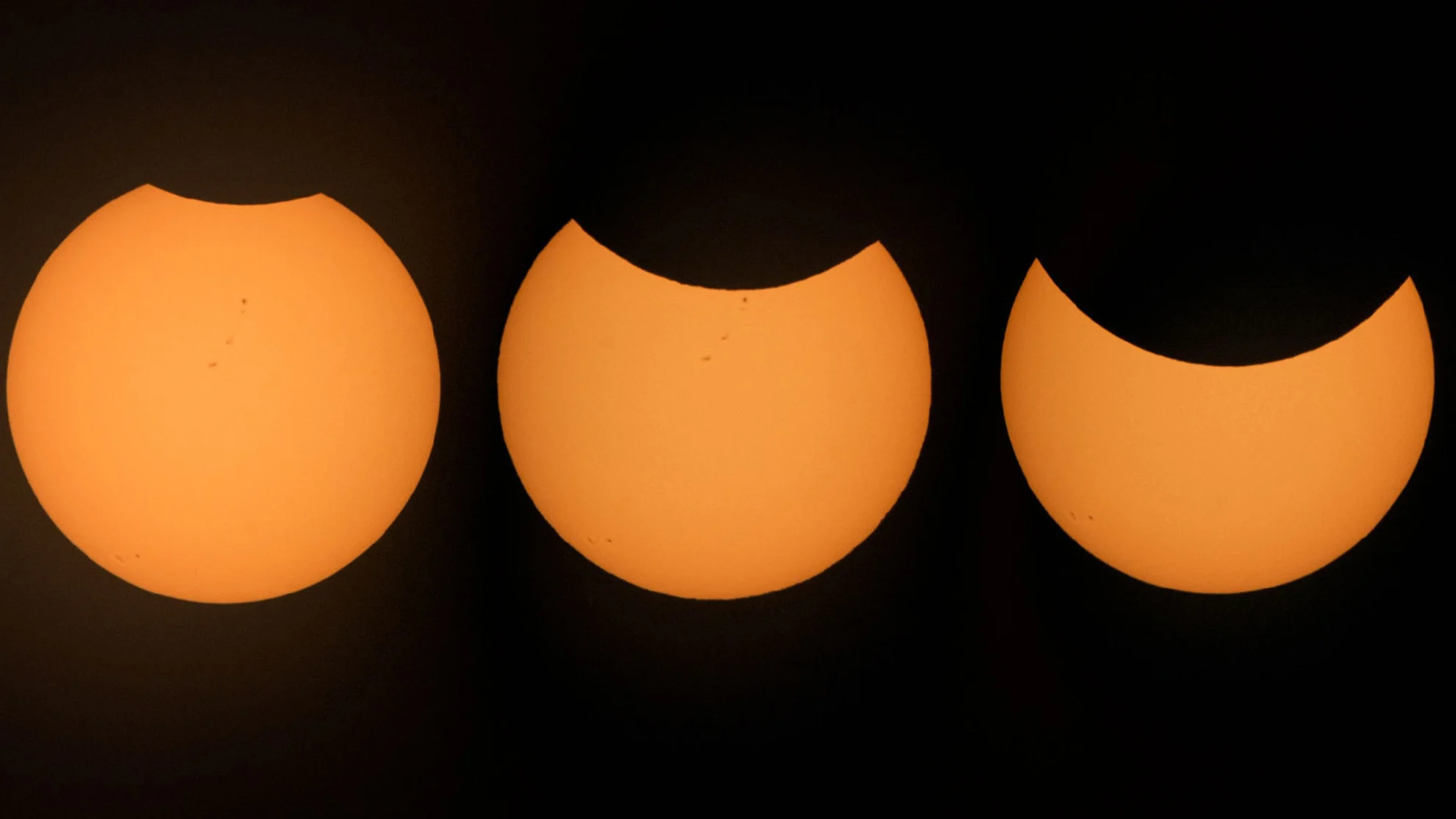
For those taking time to observe the eclipse with solar viewing glasses, or using solar filters on telescopes, binoculars, or cameras, it will appear as though the edge of a dark circle is slipping over the bright disk of the Sun.
Exactly how much of the Sun's disk is blocked, and for how long, depends on the observer's exact location.
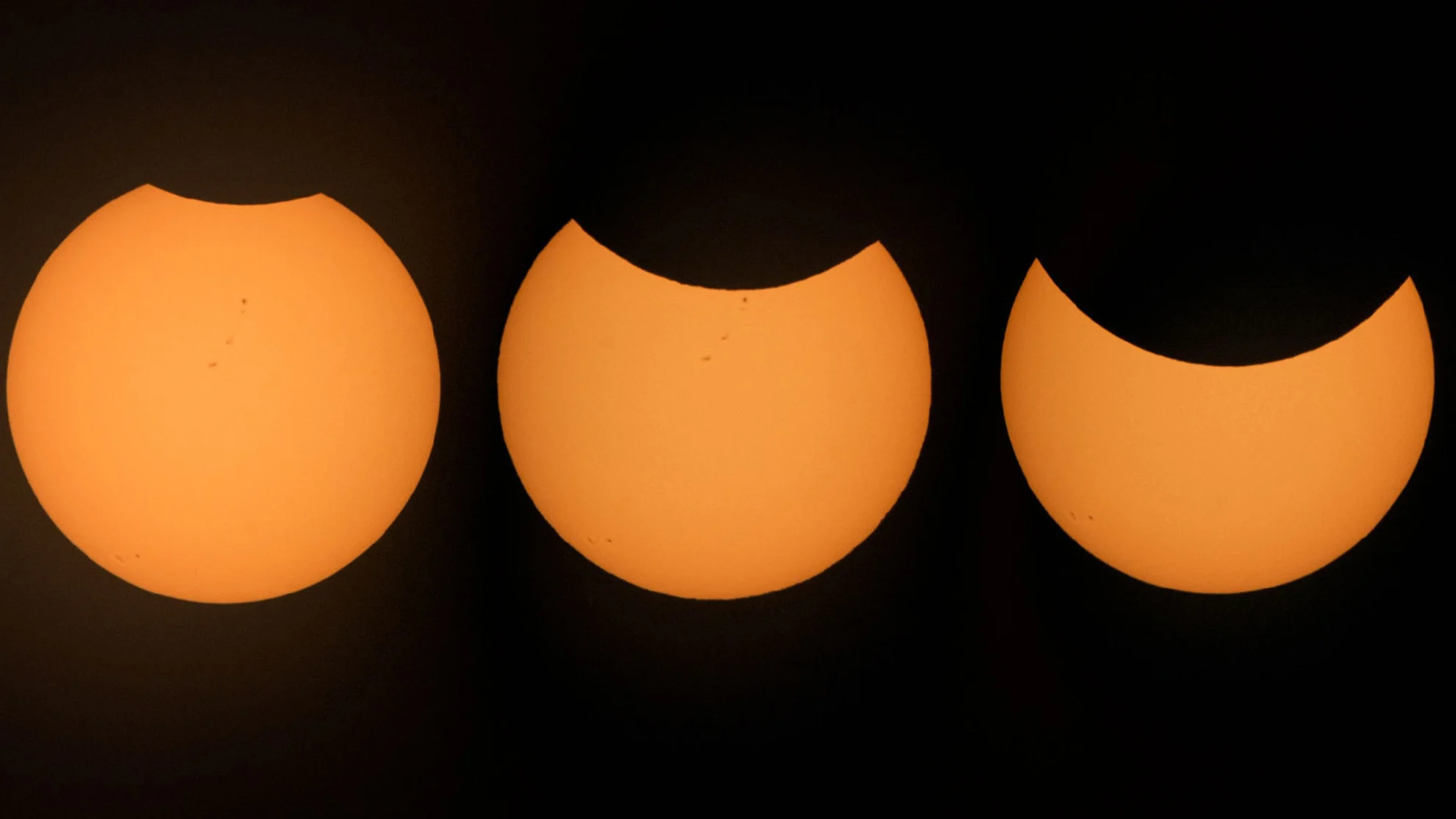
These partial solar eclipse views were captured from NASA's Johnson Space Center during the August 2017 total solar eclipse. (NASA/Noah Moran)
However, if you are not stopping to observe it directly, it's likely you will not even notice that anything is happening.
The Sun is so bright in our sky that the eclipse magnitude needs to reach over 95 per cent, leaving only five per cent of the Sun's disk unblocked by the Moon, for us to even start noticing anything unusual. At that time, street lights may switch on, depending on the sensitivity of their light sensors. As for the sky itself, the eclipse must reach 98-99 per cent for the shade of blue to darken, or to notice any difference in the temperature.
Here in Canada, the eclipse magnitude will reach a maximum of over 90 per cent in Nunavut, at the northern tip of Ellesmere Island. Communities such as Iqaluit, Coral Harbour, and Cambridge Bay, will see a magnitude of just over 70 per cent.
Will the weather cooperate?
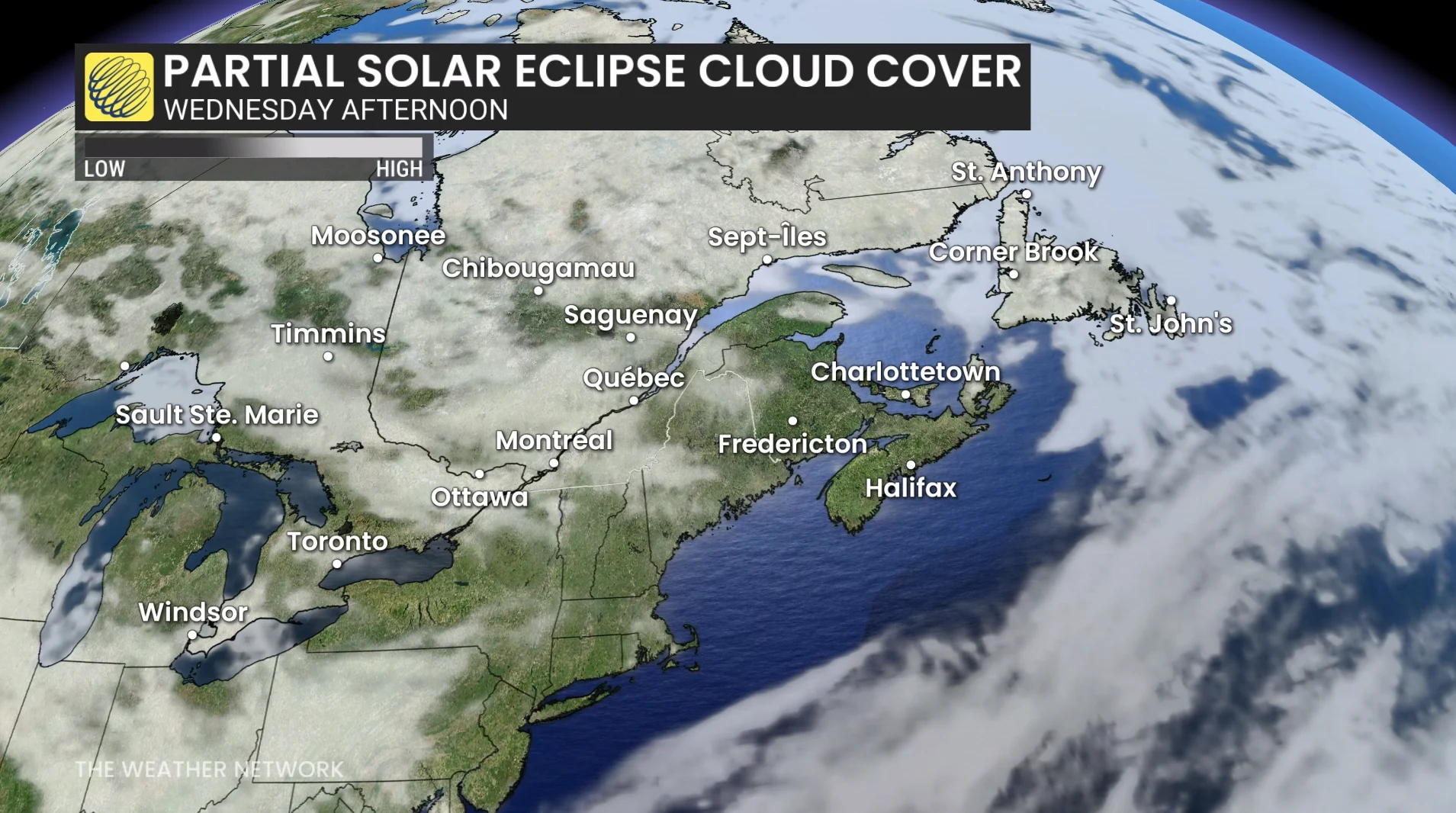
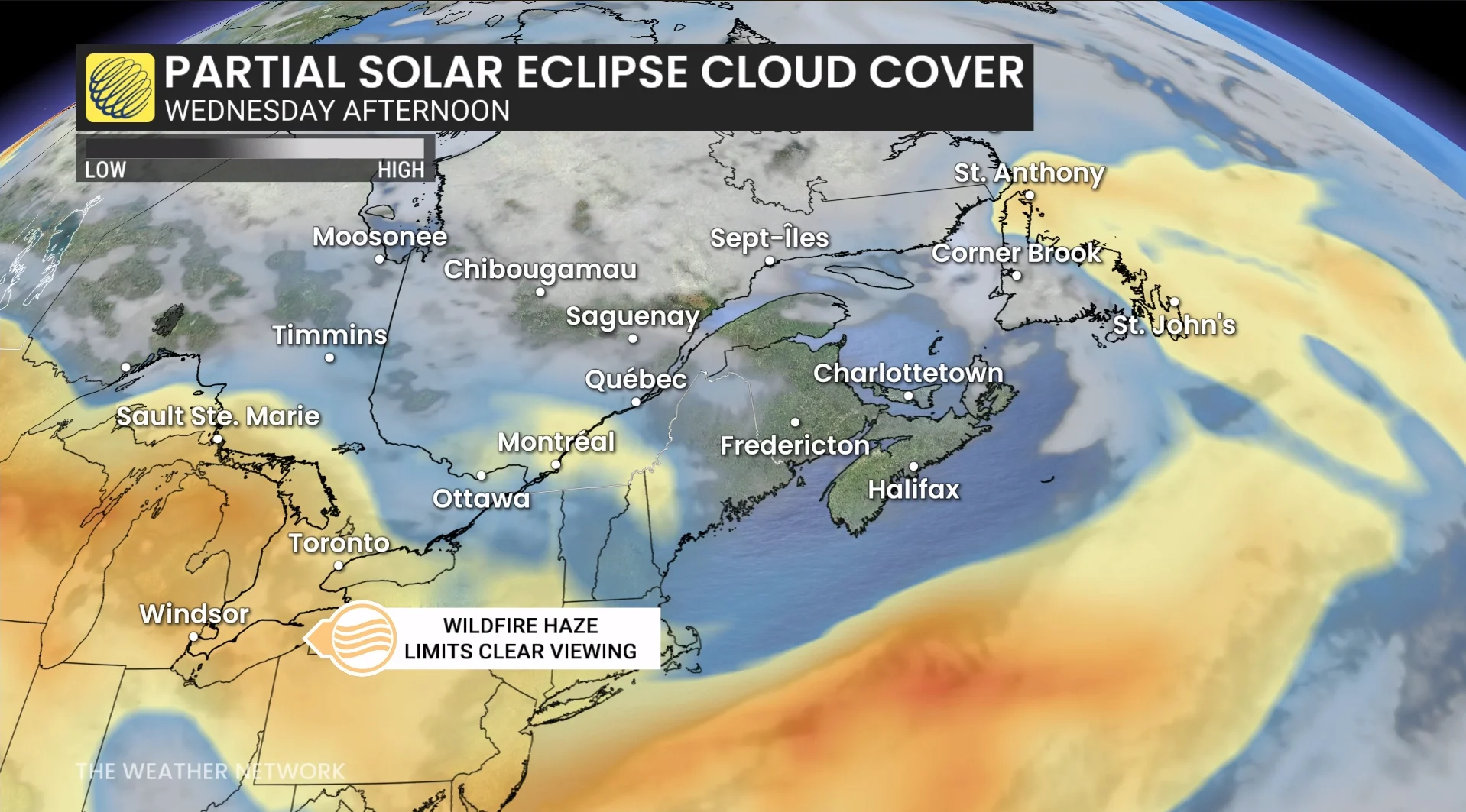
Of course, in order to watch the partial eclipse, we need a clear view of the sky. However, clouds and wildfire smoke are adding to the challenge for this event.
Here are the current cloud cover and smoke forecasts for eastern Canada for Wednesday afternoon:
And for western Canada during the morning hours.
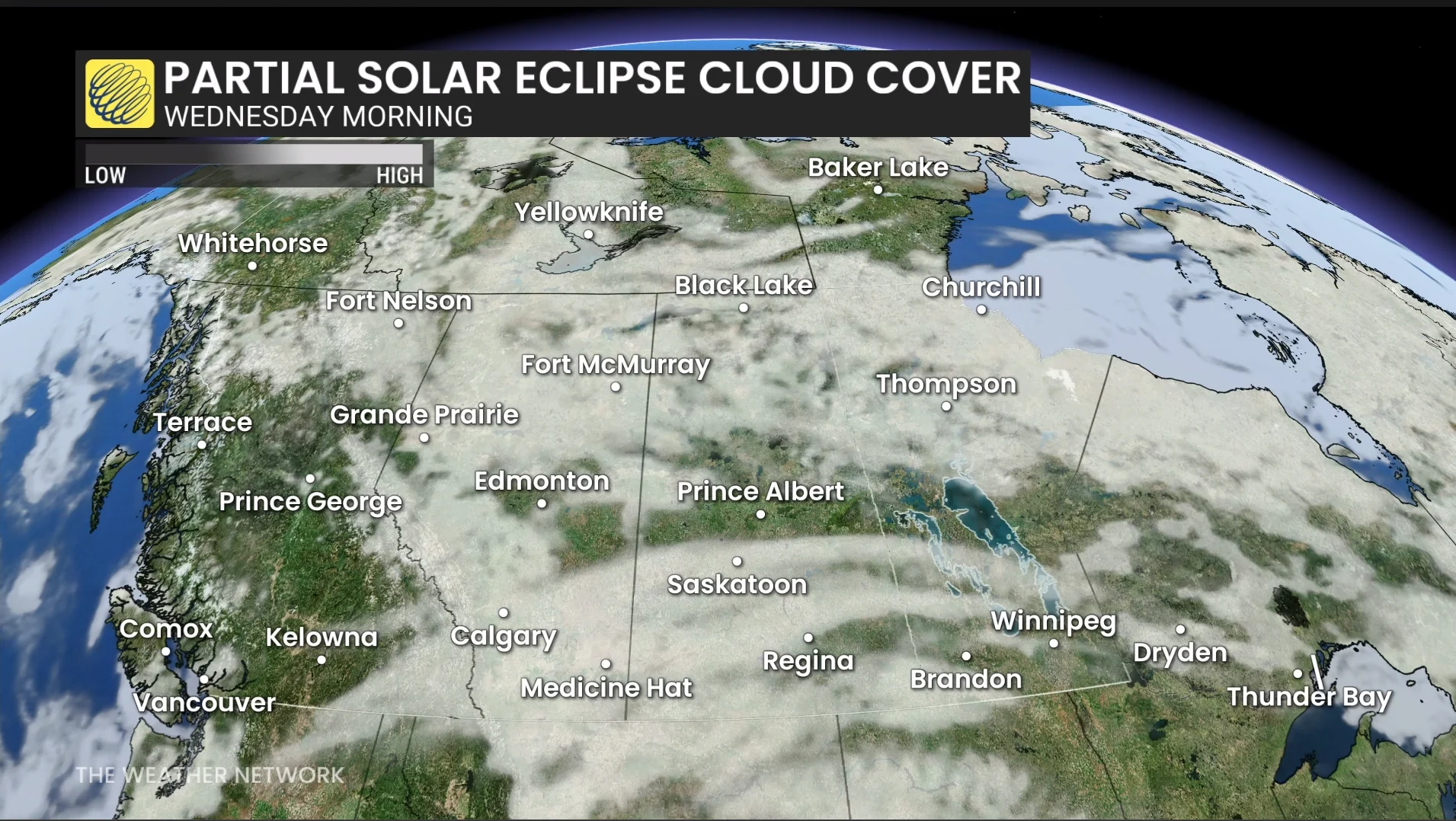
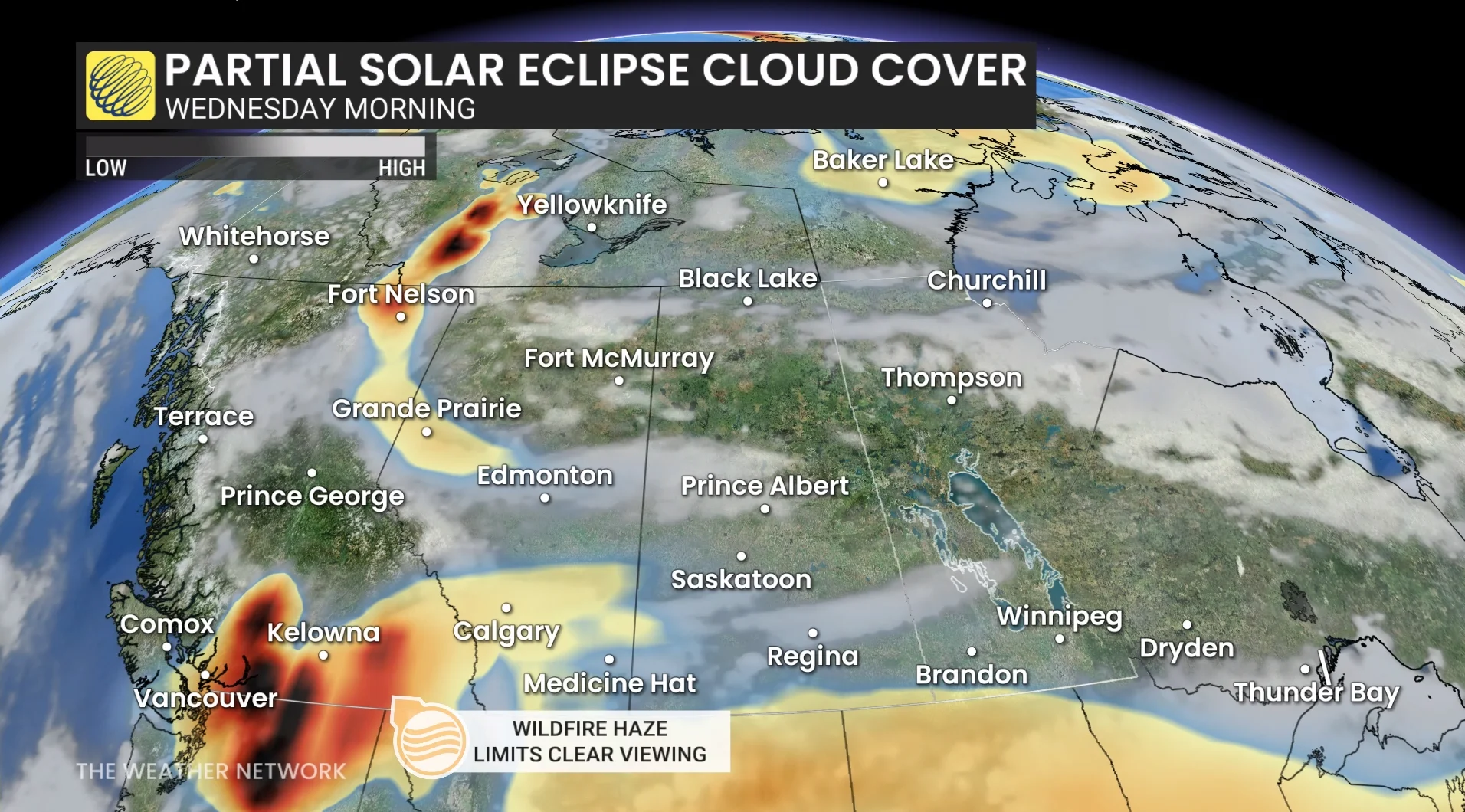
Check your forecast, on our website or on the app, for more localized information about your sky conditions.
Safety first!
During a partial solar eclipse, there is no safe time to look up at the alignment of the Sun and Moon without eye protection.
Eye protection, in this case, means a proper pair of mylar solar eclipse glasses.
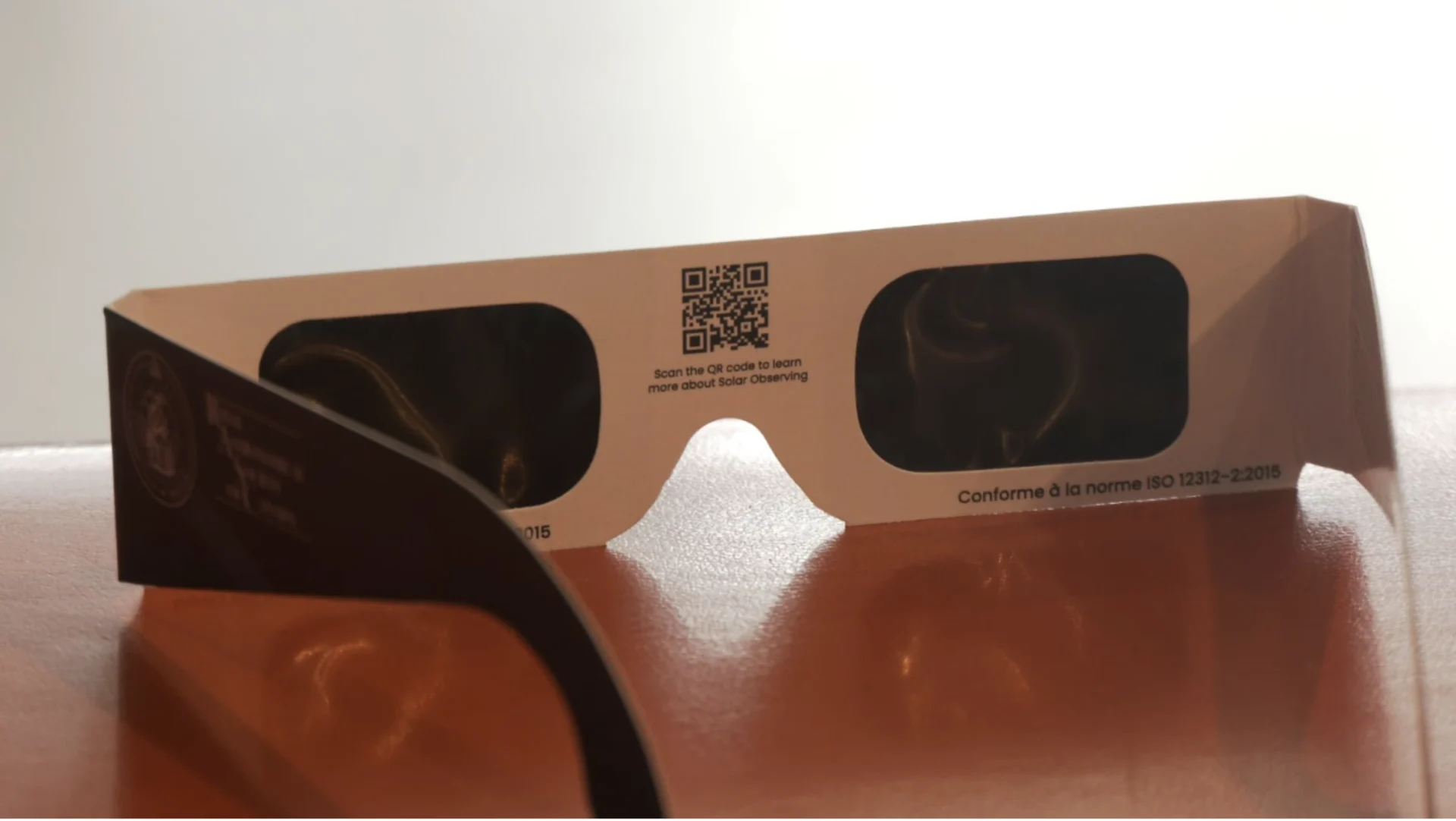
Solar eclipse glasses. (Connor O'Donovan)
Or, you can construct a simple pin-hole projector, as a way of observing the eclipse indirectly. Watch the video below for instructions on how to turn a cereal box into such a projector.
READ MORE: Follow these tips to safely observe any solar eclipse
Watch totality happen, live!
Even though we won't directly see totality from within Canada, the European Space Agency is broadcasting a live feed of the eclipse, as it occurs, from Observatorio Astrofísico de Javalambre, in Teruel, Spain.
As for the weather there, it looks amazing throughout most of the path of totality, with clear skies in the forecast.
Since Teruel is near the end of the path of totality, this is an evening solar eclipse for them. Thus, the above livestream begins at 7:30 p.m. Central European Summer Time (CEST).
Here in Canada, that translates to 3 p.m NDT, 2:30 p.m. ADT, 1:30 p.m. EDT, 12:30 p.m. CDT, 11:30 a.m. CST/MDT, and 10:30 a.m. PDT.