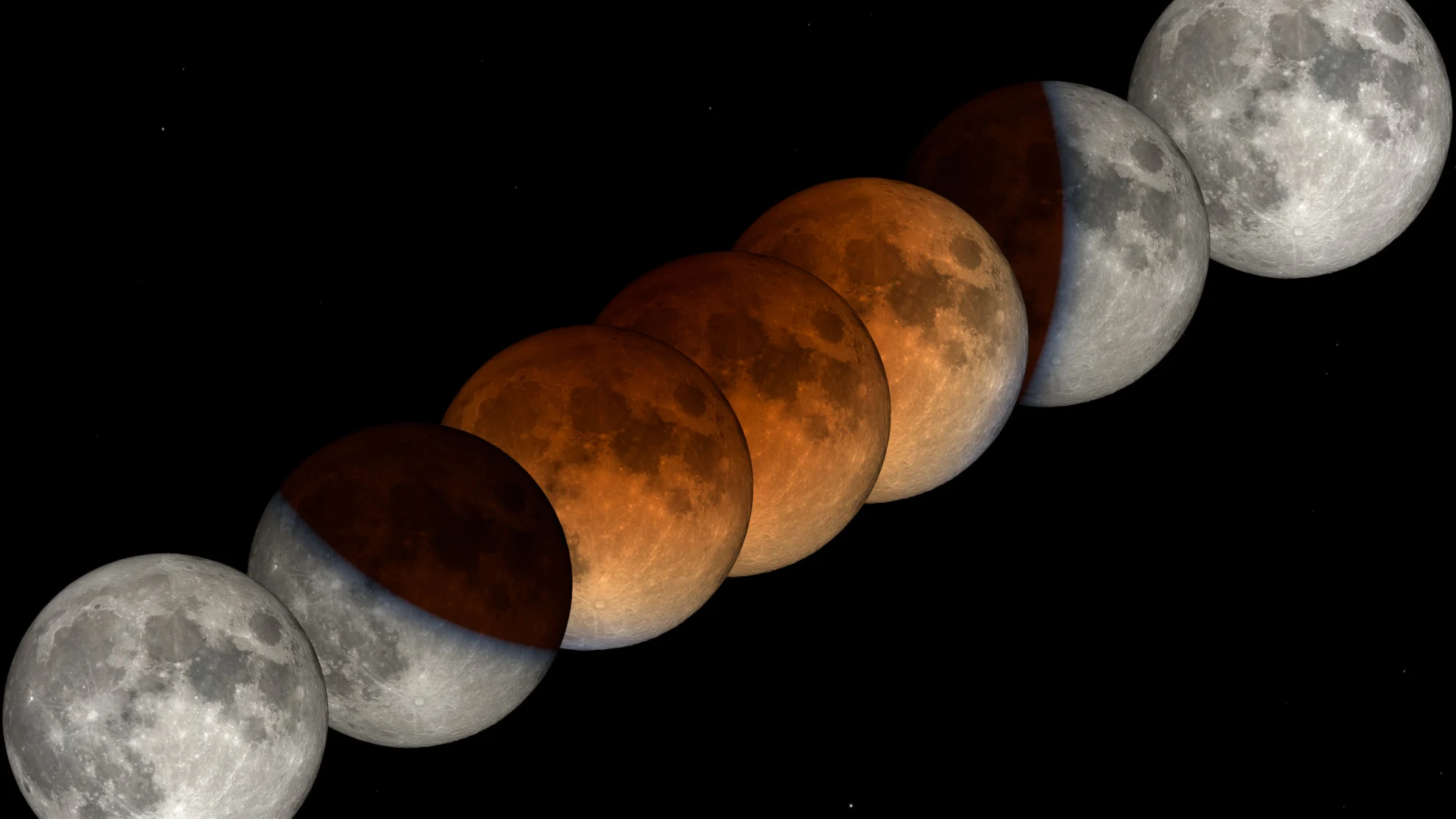
A total lunar eclipse will shine over Canada! Here's how to watch from anywhere

Don't miss the Blood Worm Moon, early in the morning on March 3rd!
Check your weather forecast for clear skies in the hours between midnight and sunrise on Tuesday, for a chance to see the last total lunar eclipse until the end of 2028!
Even if you're completely overcast, though, don't worry! Read on to discover how to watch this spectacular celestial event from anywhere, regardless of the weather!
On Tuesday, March 3, the Full Moon will pass directly through Earth's umbral shadow, resulting in a total lunar eclipse.
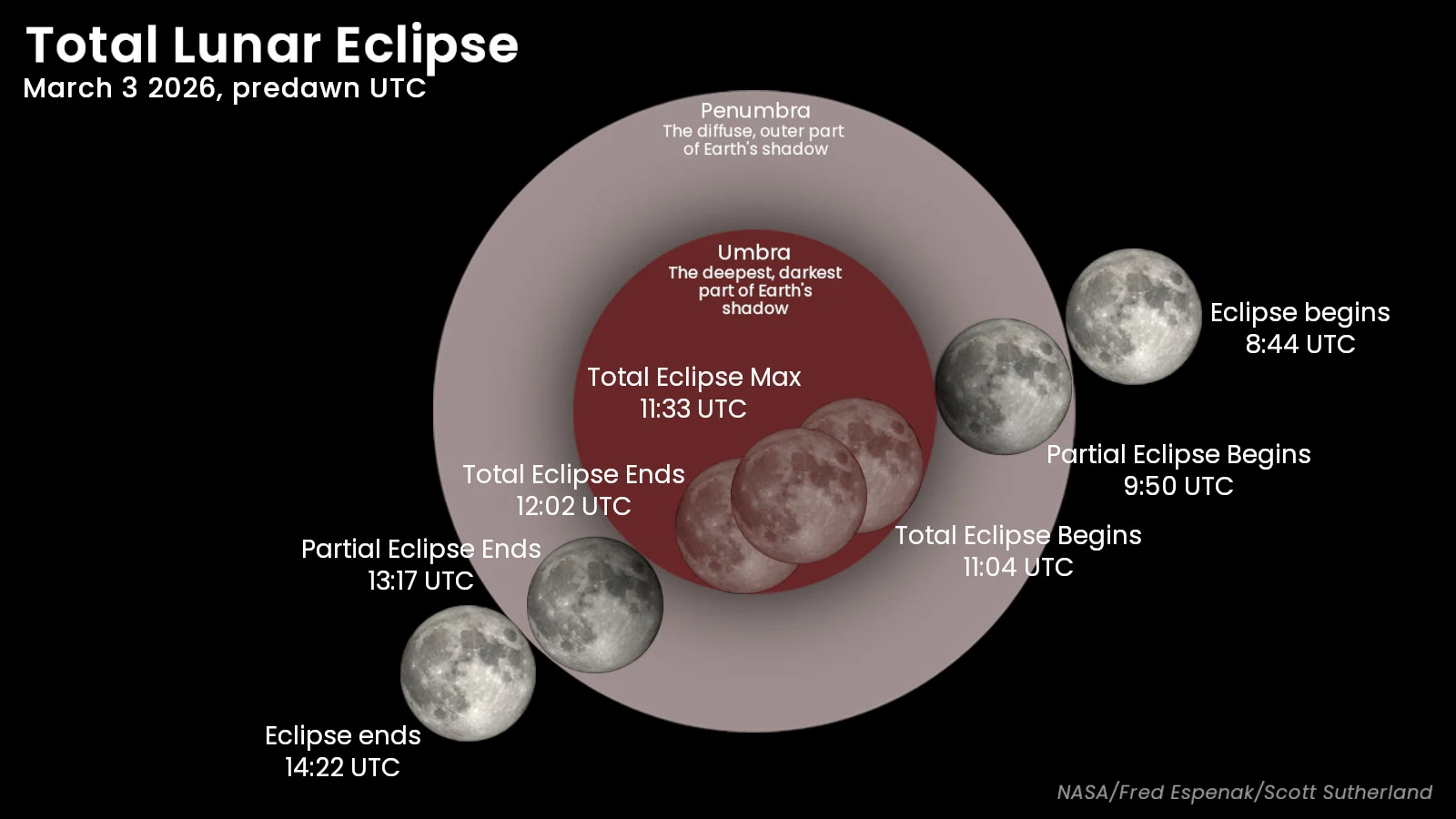
The path of the Full Moon through Earth's shadow on the morning of Tuesday, March 3, 2026. All times are in Universal Coordinated Time (UTC). (Scott Sutherland/NASA SVS)
To get the timing just right, though, this is an event we'll all have to either stay up late or get up early for.
The entire eclipse lasts for roughly five and a half hours, with the Moon in totality — when it turns red — for nearly one hour.
However, the exact timing of the event puts it in the hours between midnight and dawn. Plus, the farther east the observer is, the closer to dawn the event starts, and thus the sooner it will end as the Moon sets beyond the horizon.

READ MORE: A Great Comet may shine along with meteor showers and bright planets this spring
What will we see?
For observers in Atlantic Canada, the eclipse will become visible shortly before sunrise, and the Moon will set during the partial phase of the event. The total phase of the eclipse will be visible from Quebec to British Columbia, but for varying amounts of time.
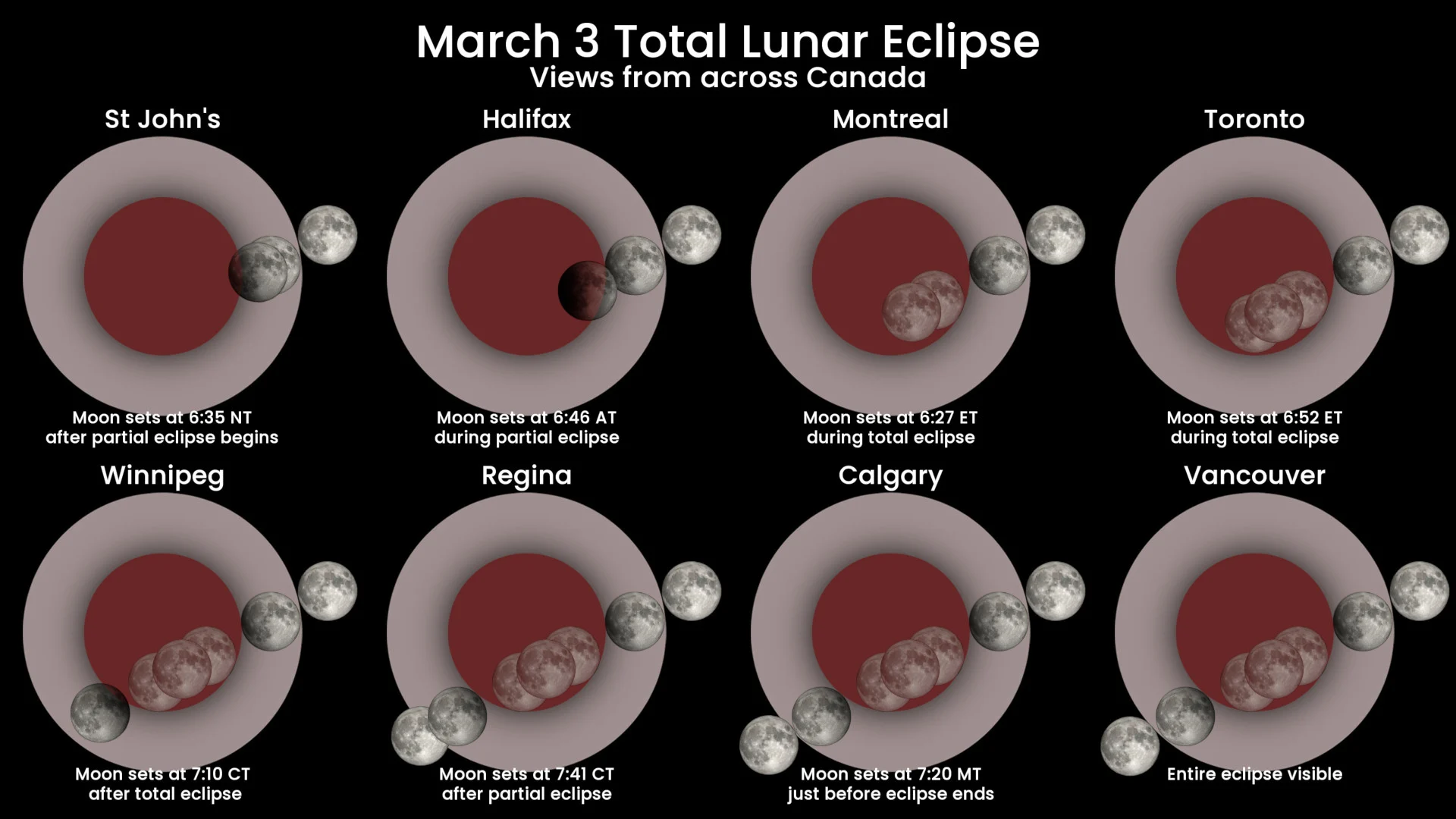
This graphical representation of the eclipse shows how much of the eclipse each location will see, based on the timing. The time the Moon sets during the eclipse is shown for all locations except Vancouver, where it slips below the horizon just after the eclipse ends. (Scott Sutherland/NASA SVS)
In general, the Moon will set during totality for Quebec and Ontario, during the final partial phase for Manitoba, as the Moon is in the diffuse penumbra for Saskatchewan, and just before the event ends in southern Alberta.
Only in British Columbia, northwestern Alberta, the Yukon, and the western half of the Northwest Territories will the entire eclipse be visible.
DON'T MISS: Asteroid impact with Moon would produce visible flash, followed by meteor storms
What if it's cloudy?
This time of year is notorious for having cloudy skies. However, it looks like we may have some good luck for this event.
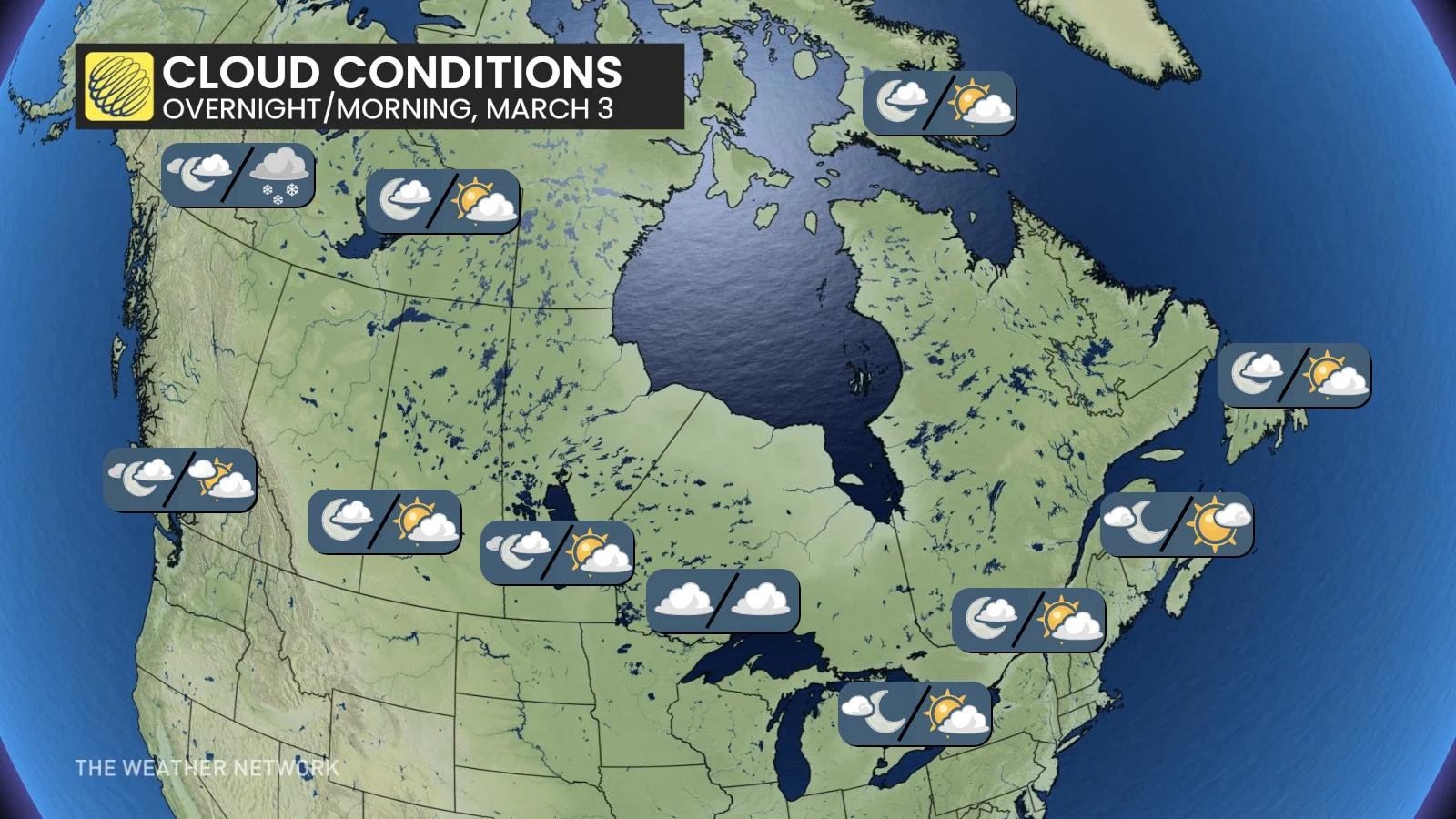
As shown below, as of Thursday's forecast (Feb. 26), it appears that much of the country will have clear or at least partly clear skies overnight from Monday into Tuesday, and through Tuesday morning. Only northwestern Ontario shows any indication of significant cloud cover for both periods, while Whitehorse looks as though it will have overcast conditions with snow in the morning.
However, in the case the weather does not cooperate, we can still watch this lunar eclipse.
We just need to turn to the internet, specifically from the Griffith Observatory, for help.
The live stream embedded above begins on March 3, at 12:47 a.m. PST (3:47 a.m. EST). They will present views of the total lunar eclipse from the south-facing slopes of Mount Hollywood, in Los Angeles, California, up until 6:25 a.m. PST (9:25 a.m. EST).