Impossibly hot 'baby' galaxy cluster may rewrite the cosmic rulebook

"SPT2349-56 changes everything we thought we understood," says one Canadian researcher.
A Canadian-led team of researchers has discovered a 'baby' galaxy cluster in the early universe surrounded by gas far hotter than anything they thought could form at that time. This discovery challenges assumptions about what the early cosmos was like, and may rewrite the rules for how galaxy clusters form.
Most galaxies we see in the universe are clumped together into clusters, where up to several thousand members are all gravitationally bound to one another and surrounded by a cloud of hot gases known as the intracluster medium (ICM).
Our Milky Way, for example, is part of the Virgo Supercluster, which contains over 47,000 members at last count.
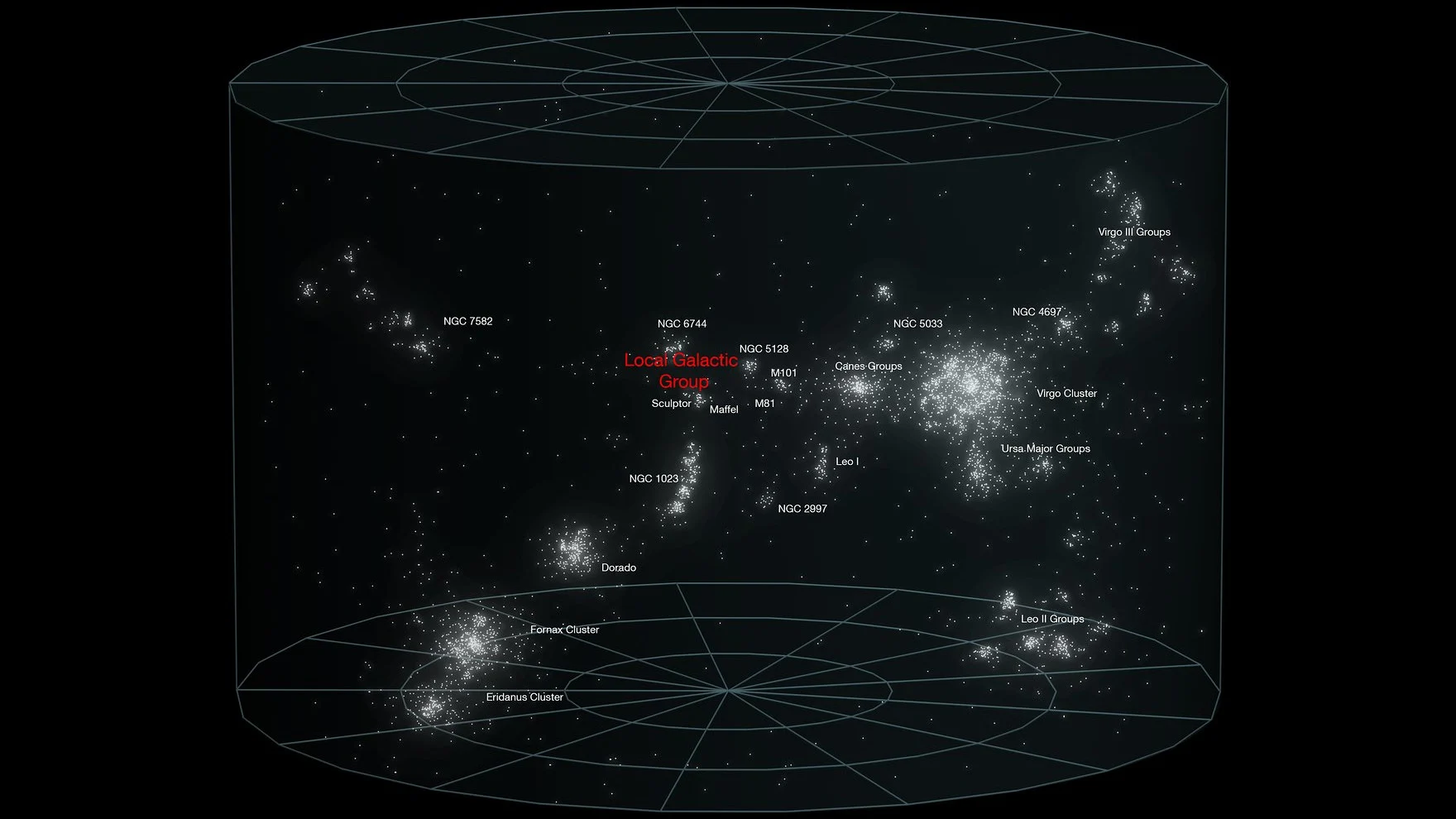
A 3D map of the Virgo Supercluster, with the Local Group (the galaxy group to which our Milky Way belongs) named in red. (ESO/Andrew Z. Colvin/N. Bartmann)
DON'T MISS: Artemis 2 may launch in a month, shattering a 55-year-old spaceflight record
In the earlier universe, these clusters started out much smaller, with maybe a few dozen members. Astronomers assumed that the 'atmosphere' of gases surrounding these smaller clusters would be much cooler than what we detect in clusters now. However, a new discovery has upended that assumption.
Using the radio telescopes of the Atacama Large Millimeter/submillimeter Array, located at the European Southern Observatory in Chile, a team of astronomers looked back in time roughly 12 billion years, to an 'infant' galaxy cluster known as SPT2349-56.
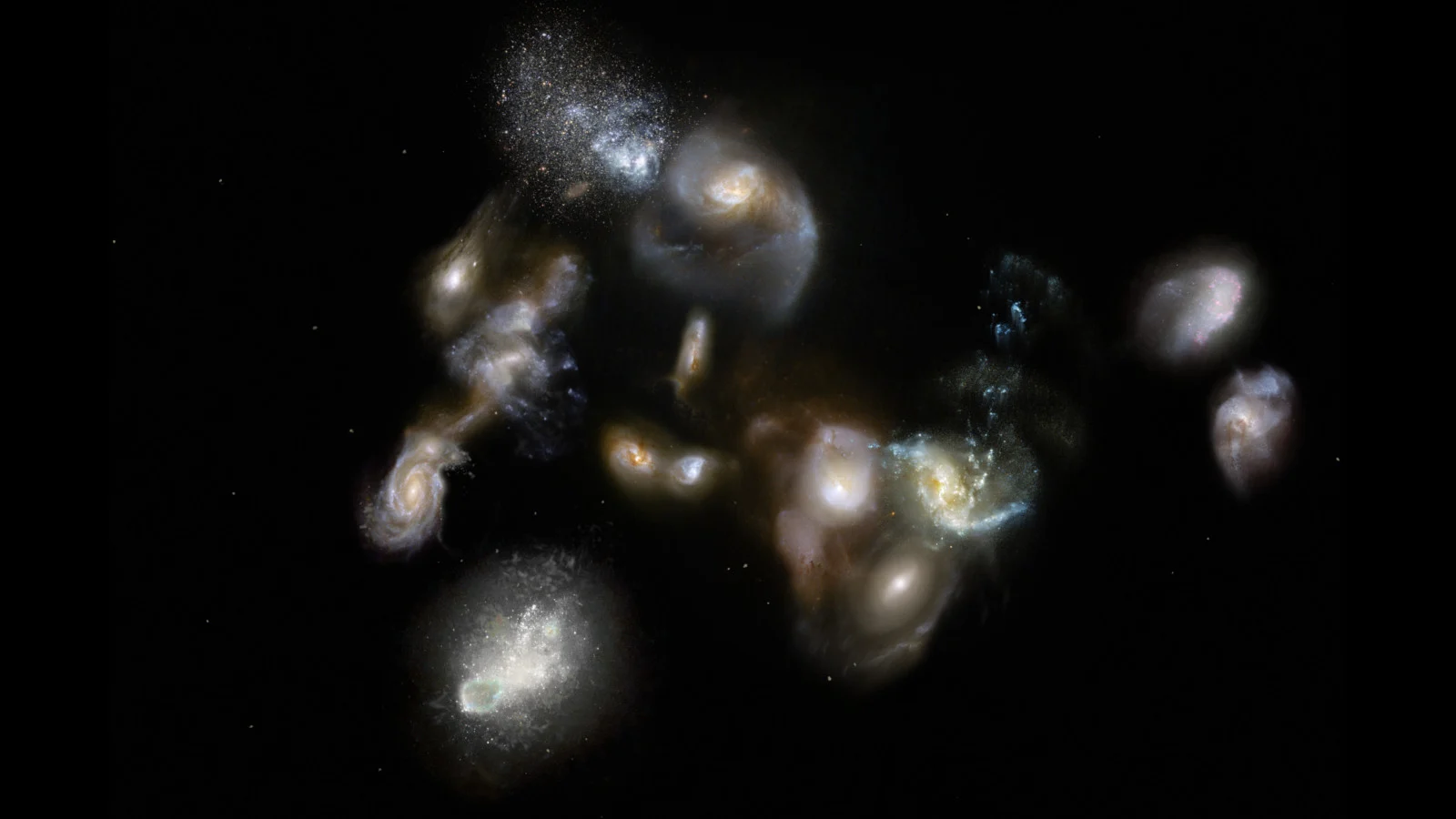
An artist's impression of galaxy cluster SPT2349-56 reveals what this group of interacting multi-celestial objects could look like if we were able to view them close-up. (ESO/M. Kornmesser)
RELATED: Jupiter shines at its brightest this weekend, alongside the Winter Triangle
SPT2349-56 is composed of over 30 young, active galaxies, gathered together into a space of around 500,000 light years in diameter. That means the entire cluster is very compact, and would fit roughly into the same space occupied by the halo of stars surrounding the Milky Way.
Radio observations of SPT2349-56 with ALMA provided the astronomers with an estimate of the temperature of its intracluster 'atmosphere' of gases. The assumption was that it would be relatively cool, as these clusters are thought to heat up very gradually over billions of years.
However, based on a new study published in the journal Nature, that wasn't the case.
Instead, SPT2349-56's intracluster medium was over five times hotter than expected.
"We didn't expect to see such a hot cluster atmosphere so early in cosmic history," Dazhi Zhou, a PhD candidate at the University of British Columbia and the lead author of the study, said in a UBC press release.
"In fact, at first I was skeptical about the signal, as it was too strong to be real," Zhou added. "But after months of verification, we've confirmed this gas is at least five times hotter than predicted, and even hotter and more energetic than what we find in many present-day clusters."

An artist's impression of galaxy cluster SPT2349-56, as it appeared over 12 billion years ago, with a few dozen galaxies packed together, along with hot gases (in red) threaded among its members. (MPIfR/N. Sulzenauer)
RELATED: Eyes to the winter sky for meteor showers, a supermoon and a total lunar eclipse
In previous research, published in early 2025, Zhou used ALMA observations of SPT2349-56 to reveal it contained far more gas (around 75 per cent more) than had previously been detected. Using this 'hidden cosmic fuel tank' the cluster was maintaining a star-forming rate thousands of times greater than what we see here in our own Milky Way.
This discovery that its intracluster medium was so hot is something new, though.
"SPT2349-56 changes everything we thought we understood,” study co-author Scott Chapman, from Dalhousie University, said in a press release from the National Radio Astronomy Observatory (NRAO). "Our measurements show a superheated cluster atmosphere only 1.4 billion years after the Big Bang, at a time when we thought the intracluster gas should still be relatively cool and slowly settling in. It suggests that the birth of massive clusters could be much more violent and efficient at heating the gas than our models assumed."
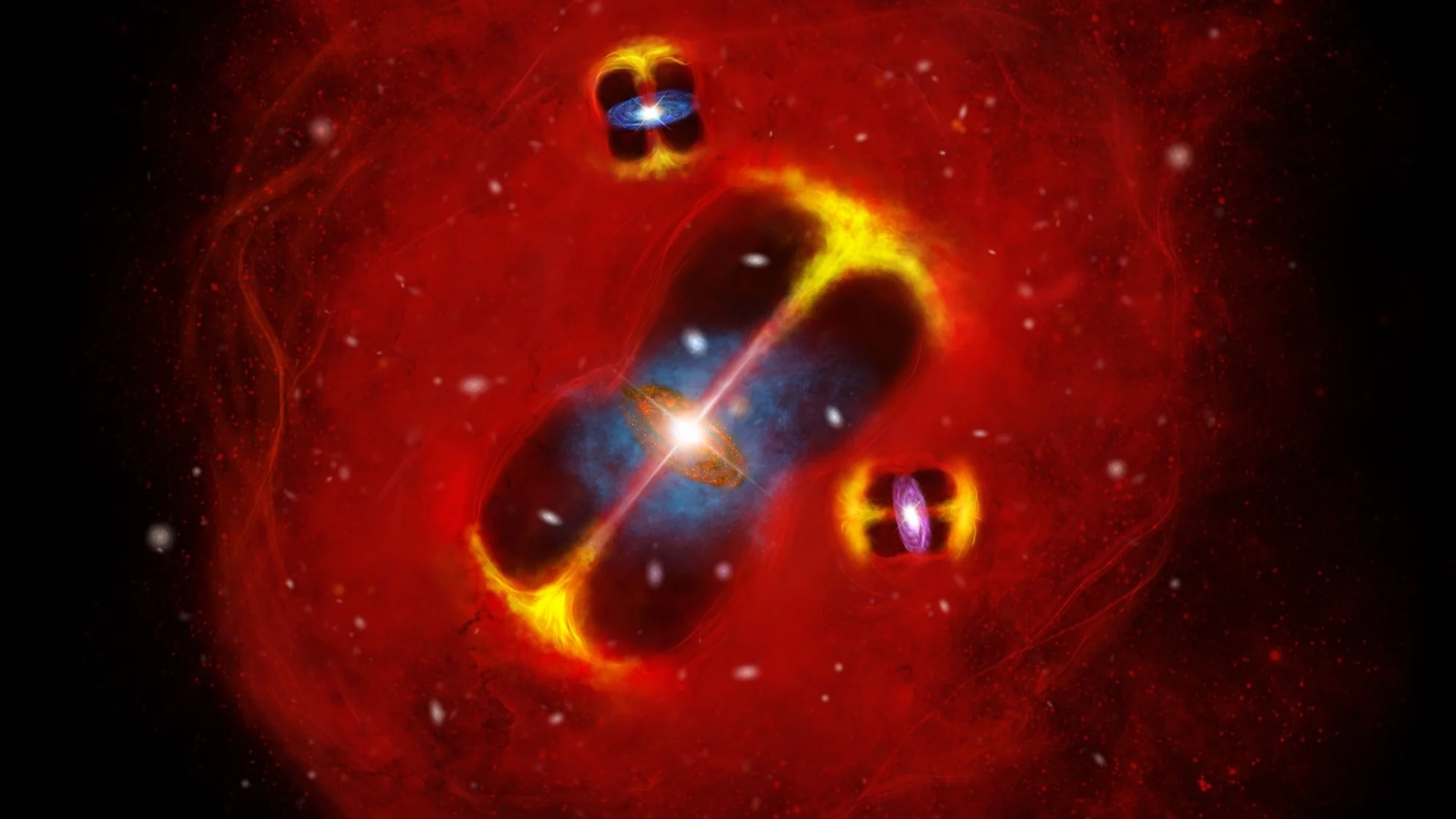
According to the researchers, the potential cause of the cluster's extreme heat is a trio of active supermassive black holes. Powerful outbursts from these three galactic cores would not only imbue the intracluster medium with a tremendous amount of energy, but they would also compress the gases, heating the cloud up even further.
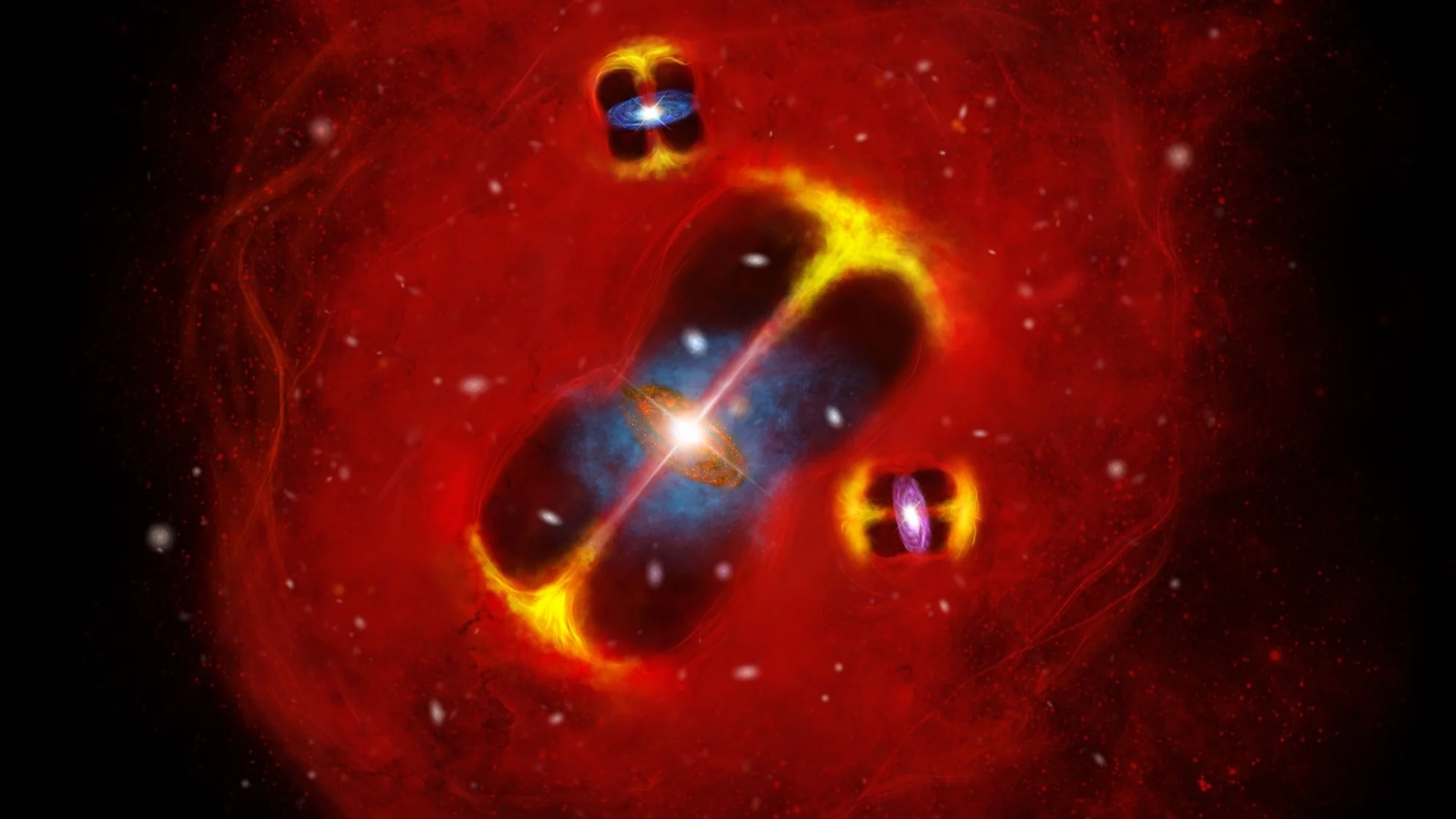
The intracluster medium is highlighted in this artist's impression of SPT2349-56, along with the potential cause of the extreme heat in the cluster — a trio of active black holes pumping vast amounts of energy into their surroundings via powerful jets. (Lingxiao Yuan/UBC)
MORE FROM SPACE: The five best Space and Astronomy stories of 2025
The next stage of the research into this intense, compact galaxy cluster is to figure out exactly how all of these odd factors relate to one another, and how they might develop into the larger clusters we see today.
"SPT2349-56 is a very strange and exciting laboratory. We see intense star formation, energetic supermassive black holes and this overheated atmosphere all packed into a young, compact cluster," Zhou told the NRAO. "There is still a huge observational gap between this violent early stage and the calmer clusters we see later on. Mapping how their atmospheres evolve over cosmic time will be a very exciting direction for future work."