Artemis 2 may soon shatter a 55-year-old spaceflight record

Apollo 13's record distance from Earth has stood for over half a century. Can Artemis 2 launch in time to break it?
We're at roughly T minus one month for the launch of Artemis 2. Here's what we can expect from this journey, the role Canada is playing in it, and how the mission may make history in more ways than one.
The very first launch window for Artemis 2 is currently scheduled to open on the evening of February 6, 2026, at 9:41 p.m. EST. That means, barring any delays due to technical issues or inclement weather, the roughly 10-day mission will lift off on that date, fly around the Moon either late on February 11 or early on February 12, and then return to Earth by the 16th or 17th.
And what is the mission? NASA astronauts Reid Wiseman, Christina Koch, and Victor Glover, and Canadian Space Agency astronaut Jeremy Hansen, will be making the first crewed flight of the Orion spacecraft.
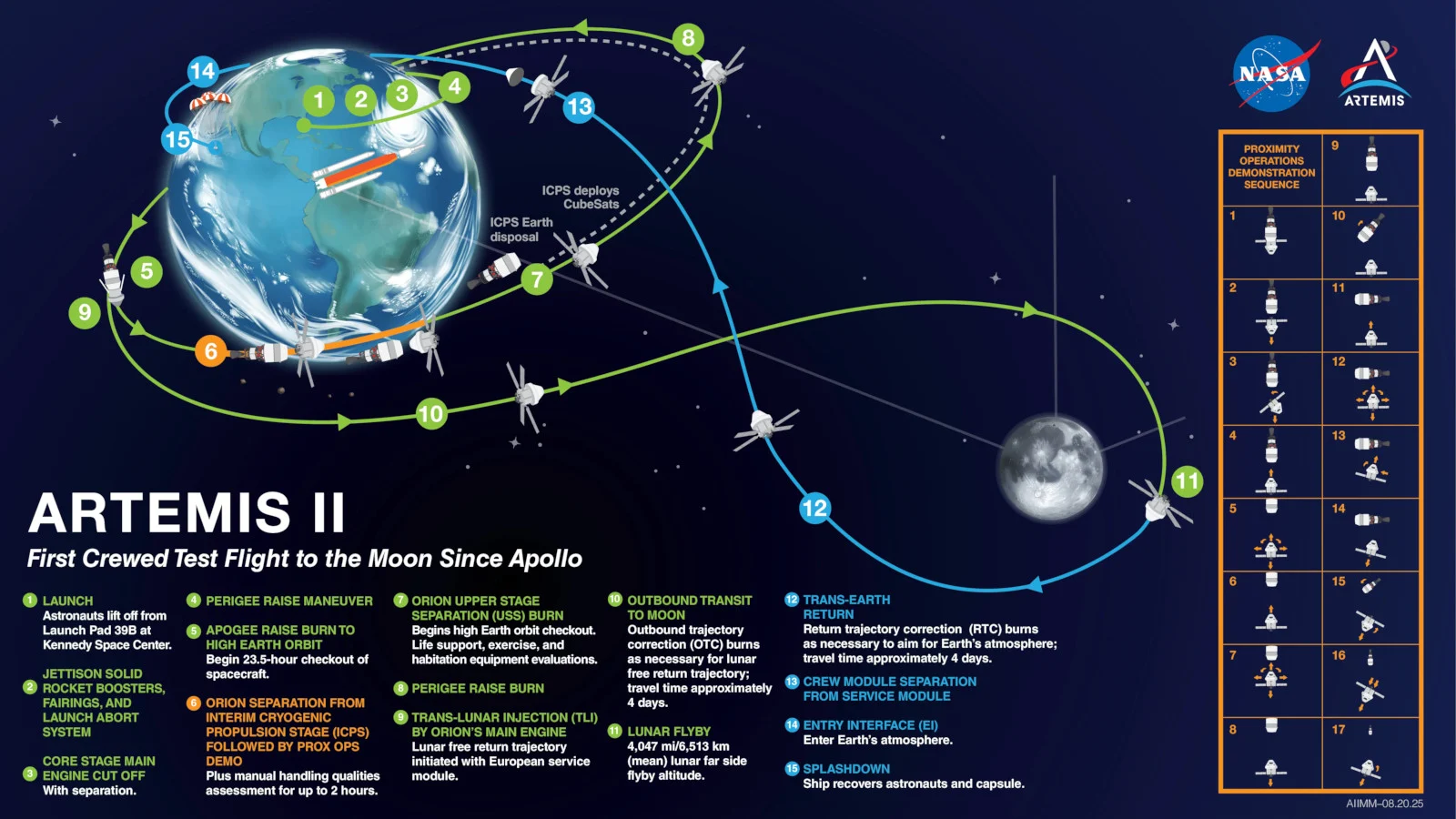
A map of the Artemis 2 mission, detailing the different stages of the flight, as well as the maneuvers the crew will perform in high Earth orbit, when in close proximity to the Interim Cryogenic Propulsion Stage (ICPS). (NASA)
With Artemis 2, NASA has essentially planned a mission that is like a combination of Apollos 7 and 8, from 1968. Like Apollo 7, they will spend time in Earth orbit, testing the Orion spacecraft's life support systems and maneuverability. Then, similar to Apollo 8, they will perform a multi-day trip around the Moon and back, to assess the spacecraft's performance with a full crew on board.
Along the way, the astronauts will perform various medical and scientific studies. This includes the closest human observations of the Moon in over 50 years.
The ultimate goal is to put NASA on track to launch Artemis 3, which will land astronauts near the lunar south pole, returning humans to the surface of the Moon for the first time since 1972.
The Crew
Artemis 2 will be the first crewed flight for Orion, taking place a little over three years after the uncrewed Artemis 1 test mission.
On board the mission will be four astronauts.
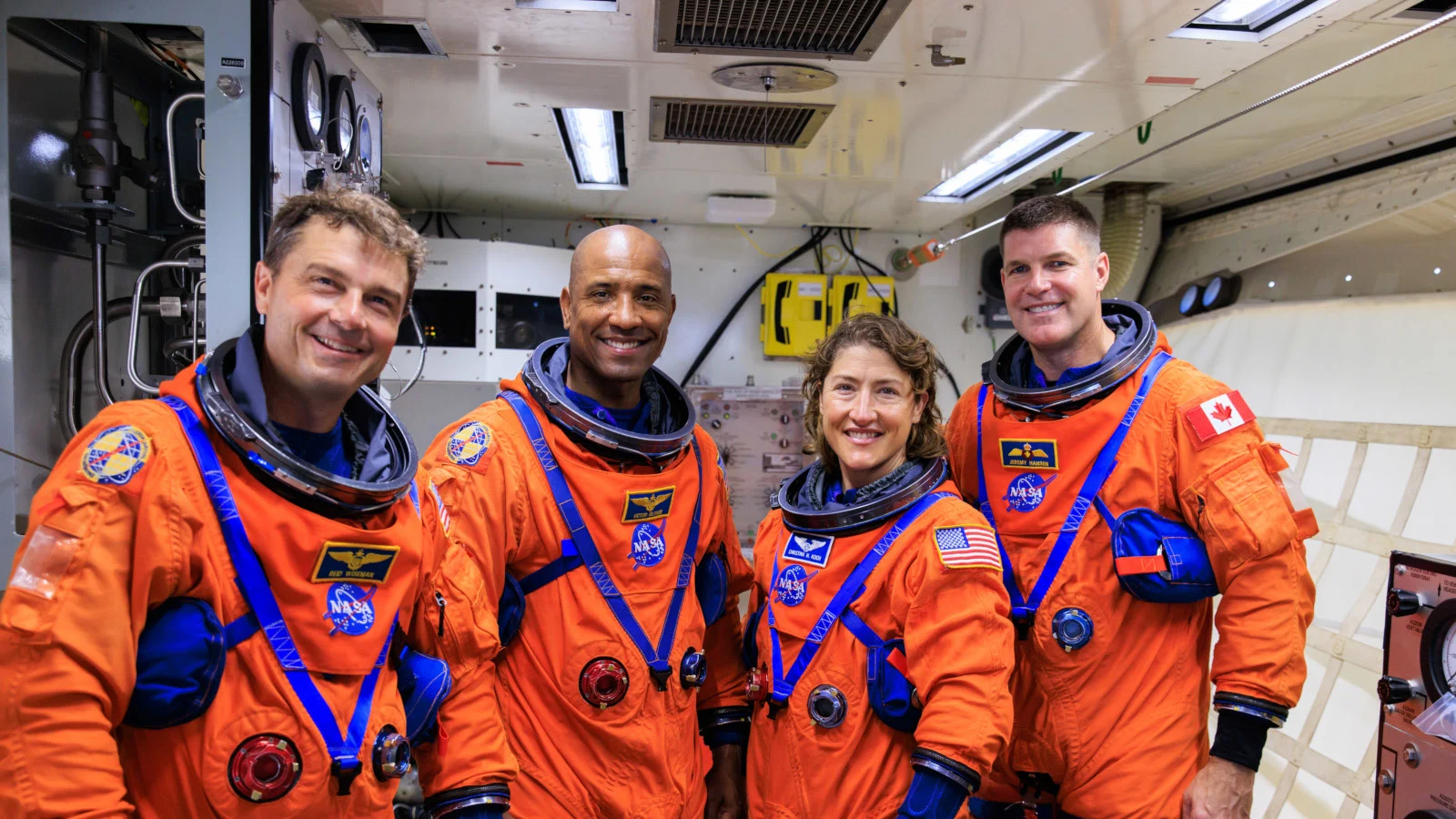
From left to right: Reid Wiseman, Victor Glover, Christina Koch, and Jeremy Hansen, are the four members of the Artemis 2 crew. (NASA)
For mission commander Reid Wiseman, pilot Victor Glover, and mission specialist Christina Koch, Artemis 2 will be the second spaceflight for each. All three have made previous trips to the International Space Station: Wiseman in 2014, Koch in 2019-2020, and Glover in 2020-2021.
This will be the very first trip into space for mission specialist Jeremy Hansen. As the first Canadian to venture beyond low-Earth orbit, Hansen will support spacecraft operations, participate in scientific and medical experiments throughout the flight, and even make geological observations of the Moon during their flyby.
Despite having high-resolution cameras in orbit of the Moon, such as on the Lunar Reconnaissance Orbiter, the geologists training the crew have emphasized the importance of human observations.
As Hansen noted in a December interview with Bob McDonald, for CBC Radio's Quirks and Quarks, he was initially skeptical that they, the crew, could pick out anything on the lunar surface from space that the satellites hadn't.
However, after their training was complete, he found himself convinced that the human eye and the human brain were essential for picking out not just the differences in the features and terrain, but also to spot what he called the "different kind of different," to guide where future missions may wish to explore.
Making History
Artemis 2 is set to make history in several ways.
Not only is this the first human mission to the Moon in roughly 53 years, it is the largest human crew ever sent on a single lunar flight. Additionally, Victor Glover will be the first person of colour, and Christina Koch will be the first woman to travel to the Moon. Also, Jeremy Hansen will be the first non-American to make the journey.
Remarkably, due to the Moon's position in its orbit at the time, these four astronauts could set a brand new spaceflight record, reaching the farthest distance humans have ever travelled from Earth.

A comparison of the Artemis 2 mission to Apollo 13, noting the differences in distance between the Earth and the Moon, and the Moon and the spacecraft, as each passed around the far side of the Moon. (Scott Sutherland/NASA SVS)
If Artemis 2 lifts off on February 6, the crew should pass around the far side of the Moon on the 11th or 12th, just after the Moon reaches its farthest distance from Earth for the month. As they fly 7,500 km above the lunar surface at that time, their maximum distance from Earth will be around 413,600 km. That's over 13,400 km farther than the Apollo 13 record of 400,171 km, set back on April 14, 1970.
However, as the Moon's distance from Earth is always changing as it swings around in each orbit, breaking the record is highly dependent on the exact date of the launch.
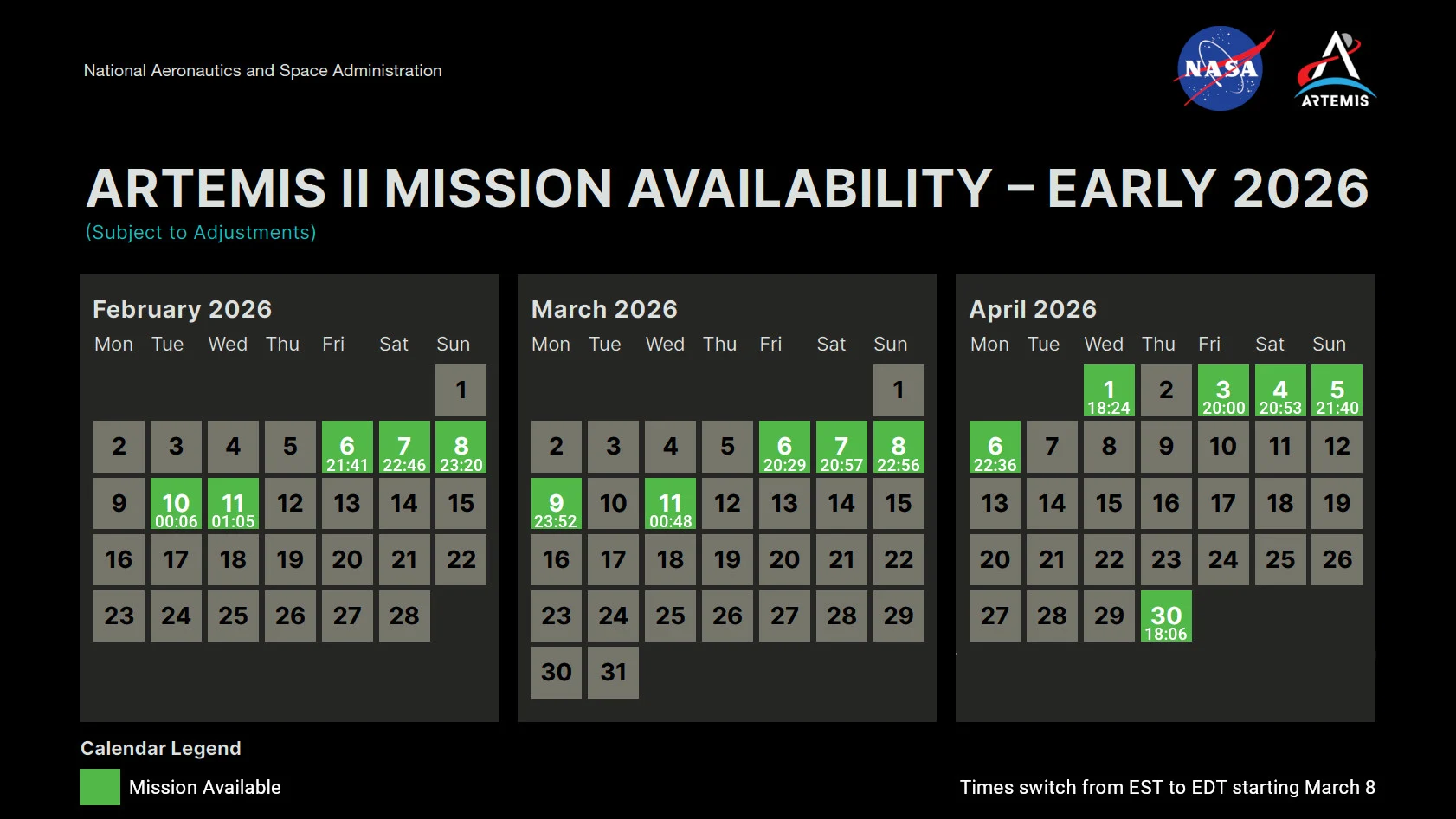
The potential launch windows for Artemis 2 (highlighted in green), in early-2026. (NASA)
Based on the mission schedule, if the Feb 6 liftoff is scrubbed, the crew can still reach farther from Earth than the Apollo 13 crew if they leave on the 7th, 8th, or 10th. The same goes for March 6-9, April 1, April 3-6, or April 30.
However, if the timing works out that they must begin the mission on either Feb 11 or March 11, the Artemis 2 crew will come close, but Apollo 13's record will stand.
(This article has been updated based on the schedule of available launch dates, released by NASA after the original article was published.)