Why do the Great Lakes freeze unevenly?

Several factors dictate how quickly the Great Lakes freeze over in the heart of winter
All five of the Great Lakes are enormous in their own right, but they’re not all equal.
Each body of water has its own characteristics that affect everything from lake-effect snow to popular culture.
The lakes reveal their personalities through ice cover during the heart of winter. All five lakes build a crust of ice in their own unique way. Here’s a look at why the Great Lakes don’t freeze evenly during the heart of winter.
Average ice cover varies greatly between the lakes
Ice coverage on the Great Lakes tends to follow a familiar pattern.

Historically, Lake Erie is the only lake that comes closest to freezing over in an average season. Lake Huron typically notches about two-thirds of its surface covered in ice at the winter’s greatest extent, followed close behind by Lake Superior.
Only about one-third of Lake Michigan holds ice cover during the peak of the season, while just over one-quarter of Lake Ontario freezes over. What’s the deal?
Lake depth matters most
A significant part of the puzzle is lake depth.
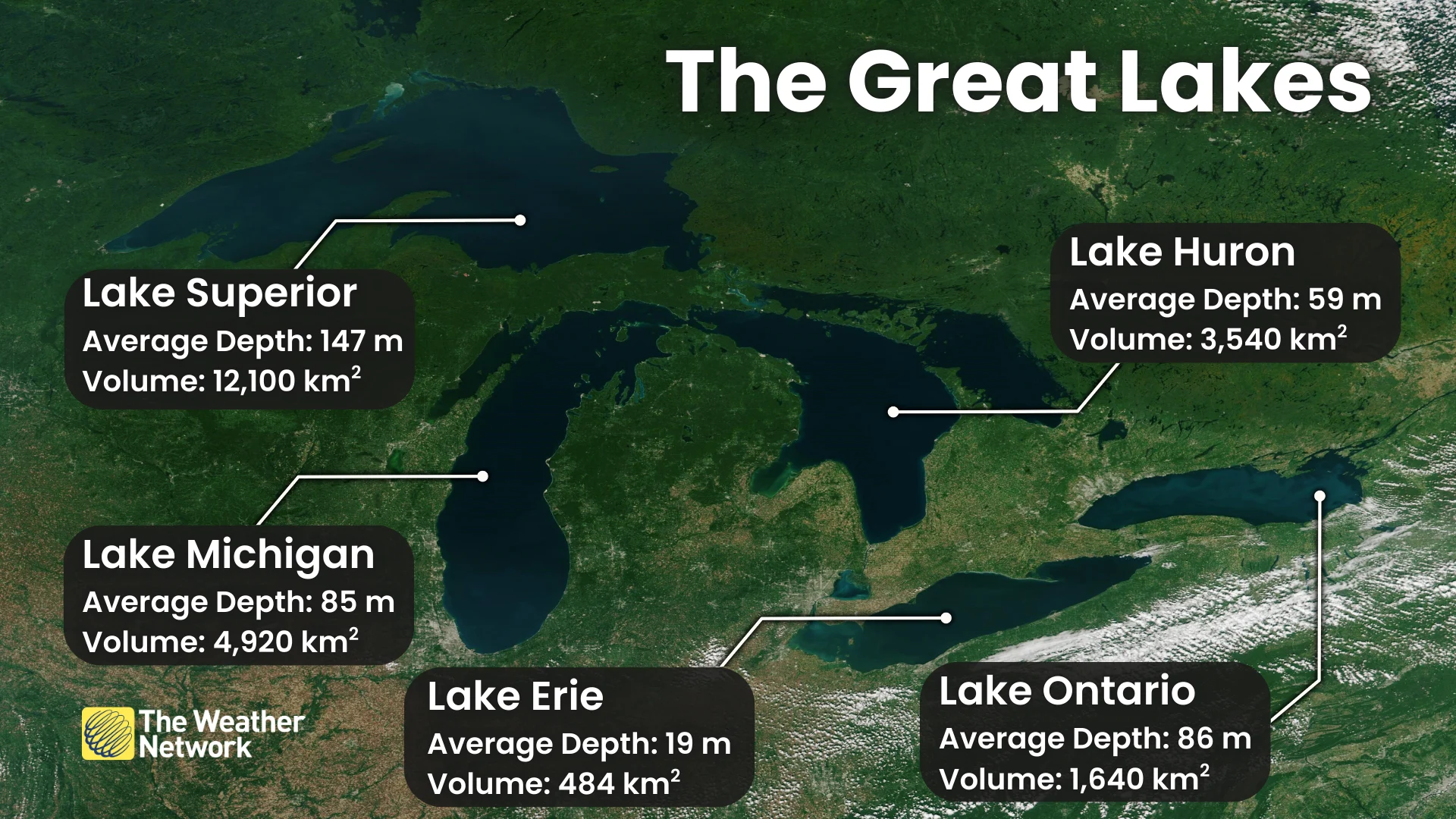
The region’s largest and smallest lakes are in different leagues when it comes to both depth and water volume.
Lake Superior lives up to its name, holding 25 times more water and an average depth of about 7.7 times deeper than its distant neighbour Erie.
RELATED: Is it safe? How thick does ice need to be to walk or skate on?
Water’s high heat capacity allows the lakes to retain the heat they absorbed during the warm season. It takes a long while to cool down these vast bodies of water. This is why lake-effect snow continues through much of the winter and we don’t see peak ice coverage until late February or early March.
Lake Erie’s shallow depth and relatively low water volume allows it to cool off quickly, building a hearty crust of ice that often approaches 100 per cent coverage after long cold spells.

Meanwhile, despite Lake Ontario’s similar shape, size, and location, its significant depth holds more than three times as much water as Lake Erie. This helps Lake Ontario retain its heat longer than the other four lakes, considerably slowing down the freezing process.
Folks who live downwind of Lake Ontario are intimately familiar with the lake’s lack of ice. Watertown, New York, averages almost 300 cm of snow per year, which is more than twice as much as Toronto’s annual average.
Climate and geography play a role
Depth and water volume aren’t the only factors that determine ice coverage.

RELATED: Steps to follow to ensure your survival after a fall through the ice
Climate conditions vary greatly across the Great Lakes region. Lake Superior manages to punch above its weight in the ice department because average wintertime temperatures in northern Ontario are much colder than the same values down in southern Ontario.
Lake Michigan, on the other hand, struggles to build and maintain a solid coat of ice due to both its depth and its north-south orientation. Ice readily builds up around its shallow shores, but the centre of the lake often remains free and clear even during the strongest winter cold snaps.
Header image created using graphics and imagery from Canva.