Record rains revive a dry, ancient lake in Death Valley

This past month was Death Valley’s wettest November on record
Record rains in November revived an ancient lake that’s been mostly dry for tens of thousands of years.
The temporary lake, located in the heart of California’s Death Valley, saw water occupy the basin after the region experienced nearly 80 per cent of its annual precipitation in just a few weeks.
DON'T MISS: Deserts are a hotbed of extreme weather
Water temporarily fills Lake Manly in Death Valley
Death Valley, California, is one of the hottest places in the world during the summer months. Temperatures routinely rise above 50°C under the searing daytime sun due to its desert location and an elevation of more than 80 metres below sea level.
The heart of the valley itself is known as Badwater Basin. A deep lake that once occupied the area dried up over tens of thousands of years. Today, only bouts of heavy rainfall can add water to this arid region.
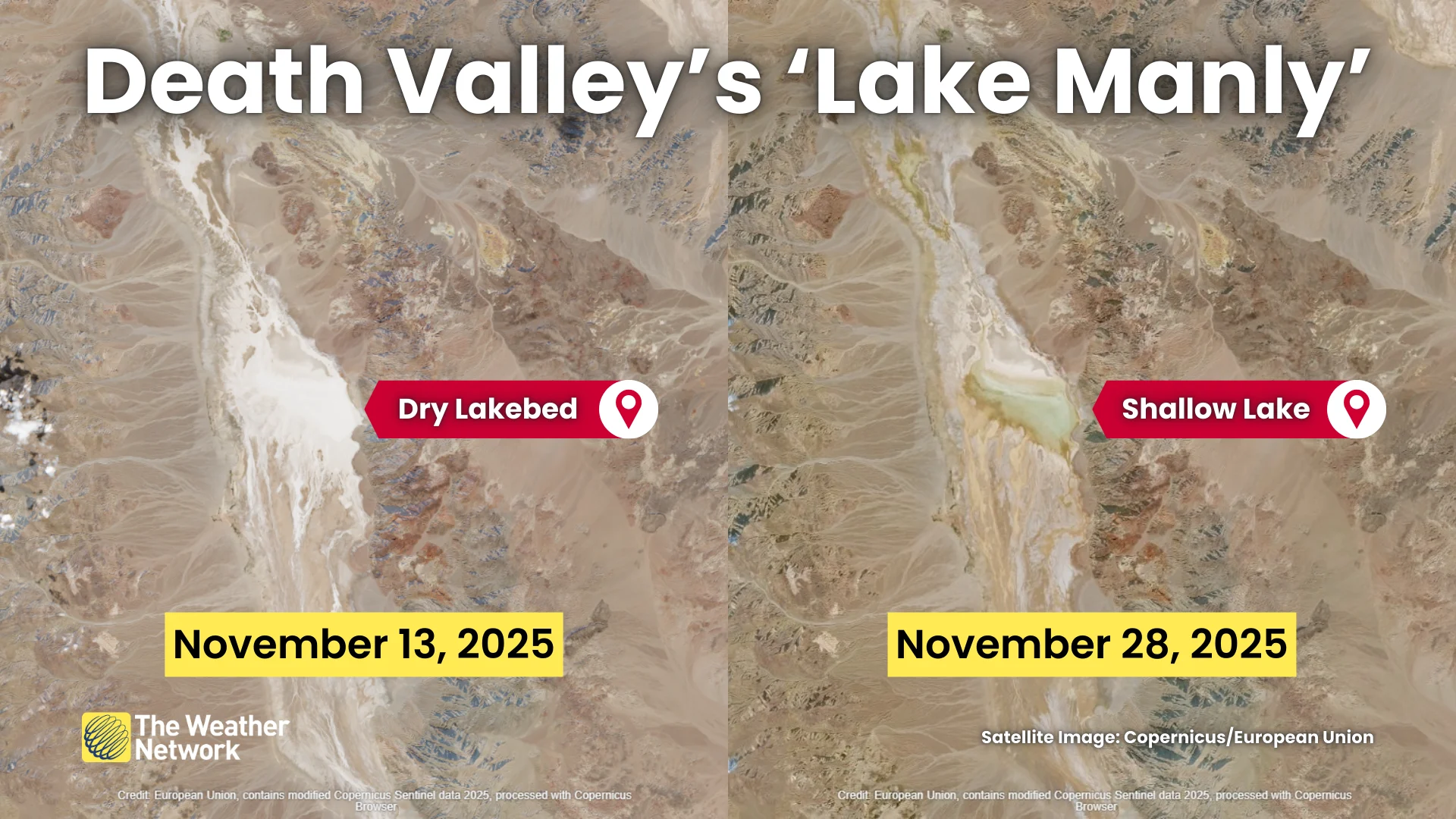
Rainwater runoff drains into Badwater Basin to create a temporary body of water commonly called Lake Manly. Record rains this past November brought that body of water to life once again.
“The water is about a mile from the Badwater parking lot and in most places would not rise above the tops of your shoes,” the U.S. National Park Service said in a recent release.
Significant rainfall events in 2024 and 2005 produced enough precipitation to refill the temporary lake with enough water for visitors to break out their kayaks.
Record rains this past autumn
A series of storms brought heavy rain and flash flooding to southern California during the month of November.

RELATED: Rare Sahara Desert rains filled lakes that hardly ever see water
Death Valley National Park recorded 44.7 mm of rain throughout the month, making for the site’s wettest November on record. This represents 79.9 per cent of the region’s annual rainfall of just 55.9 mm.
Downtown Los Angeles, which is about 275 km southwest of Death Valley, saw its fifth-wettest November on record with 140.4 mm of rainfall.
For context, one of the driest climate stations in Canada is Eureka, Nunavut, where they average around 77.6 mm of precipitation throughout the year. The country’s wettest city is Prince Rupert, B.C., which notches an astounding 2,593.6 mm in an average year.