Beware: These fake pinecones are crawling with invasive pests

The bagworms are in Canada thanks to good old global "worming" (not a typo).
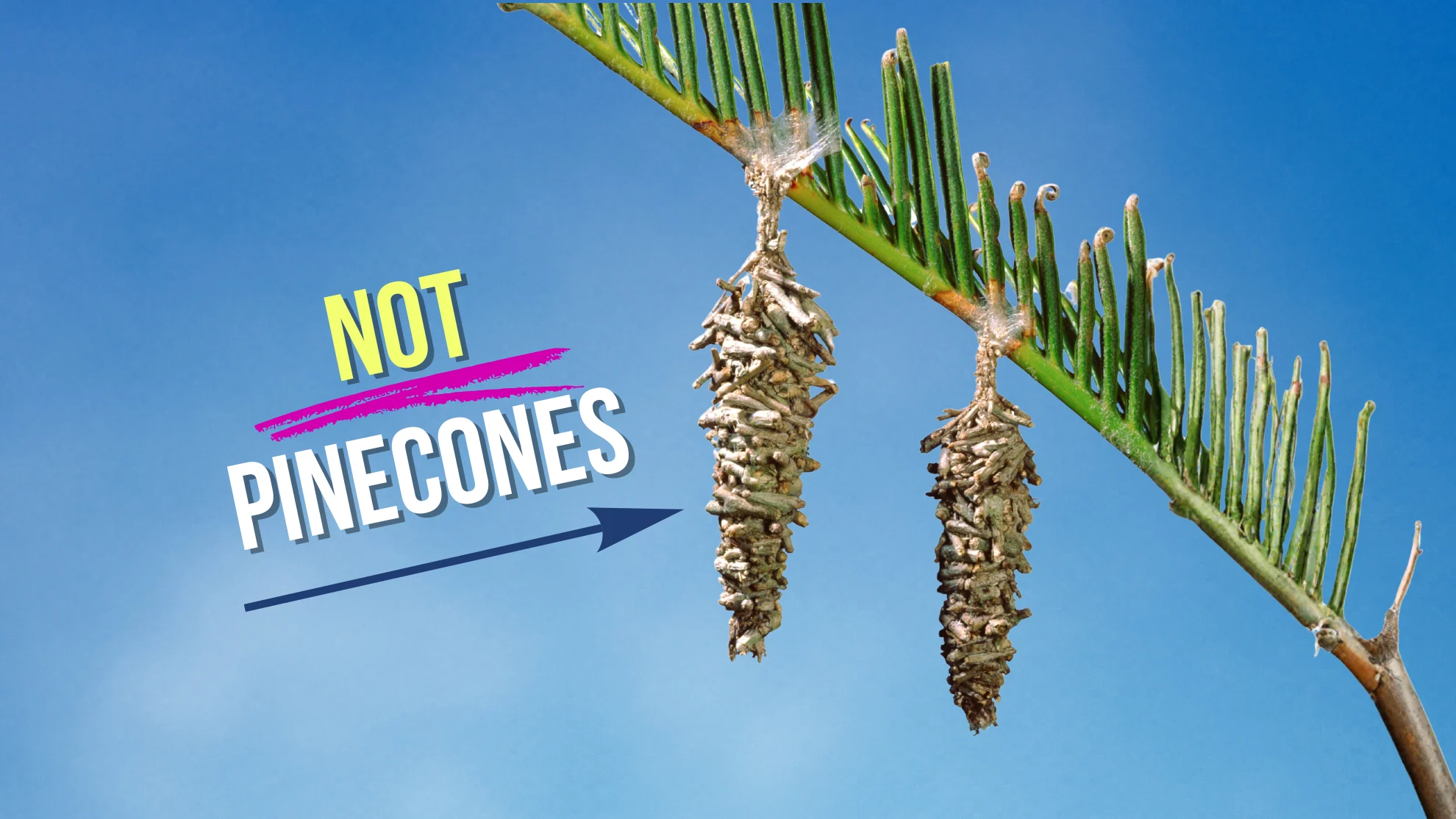
Now that temperatures are rising and the world is waking up after a chilly start to spring, people in southern Ontario may begin to notice pinecone-like growths hanging from trees:
Spoiler alert: These aren’t pinecones. What you’re looking at are the sacs, or cocoons, of invasive evergreen bagworms.
Caterpillars live inside these bags, hence the name. In late summer and early fall, a female will lay hundreds -- sometimes upwards of 500 -- eggs inside the sac. The eggs then rides out the winter, safely tucked inside.
They hatch in spring, although the exact timing is temperature-dependent. That means the chilly start to the season could delay this year’s emergence.
Identifying a bagworm cocoon (or sac)
Once you know what you’re looking for, bagworm cocoons are fairly easy to spot.
They typically appear as small, spindle- or cone-shaped sacs about 2–5 cm long. The sacs are made of silk interwoven with twigs, needles, and leaves from the host plant.
A bagworm sac can be brown or grey and it will blend in with the surrounding foliage.
In Ontario, you’re most likely to find them hanging from cedar, spruce, or juniper trees. The camouflage is highly effective and often allows infestations to go unnoticed for several generations, only becoming obvious once tree damage is severe.
You’re most likely to see bagworm cocoons in late winter and early spring, according to the Institute of Agriculture and Natural Resources, Nebraska. The bags remain attached to trees all winter, and they stand out more this time of year because trees are still dormant.
Life cycle
Once the eggs hatch, the tiny larvae don’t stay put for long.
They can be carried by the wind to nearby trees and branches. After landing on a suitable host plant, the insect begins forming a new bag around its body to protect itself from predators. This bag grows along with it.
Female bagworms cannot fly and remain inside their bags for their entire lives, sticking their head out to eat or to add to their casing, dying shortly after laying eggs.
Males, on the other hand, emerge as moths.
They are small, hairy, and dark-coloured moths with feathery antennae and clear wings.
As for their aesthetic appeal? That depends on who you ask.
"The bagworm is an ugly moth," Bob Webster of the Pryor Information Publication wrote in 2021.
"In fact, I would say it's the ugliest moth I've ever seen. It's between a half inch and an inch long (1-2.5 cm), with clear wings and a dark brown, hairy body. The bagworm moth can fly, but it's not very fast or agile."
So there you have it.

Beauty is in the eye of the beholder. (Bob Webster/Wikipedia CC BY-SA 4.0)
Both males and females feed throughout the summer, and in some years, population booms can cause widespread defoliation—stripping trees of their foliage and, in severe cases, killing the host entirely.
Extensive tree damage
Bagworms are known to attack at least 128 species of trees, the CBC reports, including both deciduous and coniferous varieties.
Evergreens such as cedar and juniper are particularly vulnerable because they don’t easily regrow lost foliage.
One area that knows this all too well is Windsor, Ontario, which has dealt with recurring bagworm infestations since 2008.
During particularly bad years, entire branches can be stripped bare, weakening trees and leaving them susceptible to further stress or death.
How did they get into Canada?
Bagworms are native to the eastern United States and have gradually expanded their range northward into Canada, where the species is considered invasive.
One reason for this spread is warming temperatures, a trend that Ohio State University (OSU) refers to as “global worming” (not a typo).
Milder winters have made it easier for the species to survive and establish populations further north.
“Bagworms have a habit of seeming to appear out of nowhere,” OSU writes.
“…Shortly after the overwintered eggs hatch, first instars can generate a strand of silk from modified salivary glands to catch the wind and "balloon" to new locations. This dispersal behavior is one of the reasons bagworms may appear in landscapes on hosts that were not infested last season.”
What to do if you spot a bagworm sac
If you spot bagworm sacs on your trees, you can save yourself a lot of headaches by manually removing and destroying them before they have hatched.
Experts recommend using gloves to cut the sacs down and then placing them in boiling water. It’s important to cut off the silk that attaches the sac to the tree, because the silk can choke and damage tree branches.
Header image: File photo via Canva Pro.