'It's taken over': Hogweed expert sees invasive plant spread along Grand River

Back in 2010, John Kemp was teaching young scouts about plants to avoid while exploring when he came across the picture of a giant hogweed.
"This is a joke," he thought to himself. After all, he's never seen such a plant in his explorations.
Fast forward to today, he leads an organization dedicated to combatting the dangerous, invasive plant that is spreading along the Grand River and posing a threat to both people and nature.
DON'T MISS: Avoid at all costs: What makes giant hogweed so dangerous
"Any watershed in southern Ontario is now infested," said Kemp, founder of the Giant Hogweed Mitigation Project. "At the present rate of progress, by 2029, we'll have difficulty getting in or out of the water without pushing our way through the giant hogweed."
Ontario's Ministry of Natural Resources says giant hogweed is a garden ornamental plant from southwest Asia that has become more common in southern and central Ontario.
The plant is considered invasive, and poses both plant biodiversity and human health concerns.
Dangerous, invasive plant
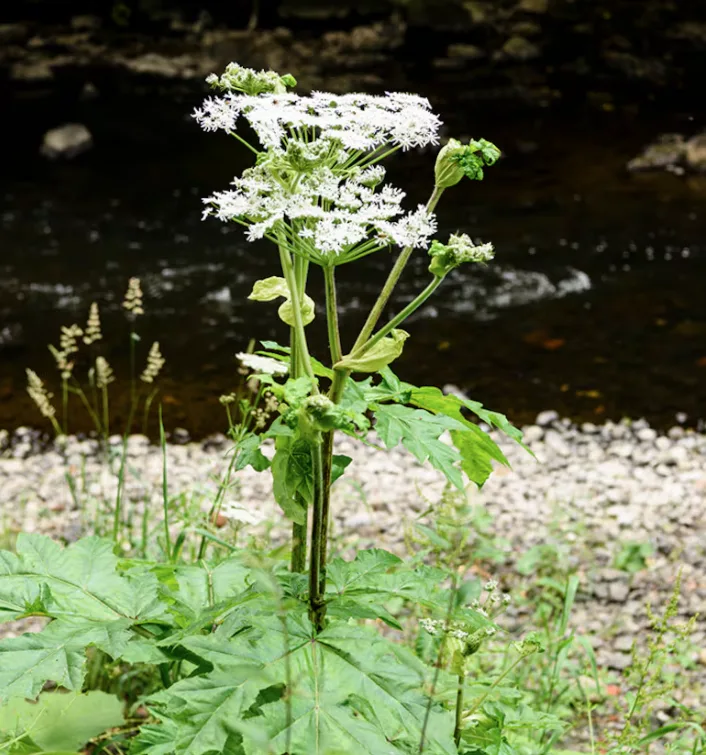
Giant hogweed, also known as giant cow parsnip, is a plant that can grow 2.4 to 4.2 metres tall. The plant's stem has coarse hairs and purple splotches. The plant also has unevenly shaped leaves and produces clusters of white flowers in the shape of an umbrella.
Kemp says the plant's clear, watery sap is the main source of danger because it contains toxins that can cause severe dermatitis or inflammation of the skin.
It's something he's familiar with from personal experience.
"I've got some burns from errors in my personal protective equipment," pointing to some scars on his forearms resulting from exposure to the plant's sap.
"They call it phytophotodermatitis," Kemp explained. "It changes your skin so that your skin doesn't protect you from ultraviolet light and then you get a deep penetration sunburn."
"If you just accidentally brush against the leaf, you're probably OK," he added.
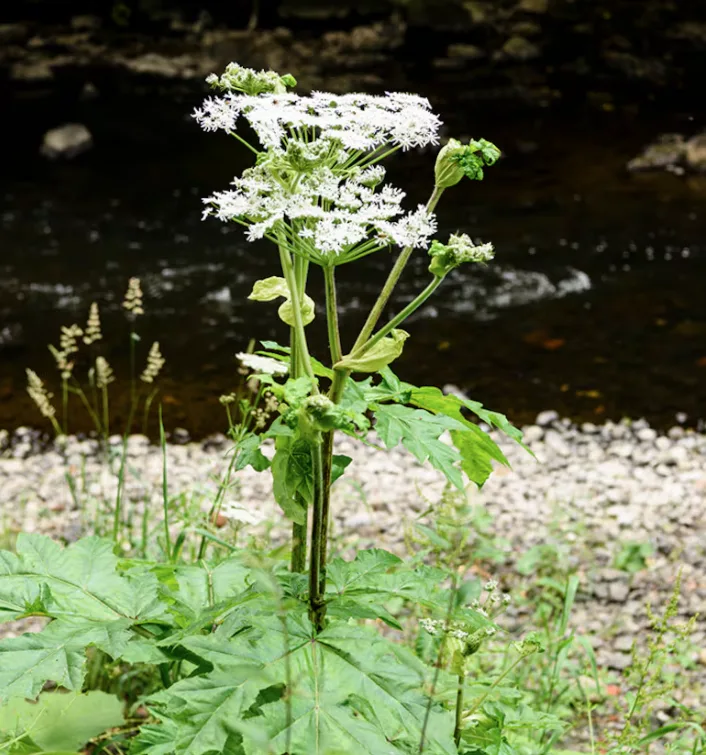
A giant hogweed plant. The Grand River Conservation Authority says the plant is part of the carrot family and can sometimes be confused with other common plants such as cow parsnip and angelica. (Credit: iStock/Getty Images)
'A perfect storm'
Kemp said one of the problems that allows giant hogweed to spread is the lack of recognition that the plant poses problems for both nature and people.
In the organization's website, Kemp wrote: "Resistance from elected officials to take interest is surprisingly strong. Plant population expansion rate is scary and it seems that we are making only slight changes – so far."
"It's kind of like a perfect storm," Kemp told CBC K-W's The Morning Edition host Craig Norris. "People don't know what it is. They don't know it exists. They don't know where it is and they don't know how to avoid it."
But some local organizations are doing what they can to combat the invasive plant – at least in their backyard.
Fraser Gibson is a member of Waterloo Region Nature, a non-profit in Waterloo region engaged in conservation activities. He's a part of the organization's Montgomery Committee that looks after their Montgomery Wildlife Sanctuary located in the Nith River near New Dundee.
"If we wouldn't be managing it, I think it would be a major problem," Gibson said of the giant hogweed situation on their wildlife sanctuary property.
He said members of Waterloo Region Nature have undergone training with the rare Charitable Research Reserve on how to safely remove giant hogweed on their property.
"Every week someone walks the property, especially near the shore of the river. Any giant hogweed plant that we find, we dig out," Gibson said. "We place the plant in a sunny area so that it's going to dry up and wither up.
"The very first time this year the person that was scouting removed in excess of 30 plants on the very first days," Gibson said. "After that the numbers have been significantly lower."
'Owner's responsibility' to remove giant hogweeds
Kemp explains that people may be expecting organizations like the Grand River Conservation Authority (GRCA) or the government to take care of giant hogweeds, but that's not the case.
According to GRCA's website, the organization only removes giant hogweed found on its properties.
"If you spot it on your own property, private land, a municipal park or other areas such as along a riverbank or stream, contact your local municipal weed inspector," the website continued.
"By law of the land, [it's the] owner's responsibility. Every landowner should inspect their property and remove the weeds," Kemp said. "And that's where we fall short."
Kemp says one of his goals with the Giant Hogweed Mitigation Project is to help those who can't get rid of giant hogweed on their own.
"What we really need to do is help our neighbors and all take care of our own shoreline," he said.
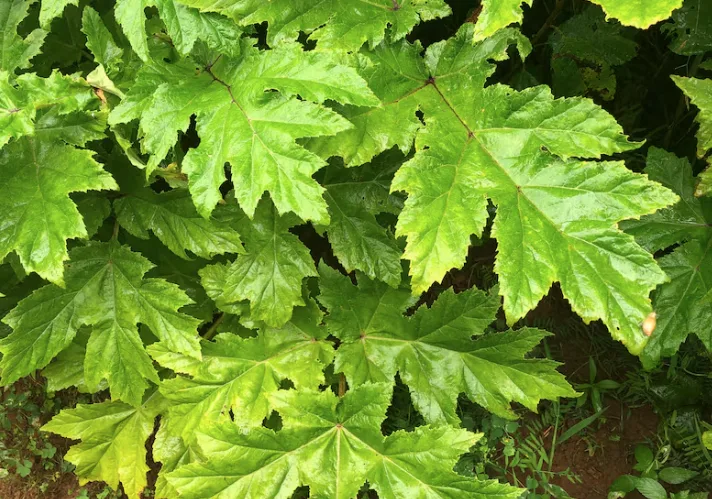
Giant hogweed leaves. According to the Grand River Conservation Authority, the plant's sap will make a person's skin extremely sensitive to light, which can then result in "severe burning and blistering" following sun exposure. (Brittany Spencer/CBC)
Safe removal of giant hogweeds
To ensure safe removal of giant hogweeds, the province's invasive species website recommends calling in professional exterminators.
The natural resources ministry also recommends removing the plant in late April or early May when the plant is usually less than 30 centimetres tall. This makes it easier to dig up with a shovel, and is more susceptible to herbicides if one decides to go the chemical extermination route.
When personally dealing with the plant, Kemp recommends wearing some protective clothing such as a hazmat suit, gloves and eye protection to prevent exposure to the plant's sap.
"If you do get [sap] on you, you wash them off with soap and water within 20 minutes and you're fine," he explained.
Kemp said he recognizes it just might be impossible to get rid of the pesky plant.
"We need to learn how to share the shorelines with it," he said.
"Right now it's the bully. It's taken over."
The story was originally written by John Dalusong and published for CBC News on July 28, 2026