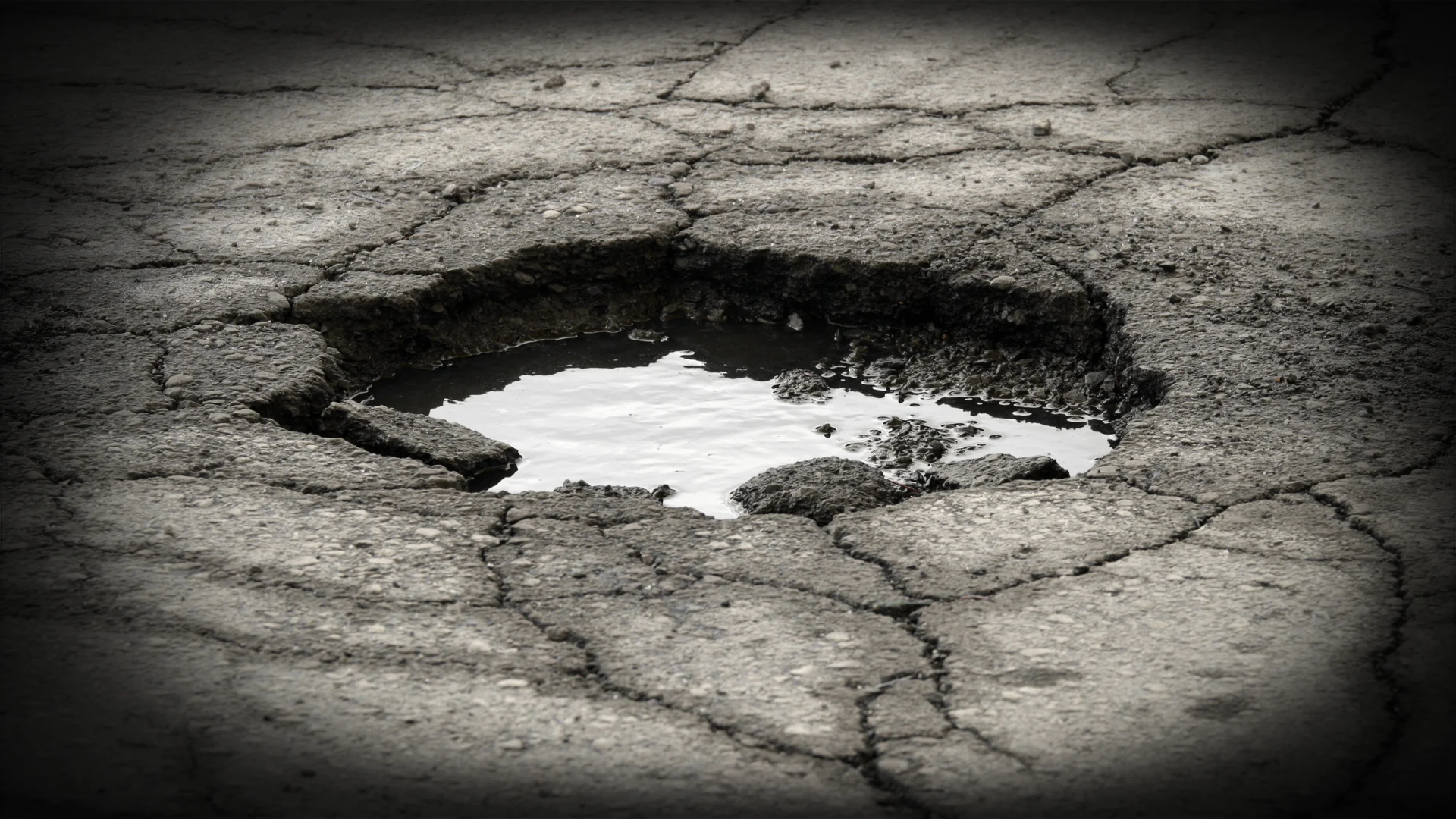
Self-healing pavement could fix a billion-dollar problem for Canada’s roads

Data suggests that potholes cost Canadians about $3 billion every year in vehicle damage
They’re jarring, unavoidable, and everywhere, every spring.
Potholes are one of the clearest signs of how Canada’s climate wears down infrastructure, costing communities millions and drivers even more. But while they may feel inevitable, recent work in the field of materials science suggests they don’t have to be.
RELATED: Mind the bumps: Pothole season has arrived
Potholes are driven by one key factor: freeze-thaw cycles. Water seeps into cracks in the road, freezes and expands, then melts. This weakens the pavement until traffic eventually breaks it apart. The heavier the traffic, the faster this happens; the more temperatures swing above and below zero, the worse the damage gets.

The freeze-thaw cycle. (Cheryl Santa Maria/Canva)
"We can have dramatic swings in temperature -- minus fifteen one day and then a few days later it’s plus two or three degrees. That temperature change is massive, and really a big driver of why the pavement cracks in the winter," says civil engineer and chemist Mike Aurilio of Yellowline Asphalt Products in Hamilton, Ont. "With the massive freeze‑thaw cycles we have in Canada, you can tear up a road really fast."
Fixing them isn’t easy, especially during winter, when crews must rely on temporary cold patches because permanent asphalt won’t set in low temperatures. Those patches are usually replaced with a more permanent material come summer.
The cost also adds up quickly. Toronto budgeted $6.2 million for potholes in 2026. Ottawa has more than $12 million annually to work with. Montreal spent nearly $500,000 in just 10 days during a recent surge.
Drivers are paying too, with damage claims rising sharply and some repairs costing hundreds per incident.
Altogether, the most recent numbers from CAA suggest that potholes cost Canadians about $3 billion every year in vehicle damage.
SEE ALSO: Has Toronto's snow removal strategy been enough? A review of what's been done
"We're just hitting March, and we're already starting to see the damages occur on a daily basis. I get calls every day with regards to pothole damage or an impact of some kind," says Sean Cooney, General Manager at OK Tire in Etobicoke, Ont. "These are costs that people are not expecting. It's hitting them hard. People are trying to cut their costs down, and you can't foresee that, and it can be anywhere from a two, $300 repair just by simply going to the grocery store – and it hurts."
Traditionally, pothole repair has been reactive: patch the hole after it forms. Now, the focus is shifting to prevention — fixing cracks earlier, improving materials, and using technology to detect problems before they surface.
Cities and researchers are increasingly asking the same question: how do we stop potholes from forming in the first place?
Some are ideas being tested in Canada right now include:
Self-healing asphalt
Researchers are developing asphalt and concrete that can repair their own cracks using embedded materials or bacteria that activate with moisture.
"Self‑healing materials in general are a growing area of materials research. For pavements specifically, you take advantage of the natural ability of asphalt to heal itself, which is based on the fact that it can flow," says Aurilio. "Even at room temperatures, there's a little bit of flow."
Recycled tire roads
At the University of British Columbia, researchers have explored using shredded tires to make roads more flexible and resistant to cracking. Other systems use tire-based structures to create stronger road foundations. Stronger roads, less waste.
Low-carbon and lignin-based asphalt
Canada’s forestry sector is testing lignin — a plant-based material — as a replacement for petroleum in asphalt. There’s also growing interest in carbon-capturing pavement that could absorb emissions.
AI-powered smart roads
At the University of Waterloo, researchers are developing roads with sensors that detect internal cracking early. In Durham Region, AI tools are already being used to scan roads and prioritize repairs.
Faster repair machines
Machines like the JCB "pothole killer" — used in Vancouver — can repair potholes in minutes instead of hours.
Potholes may be a familiar part of Canadian life, but they’re not inevitable. With smarter materials, better data, and faster repairs, the focus is shifting from reacting to damage to preventing it altogether. And if those solutions scale, the annual ritual of dodging potholes each spring could become far less common — and far less costly.